The Seam
The sonar image was wrong.
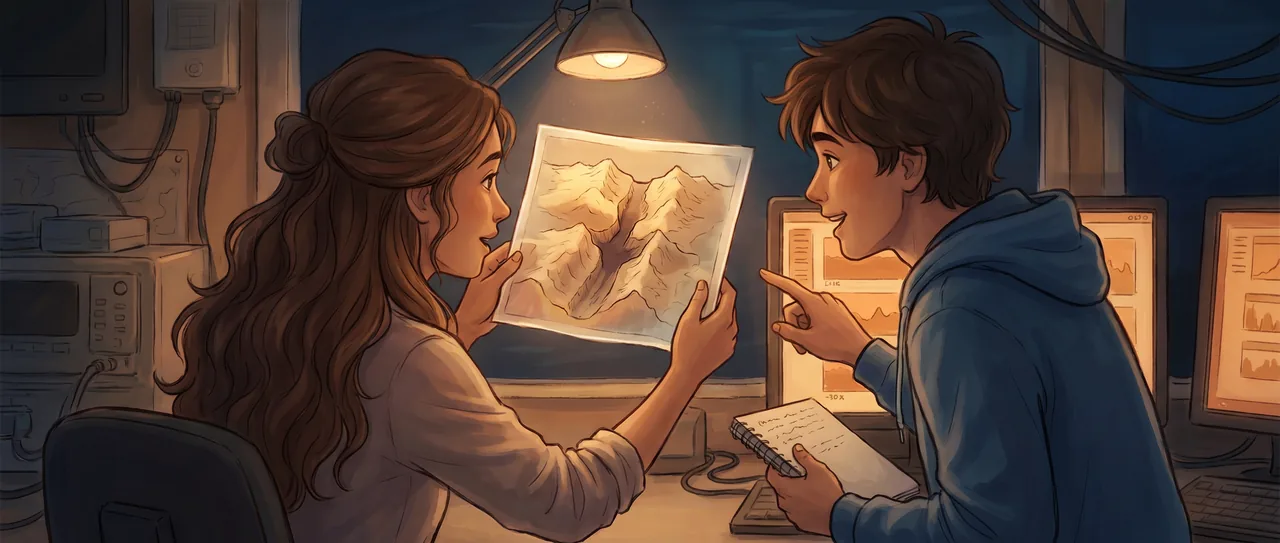
Maya knew it the second Dr. Halvorsen pinned it to the corkboard in the ship's lab. The printout showed the ocean floor beneath them in shades of blue and orange, a topographic map of something no human eye had ever directly seen. And right down the center, where the Mid-Atlantic Ridge was supposed to be a clean spine of mountains, the image showed a gap. A valley. A crack running between two ridges that were pulling away from each other.
"That's not a mountain range," Maya said.
Dr. Halvorsen was already walking away, coffee in hand, talking to the ship's navigator about tomorrow's sampling coordinates. She called back over her shoulder: "It absolutely is. Longest one on the planet. Print me the bathymetric profile for station seven, would you?"
Soren was sitting cross-legged on the lab floor with his notebook open, copying numbers from the depth readouts. He looked up at Maya, then at the image.
"She's right, though," he said. "It is a mountain range. The ridge system. Sixty-five thousand kilometers. Goes through every ocean."
"I know what it is," Maya said. "But look at the middle."
Soren stood up and looked. The two of them stood close enough to the printout that they could see the individual sonar pings rendered as tiny dots. And there, between the two rising walls of underwater mountains, the floor dropped away into a rift valley. Not a peak. A split.
"Mountains don't do that," Maya said. "Mountains push up. These are pulling apart."
Soren traced the valley with his finger. "The depth readings here are different from yesterday's station. Yesterday the ridge crest was maybe twenty-seven hundred meters down. Here the valley floor is closer to thirty-five hundred."
"So the gap is deeper."
"The gap is deeper here, yeah." He wrote the numbers side by side in his notebook. Then he looked at the temperature data from the water sampling probes. "Maya. The water temperature at the rift is different too."
"Warmer?"
"Way warmer. The surrounding deep water is about two degrees Celsius. Near the valley floor it spikes to almost eight."
Maya pressed both palms flat on the table. "Something down there is hot."
This was the part Soren needed to work through. He pulled up the geological survey on the lab's shared computer. The Mid-Atlantic Ridge. Part of a continuous chain of underwater mountains that wound through the Atlantic, around Africa, across the Indian Ocean, between Australia and Antarctica, and up through the Pacific. One single seam, circling the entire planet like the stitching on a baseball.
But it was not stitching that held things together. It was the opposite.
"The plates are moving apart," Soren said, reading. "The North American plate and the Eurasian plate. They're separating. Right here. Right under us."
"How fast?" Maya asked.
"About two and a half centimeters a year."
Maya held up her thumb and forefinger, a tiny distance apart. "That's nothing."
"That's nothing in one year," Soren said. He was calculating. "In a million years, that's twenty-five kilometers. In a hundred million years..."
"The entire Atlantic Ocean," Maya said.
They both went quiet.
The ship rocked gently. Somewhere above them, the engines hummed. They were floating on four thousand meters of water, and beneath that water were mountains taller than anything in the Alps, and those mountains were actively, right now, in this exact moment, splitting open.
"So the warm water," Maya said. "That's from below. From inside."
Soren nodded. "Magma rises where the plates pull apart. It cools and becomes new rock. New ocean floor. The warm water is from hydrothermal activity near the rift."
"New rock," Maya repeated. She said it the way someone says a word in a language they are hearing for the first time. "The ground under the ocean is being made. Right now."
"Right now."
Maya grabbed the sonar printout and held it up to the light. "So this entire image. Every piece of ocean floor spreading out from the ridge. All of it was once right here. Right at this crack. And it got pushed outward as new crust formed behind it."
"Like a conveyor belt," Soren said.
"Like the world unzipping itself and filling in the gap with new planet."
Dr. Halvorsen came back, refilling her coffee from the pot that was bolted to the counter because everything on a ship must be bolted to something. She glanced at them standing in front of the printout.
"Station seven profile?" she asked.
"Dr. Halvorsen," Maya said. "The oldest rock on the ocean floor. It's near the continents, right? Because it formed at the ridge and moved outward?"
"Correct. About two hundred million years old at the edges. Brand new at the ridge."
"So there's no ocean floor older than two hundred million years."
"Also correct." Dr. Halvorsen took a sip of her coffee. "The old crust gets pushed into the mantle at subduction zones. Recycled. The ocean floor is constantly being created and constantly being destroyed. None of it lasts."
She said this casually, the way someone mentions that it might rain later, and walked back toward the navigation room.
Maya and Soren looked at each other.
The continents carried rocks billions of years old. The ocean floor, which covered most of the planet, was never older than a couple hundred million. The entire skin of the Earth beneath the water was young. Was always young. Was perpetually being born at this seam and swallowed at distant trenches and born again.
Soren opened his notebook to a fresh page. He started drawing the ridge system from memory, the way it wound between continents, the longest mountain range on Earth. Sixty-five thousand kilometers of mountains hidden under water, and at the center of those mountains, a wound that was not a wound because it was where everything new came from.
He stopped drawing.
"Maya."
"Yeah."
"We're floating over the place where the Earth makes more of itself."
Maya looked down at the floor of the lab, as if she could see through the steel hull, through four kilometers of black Atlantic water, through the basalt and the sediment, all the way to the place where the planet opened and glowed.
The ship tilted gently on a wave, and somewhere far beneath them, in absolute darkness, new rock cooled for the first time.
Read the interactive version, listen to the narration, and earn a gold star →
A science-verified short story for curious kids · Curiosity Land