The Salt That Remembers the Sea
The argument started because of the salt.
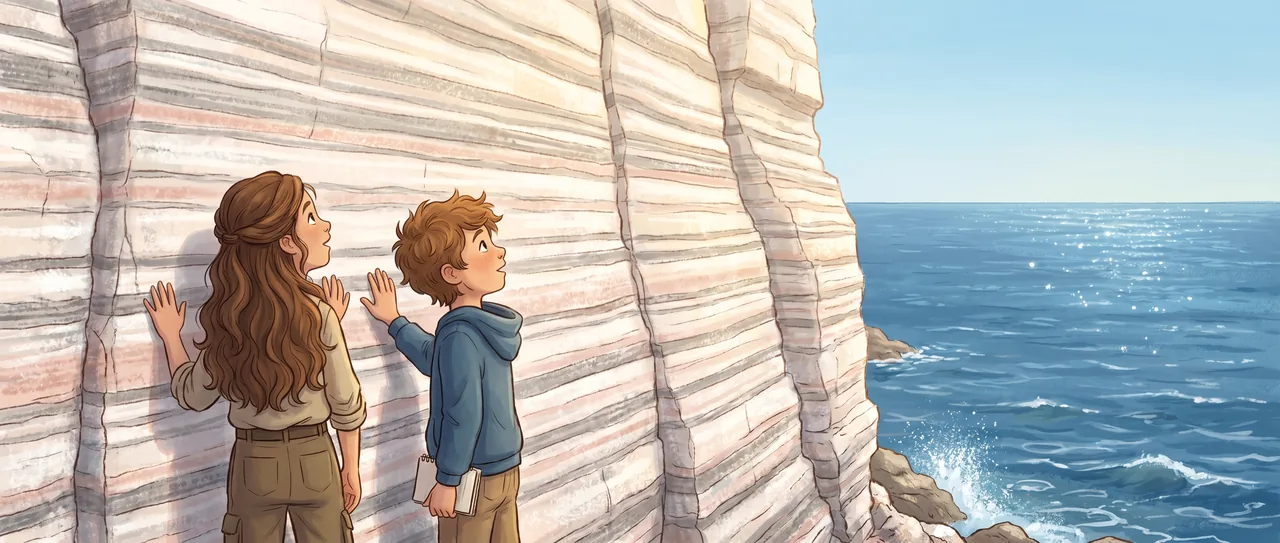
Not table salt. Not the kind you shake onto eggs. This was a wall of salt taller than Maya's house, exposed in a cliff face on the Sicilian coast, and their group leader, Dr. Petrosino, had just told them it was deposited at the bottom of a sea that no longer existed.
"It still exists," Soren said. He pointed past the cliff edge to the very blue, very present Mediterranean. "It's right there."
"This is what I am telling you," Dr. Petrosino said, already walking ahead to catch up with the university students. She waved one hand without turning around. "It exists now. It did not exist then. Work it out. That is why I brought you."
She had not actually brought them. She had brought her graduate students. Maya and Soren were here because Maya's mother was one of those students and could not find a sitter for a week in Sicily, and Soren was Maya's friend who had asked to come along because, as he explained to his parents, he had never seen a volcano. They had not yet seen a volcano. They had seen a lot of salt.
"She means it dried up," Maya said.
"The whole Mediterranean."
"Yes."
"Maya, it's enormous. It goes from here to Africa. You can't just dry up something that goes from here to Africa."
Maya pressed her palm against the cliff. The salt was rough and warm. Tiny crystals caught the sun and threw it back in splinters. She scraped a fingernail along a layer and watched white powder fall.
"Feel this," she said.
Soren pressed his hand next to hers. The salt was layered. Not just one band but hundreds, thin and thick, like pages in a book that had been compressed.
"Those are cycles," he said slowly. "Like tree rings. Evaporation cycles."
"A lot of them."
Soren pulled his notebook from his back pocket and started counting visible layers in a section about the width of his hand. He got to forty-seven before Maya interrupted him.
"Soren. If this salt came from the sea, then the water was here first. And then it wasn't. And these layers mean it happened slowly. The water kept coming in a little and drying up again, over and over."
"Coming in from where?"
They both turned and looked west. You couldn't see the Atlantic from here, obviously. You couldn't see Spain. But Maya knew, and she could tell Soren knew too, that in that direction, very far away, there was a narrow passage between Europe and Africa where the Atlantic poured into the Mediterranean.
"The Strait of Gibraltar," Soren said.
"What if it closed?"
Soren stared at her. Then he stared at the salt wall. Then he took three steps back so he could see the full height of it, a white and gray and faintly pink cliff face rising twelve meters above them.
"If the connection to the Atlantic closed," he said carefully, "the Mediterranean would just keep evaporating. Sun would keep hitting it. Water would keep leaving as vapor. But no new water would come in to replace it."
"And all the salt dissolved in the water would be left behind."
"It would take a long time."
"Thousands of years," Maya said. "Maybe more."
Soren wrote something down. Then he looked at the Mediterranean, the actual living sea sparkling below the cliff. "So what's down there now? Under the water?"
"More salt," Maya said. "This stuff. Kilometers of it."
"Kilometers."
"The Mediterranean basin is deep, Soren. Three, four, five kilometers in places. If you drained it, you'd be looking down into a canyon deeper than anywhere on land. A salt desert at the bottom. Imagine standing on this cliff and looking down and there's no water. Just white. Going all the way to Africa."
Soren sat down on a rock. He put his notebook on his knee and didn't write anything. He was doing the thing he did when something was too large to hold. He was just sitting with it.
Maya sat next to him.
"It came back, though," he said after a minute.
"Obviously. It's right there."
"How?"
Maya thought about this. The layers in the salt, all those cycles of wetting and drying. And then, at some point, the cycles stopped. The salt was buried under marine sediment. The sea was just back, and it stayed.
"The strait opened again," she said.
"Opened how? Like slowly, a trickle getting wider?"
"Maybe. Or maybe fast."
They looked at each other.
"How much water is in the Atlantic Ocean?" Soren asked.
"More than enough."
"If a dam broke between the Atlantic and an empty basin five kilometers deep and thousands of kilometers long..."
He stopped talking. Maya could see him running it in his head. She was running it too. A trickle becomes a stream becomes a river becomes something that has no name because nothing like it has happened in human memory. Water pouring over a sill of rock, carving it deeper every hour, the flow increasing as the channel widened, a waterfall that dwarfed everything, a flood that could fill a swimming pool the size of a sea.
"How fast?" Maya said. Not to Soren. To the question itself.
"Months, maybe," Soren said. "Maybe less. Maybe the water level rose ten meters a day."
"We don't know, do we."
"No. But someone could figure it out. You'd look at the erosion on the strait's floor. You'd look at the sediment layers. The transition from salt to marine mud."
He was writing now, fast, his pencil moving in the short fragments he used when ideas came quicker than sentences.
Maya stood and walked to the edge of the cliff. Below, the Mediterranean was doing what it always did. Small waves. Fishing boats. A container ship on the horizon.
She thought about the weight of it. All that water, sitting in its basin like it had always been there. And underneath it, beneath the mud and the sediment and the slow accumulation of millions of years, the salt remembered when there was no sea. When this was a desert so deep it had its own weather, its own crushing air pressure at the bottom, a white plain where nothing lived and the heat was beyond anything on the surface of the Earth today.
And then one day, from the west, a sound. Water finding a crack.
"Soren," she said.
He looked up.
"Every ocean on Earth is only here because of where the land happens to be right now. The continents are still moving."
Soren's pencil stopped. He looked at the Mediterranean, and she knew he was seeing it the way she was. Not permanent. Not even old, in the way rocks measure time. Just a temporary arrangement of water in a bowl that the Earth's crust happened to make.
"What else has dried up that we don't know about?" he said.
A wave broke against the rocks below, and the spray reached almost high enough to touch them.
Read the interactive version, listen to the narration, and earn a gold star →
A science-verified short story for curious kids · Curiosity Land