The Roads They Keep
The lab smelled like coffee and warm electronics. Dr. Oduya had left them alone twenty minutes ago, called away by a phone call she took in the hallway with her voice getting louder and louder. Something about funding. Something about deadlines. She had waved vaguely at the monitors and said, "Explore. Don't delete anything."
Soren was already sitting at the central workstation. The screen showed East Africa from space, overlaid with colored lines. Thousands of them. They pulsed faintly, like veins.
"These are elephants," he said.
Maya leaned over his shoulder. "All of them?"
"Three years of movement data. The AI tracked individuals from satellite photos. See the labels? Each line is one elephant, identified by ear shape and body scarring." He scrolled through a sidebar of thumbnail images. Each one showed a gray shape from above, annotated with a name. Amara. Kibo. Old Dust. Someone had named them, or the AI had.
"Old Dust," Maya said. "I like Old Dust."
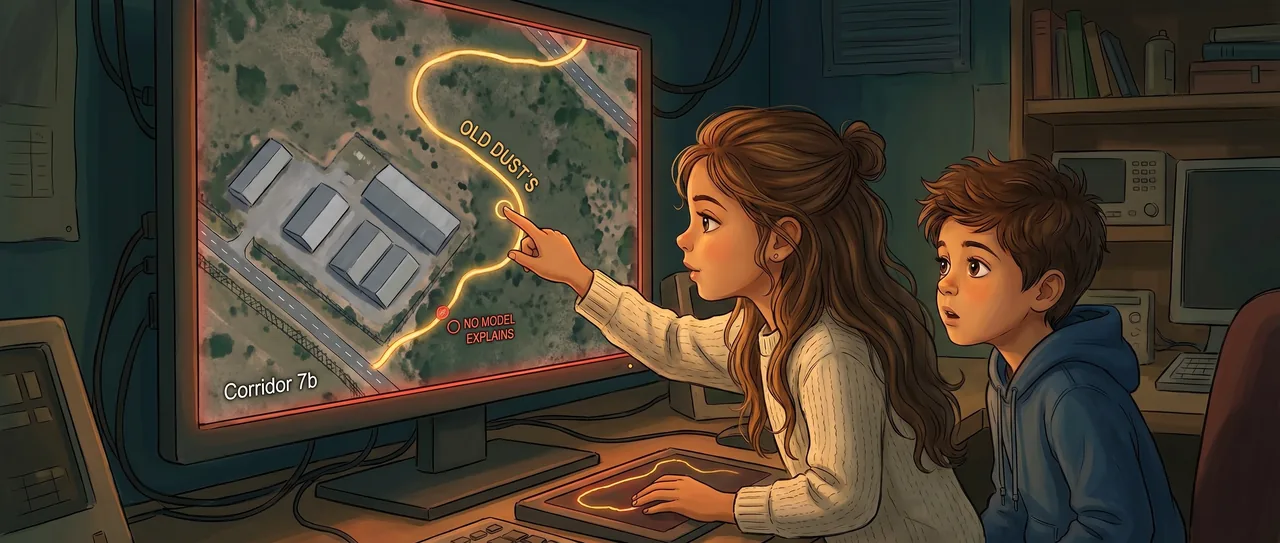
Soren clicked on the name and one line lit up brighter than the others, golden, stretching from southern Tanzania up through a national park, across a brown patch of farmland, through something labeled Corridor 7b, and into Kenya. Three years of walking compressed into a single glowing thread.
"She did the same route every year," Soren said. "Almost exactly."
"Almost?"
He zoomed in on a section near Corridor 7b. The three annual paths diverged slightly. In year one, Old Dust had passed through what looked like open grassland. In year two, a gray rectangle had appeared. A building or a warehouse. The path curved around it. In year three, more gray rectangles. A road. The path curved tighter, squeezing through a narrower gap, but it did not stop. It did not reroute. Old Dust kept walking through.
Maya pulled a chair over and sat down. "Show me the other elephants through that same corridor."
Soren filtered. Fourteen elephants used Corridor 7b over the three-year dataset. Every single one showed the same pattern. The corridor narrowed as infrastructure grew. The elephants adjusted slightly. None of them abandoned the route.
"Dr. Oduya's notes say the AI flagged this," Soren said, reading from a text panel on the side. "It says anomaly. The model predicted that when human infrastructure crosses a corridor, use should decline over five years to near zero. But these corridors. Forty-three of them across the continent. The animals keep using them."
"Forty-three," Maya repeated.
She was quiet for a moment, the kind of quiet that meant she was running something against everything else she knew.
"Which animals?"
"Elephants. Wildebeest. Zebra. Some of the big cats." He scrolled. "Different species, different corridors, same pattern. The AI says they should stop. They don't."
Maya said, "The AI doesn't know why."
"No. It just flags it."
"What does Dr. Oduya think?"
Soren found another note, a personal annotation in the data. It read: Field teams never documented these corridors. We found them from space. The animals knew. We did not. Why they persist through infrastructure is an open question. I have four hypotheses and no confidence in any of them.
Maya read it twice.
"She doesn't know either," Maya said. There was something in her voice that was not disappointment. It was closer to relief.
"Look at this one," Soren said. He had found a corridor in Botswana. A line of zebra paths, hundreds of them layered on top of each other, crossing a highway. The highway had been built nine years ago according to the metadata. The zebras crossed it at nearly the same point, year after year. The AI had drawn a red circle around the crossing and labeled it: PREDICTED ABANDONMENT YEAR 4. ACTUAL: CONTINUED USE. NO MODEL EXPLAINS.
Maya leaned closer. "How does the AI know these corridors exist at all? If no field researcher ever mapped them?"
"It tracked individuals. Over years. From millions of satellite images. It found the paths by watching where the animals actually went, not where people thought they went."
"So the paths were always there. We just couldn't see them from the ground."
"Not couldn't. Didn't." Soren pulled up a topographic layer. Corridor 7b ran along a subtle ridge, slightly higher ground between two seasonal floodplains. From above, the logic was visible. The ridge stayed dry when the rains came. It was a road. An animal road, older than any human one.
Maya touched the screen where the gray rectangles of new buildings pinched the corridor tight. "They're walking on a road that might be thousands of years old. And we put a warehouse on it because we didn't know it was there."
"And they walk around the warehouse."
"And keep going."
Soren sat back. He opened his notebook and started writing, then stopped. He looked at the screen again. The forty-three flagged corridors glowed red across the continent, each one a place where an animal's ancient path met a human structure and neither yielded.
"The AI can see the paths," he said slowly. "It can see the buildings. It can see that the two overlap. But it can't figure out why the animals don't leave."
"Because it's modeling the cost wrong," Maya said. "It thinks a highway is a wall. For us it would be. But for Old Dust it's just a thing in the way. The path is still the path."
"You don't know that's why."
"No. Neither does anyone." She almost smiled. "Forty-three mysteries and the best AI on the planet just puts a red circle around each one and says I don't know."
Dr. Oduya came back in, still distracted, phone in one hand, a stack of printouts in the other. "Find anything interesting?"
"The corridors that cross infrastructure," Maya said. "The ones the AI can't explain."
Dr. Oduya set her papers down. For the first time she looked fully at them. "What about them?"
"If the AI can see them now, you could tell people where they are before new buildings go up. Before the roads get planned. You wouldn't have to explain why the animals stay on them. You'd just have to show that they do."
Dr. Oduya stared at her. Then she pulled up a chair.
"Show me what you found," she said.
Soren turned the monitor so all three of them could see it. On the screen, Old Dust's golden path crossed a warehouse, a road, and a fence, bending but never breaking, stretching north into country that the elephant had walked before any satellite had learned to watch.
Maya reached out and traced the line with her finger, from south to north, and it kept going past the edge of the map.
Read the interactive version, listen to the narration, and earn a gold star →
A science-verified short story for curious kids · Curiosity Land