The Poison Makers
The lake smelled wrong.
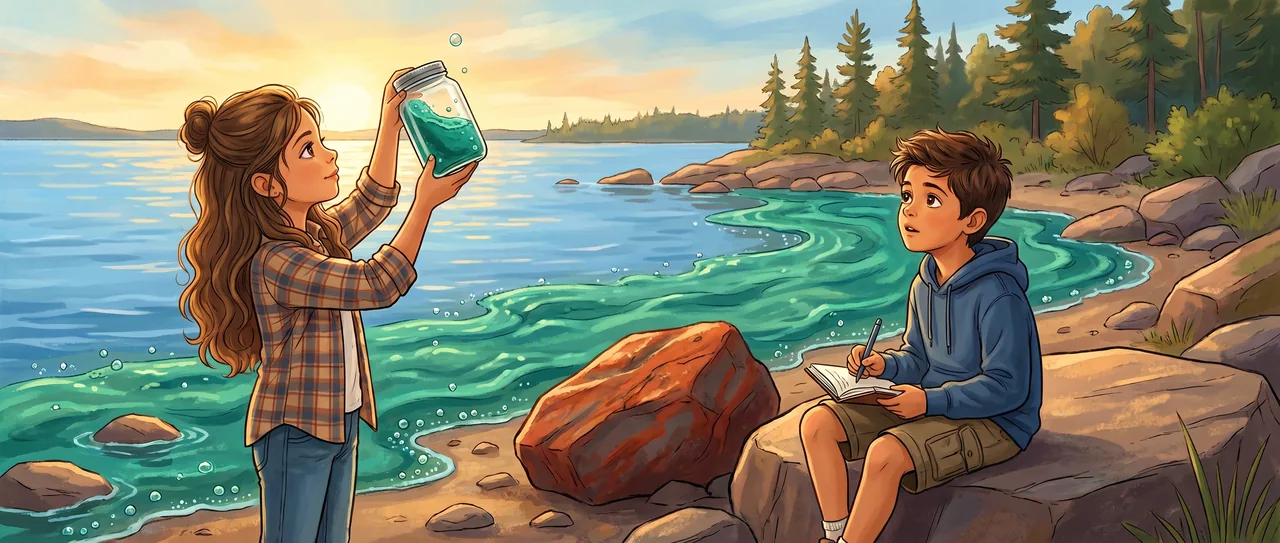
Not bad exactly, but thick and green and alive in a way that made Soren's nose wrinkle. The rocks along the shore were coated in something that looked like someone had smeared them with bright teal paint.
"Cyanobacteria," said Dr. Patel, already three steps ahead of them, already pulling on nitrile gloves. "Gorgeous bloom this year. Gorgeous. Get your sample jars."
She was crouched over a tide pool with her own collecting kit, muttering numbers into her phone, and within thirty seconds she had completely forgotten them. That was Dr. Patel. She gave you instructions like she was throwing things out of a moving car.
Maya was already at the waterline, holding her jar at an angle so the green film slid into it without breaking apart. "It's slimy but it's also kind of structured. Like it has layers."
"It does have layers," Soren said, opening his notebook. He'd been reading about this on the bus. "They build mats. Stromatolites. Some of them are fossils three and a half billion years old."
"Three and a half billion."
"Yeah."
Maya held the jar up to the sun. The green shifted, catching light. Tiny bubbles clung to the edges of the bacterial mat inside.
"Oxygen," she said.
"Right now. Making it right now, in the jar."
They both watched the bubbles form. One broke free and rose to the surface.
"So these are the things that made the atmosphere," Maya said. Not a question. She was turning something over in her head.
Soren sat down on a flat rock and opened his notebook. He'd written down the timeline that morning, copying it from the camp's reference sheet. "Okay, so. Two point four billion years ago. Cyanobacteria had been around for a long time already, but the oxygen they made kept getting absorbed. Iron in the oceans, volcanic gases, all of it reacting with the oxygen before it could build up."
"Like a sponge."
"Like a sponge. But eventually the sponge was full. The iron was used up. And the oxygen just started accumulating. In the water first, then the atmosphere."
Maya put her jar down carefully on a rock. "And everything died."
Soren looked up. "Most things. Yeah."
Dr. Patel's voice floated over from twenty meters away. "Don't forget to label your samples with GPS coordinates." Then she went back to her phone.
Maya sat down next to Soren. The lake lapped at the rocks below them, and the green bloom stretched along the shore in both directions, vivid in the afternoon light.
"I keep getting stuck on this," she said. "Oxygen was poison."
"To anaerobic life. Which was basically all life. Oxygen is reactive. It rips molecules apart. If you aren't built for it, it destroys you."
"We breathe it."
"We breathe it because we're descended from the survivors. The ones that figured out how to use it instead of dying from it."
Maya picked up a smaller rock and turned it in her hands. It had a rust-red streak through it. "Iron oxide?"
"Could be." Soren leaned over to look. "Banded iron formations. That's literally the evidence. The oxygen from cyanobacteria bonded with iron dissolved in the ancient oceans, and the iron oxide sank. Built up in layers on the sea floor. Billions of years later, we mine it and build cars."
Maya put the rock down and stared at the green bloom in the water.
"The cyanobacteria didn't know," she said.
"They were bacteria. They didn't know anything."
"That's what I mean. They were just doing what they did. Taking in sunlight, taking in carbon dioxide and water, making sugar to live on. And the waste product was oxygen. They were just living. And their waste killed almost everything else on the planet."
Soren had written pollution event in his notebook and then crossed it out and written mass extinction and then crossed that out too, because neither phrase was big enough. He wrote: the world changed states.
"But here's the thing," Maya said, and she stood up, because she always stood up when she was about to say something she'd been circling for a while. "Without it, we don't exist. No complex life. No mitochondria, because mitochondria are the whole reason cells can use oxygen for energy. No animals. No us. The worst catastrophe in the history of life on Earth is also the reason there's a history of life on Earth. The complex part, anyway."
Soren put his pen down.
The bubbles in Maya's jar kept forming. Tiny, steady, patient.
"It's not a good thing or a bad thing," he said slowly. "It's both at the same time. And it's neither."
"It's just what happened."
"The biggest transformation the planet ever went through, and it was just bacteria being bacteria."
Maya picked up her jar again. She tilted it, and the cyanobacteria shifted inside, green and dense and impossibly old in their lineage, doing exactly what their ancestors had done for three and a half billion years. Making oxygen. Making poison. Making the future.
"Every time I breathe in," she said, "I'm using the thing that killed almost everything."
"And every time the cyanobacteria do their thing, they're still at it. Still pumping it out. Right now."
Dr. Patel walked past behind them, carrying a cooler, not looking up. "GPS coordinates," she said again.
Neither of them moved.
Soren stared at the green bloom stretching along the shore. You could see it from space, probably, if the bloom was big enough. A visible stain of life doing the one thing it had always done, the simple mechanical act of photosynthesis, the act that had once turned the entire atmosphere into something lethal, that had rusted the iron out of the seas, that had smothered a world and built a new one on top of it.
And it wasn't dramatic. It wasn't violent. It was just this. Slime on rocks. Bubbles in a jar. A faint green smell at the edge of a lake in Minnesota.
"Soren."
"Yeah."
"What's the next one?"
He looked at her.
"What's the next transformation that nobody sees coming because it's just something small, doing what it does, and the waste product changes everything?"
He didn't answer, because there wasn't an answer. There was only the question.
A bubble broke the surface of the jar, and the air took it in.
Read the interactive version, listen to the narration, and earn a gold star →
A science-verified short story for curious kids · Curiosity Land