The One Percent That Stayed
The screen said Soren was two point three percent someone else.
He stood in front of it while the other visitors moved on to the next station, where a graduate student was showing how you could extract DNA from a strawberry using dish soap and rubbing alcohol. That station had a line. This one did not.
The display read: NEANDERTHAL ANCESTRY ESTIMATE: 2.3%. Below that, a simple bar chart compared him to the average for people of Northern European descent, which was about two percent. He was slightly above average. There was a cartoon Neanderthal next to the bar chart giving a thumbs up, which Soren thought was the worst design choice he had ever seen.
But the number.
He pulled out his notebook and wrote it down. Then he wrote: What does 2.3% actually mean?
The graduate student running this station was talking to a professor near the door, gesturing about something that clearly had nothing to do with Soren. Her name tag said Priya. She had spent about forty seconds explaining the display to each visitor before they smiled politely and moved to the strawberry table. Soren had been standing here for four minutes.
He did the math in his notebook. The human genome had roughly three billion base pairs. Two point three percent of three billion was sixty nine million. Sixty nine million base pairs that came from Neanderthals. He stared at the number. Sixty nine million positions in his DNA where the code had been written by someone from a different species, tens of thousands of years ago, and had just kept getting copied, generation after generation, all the way to him.
He wrote: Why did it stay?
Then he walked over to Priya.
"Why didn't it get diluted out?" he asked.
Priya blinked. She had the expression of someone who had been talking about grant deadlines and needed a second to switch gears. "Sorry, what part?"
"The Neanderthal DNA. If it's been tens of thousands of years, and every generation you're getting half your DNA from each parent, why is any of it still there? Shouldn't it have been diluted to basically nothing by now?"
Priya looked at him properly for the first time. "How old are you?"
"Eleven. But that's not really relevant to the question."
She laughed. Not a mean laugh. More like she had been caught off guard. "Fair. Okay. So the short answer is that some of it did get diluted out. Neanderthals and early modern humans interbred maybe fifty to sixty thousand years ago. A lot of the Neanderthal DNA was probably harmful in a Homo sapiens body, and natural selection pushed it out over time. But some of it was useful. Some of it helped."
"Helped how?"
"Different variants helped with different things. Some are linked to immune response. Your Neanderthal ancestors had been living in Europe and Western Asia for hundreds of thousands of years before modern humans arrived. They had adaptations for those environments. When the two groups interbred, some of those adaptations gave the hybrid children an advantage. Immune genes. Maybe some genes related to skin and hair. Things that helped survive in those specific conditions."
Soren wrote this down. Then he stopped writing because something was bothering him.
"So the pieces that stayed aren't random," he said. "They're the pieces that were good enough to keep."
"Basically, yes. Not every piece. Some neutral stuff drifted along too. But the pattern across populations is that the surviving Neanderthal DNA clusters around certain functions."
"But it's different pieces in different people."
"Right. You and I might carry different Neanderthal segments. Across the whole non-African population, something like forty percent of the Neanderthal genome is still floating around. But no single person has more than about four percent."
Soren put his pen down. "Wait. Say that again."
"Which part?"
"Forty percent of their whole genome. Spread across all of us."
"Roughly. Different studies give different numbers, but that's the ballpark."
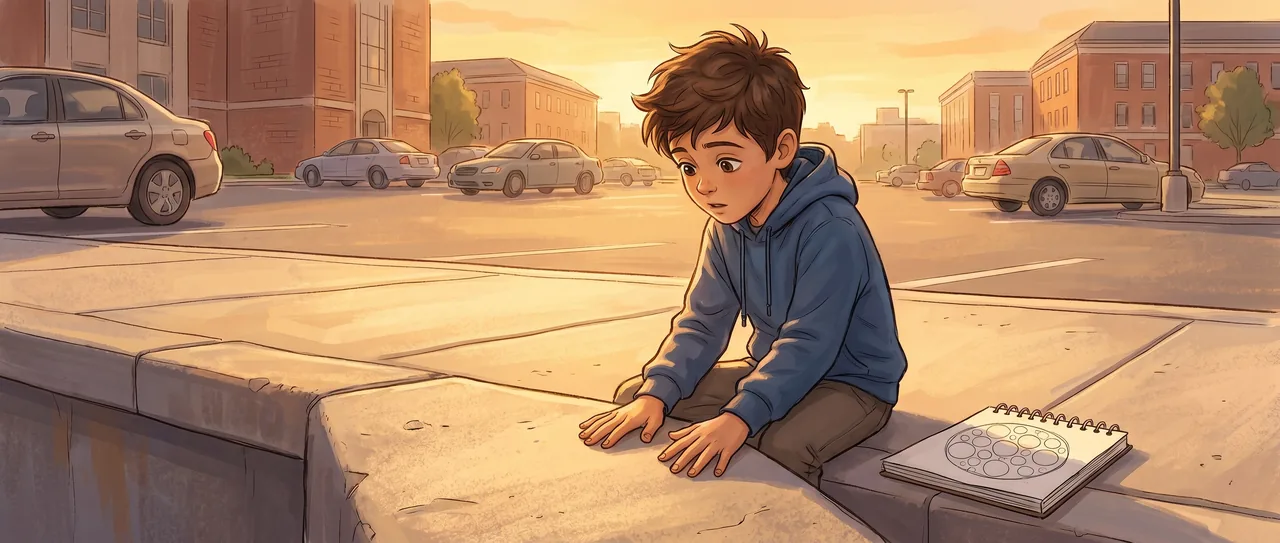
He picked up his pen again and drew a circle in his notebook. Then he drew lots of smaller circles inside it, each one overlapping with different parts of the big circle. Each small circle was a person. Each person carried a different fragment. But if you put all the fragments together, you could reconstruct almost half of a genome that belonged to someone who had been gone for forty thousand years.
Priya's professor called her name from across the room. She held up one finger in his direction. "I have to go. But that's a really good question you asked. About the dilution. Most people don't think to ask that."
She left. Soren stood there.
He looked at the cartoon Neanderthal with its terrible thumbs up. He looked at the number. 2.3%.
Something was turning over in his head that he could not quite land. He walked outside into the parking lot where his mother was waiting in the car, reading something on her phone. She waved. He held up one finger, the same way Priya had.
He sat down on the curb and opened his notebook to the circle diagram.
The Neanderthals were gone. Every single one. The last ones had died around forty thousand years ago in the caves of Gibraltar or somewhere in the shrinking forests of Europe, and their fires had gone out, and that was it. Extinction. The word was supposed to mean the end.
But they were in him. Sixty nine million base pairs. And different pieces were in everyone around him, in the graduate student, in the professor, scattered through billions of people like a library with its pages torn out and distributed to readers across the whole world. No single reader had the whole book. But the book was not gone.
He thought about what it meant to be gone. Whether you could be gone if pieces of you were still doing work inside living people. Whether the Neanderthals who had contributed those immune genes had known they were contributing anything at all, or whether they had just been two people meeting and deciding to stay together for a while.
His mother honked lightly.
Soren looked at his hands. Same hands as this morning. But this morning he had not known that sixty nine million parts of him were a message from someone who was supposed to be extinct, still helping, still working, still here.
He closed the notebook and pressed both palms flat against the warm concrete of the curb, as if he could feel all the way down through the ground to something ancient and unfinished.
Read the interactive version, listen to the narration, and earn a gold star →
A science-verified short story for curious kids · Curiosity Land