The Museum of Lost Mornings
The problem was not that their exhibit was broken. The problem was that it was working too well.
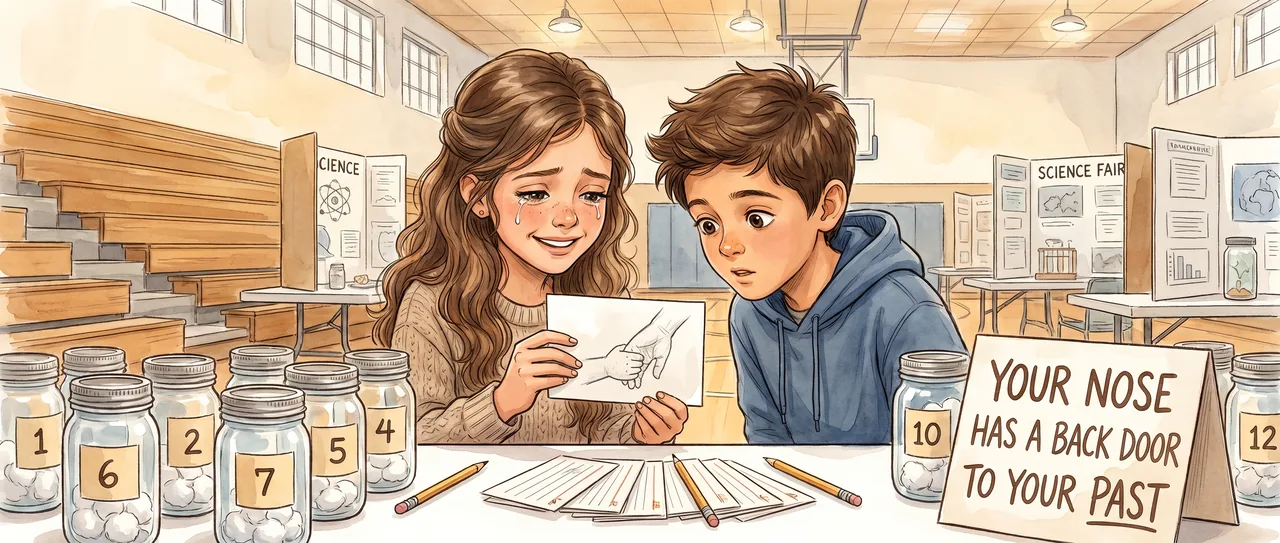
Maya had started crying over a jar of cinnamon.
Not sad crying. Not hurt crying. The kind of crying that happens when something arrives inside you so fast you have no time to build a wall against it. She was holding jar number four, labeled CINNAMON/CLOVE, and tears were running down both cheeks, and she was laughing at the same time.
"My grandmother's kitchen," she said. "I haven't thought about that in three years."
Soren set down the label maker. "Which grandmother?"
"The one in Oaxaca. She died when I was seven. I forgot what her kitchen smelled like. I forgot I forgot." Maya wiped her face with the back of her wrist. "I could see the yellow tiles, Soren. Not like remembering. Like being there."
This was supposed to be a straightforward exhibit. For the community science fair they had built a Memory Map: twelve numbered jars, each containing a cotton ball soaked with a different scent. Visitors would sniff each jar, then mark on a chart whether the smell triggered a memory, an emotion, both, or neither. Simple data collection. They had a poster with a diagram of the brain and a hypothesis printed in neat letters.
But three hours before the fair opened, they were testing the jars themselves, and jar number four had just demolished Maya.
"Try it," she said, holding it toward him.
Soren sniffed. Cinnamon. Clove. Pleasant. He thought about winter, vaguely. "It smells nice," he said. "But I don't get the yellow tiles."
"Because those aren't your tiles."
"Right." He picked up jar number seven. FRESH CUT GRASS. He unscrewed the lid and breathed in, and his hands went still.
The smell hit him below thought. Before thought. He was five years old, lying on his back in the yard of a house his family had moved away from six years ago. He could feel the specific itchiness of that specific grass against the backs of his arms. His dog Pepper was alive and barking at the neighbor's sprinkler. The sky was the color it is when you are five and not yet aware that skies have colors.
He put the jar down.
"You felt it," Maya said.
"Pepper," he said. That was all he could say for a moment.
Maya pulled their brain diagram off the poster board and spread it on the table between them. "Okay. Something is going on. When I looked at the photo of my grandmother's kitchen last year, I felt sad. Normal sad. This was not that."
"The smell skipped something," Soren said. He was already tracing the diagram with his finger. They had researched this. When you see something or hear something, the signal goes first through the thalamus, a relay station in the middle of the brain that sorts and processes before passing information along. Like a receptionist who screens your calls.
"But smell doesn't go through the thalamus," Maya said, tapping the diagram. "It goes straight to the olfactory bulb, and the olfactory bulb connects directly to the amygdala and the hippocampus."
The amygdala. Emotion. The hippocampus. Memory.
No receptionist. No screening. The call goes straight through.
"That's why it hit like that," Soren said slowly. "Every other sense gets filtered first. Organized. By the time a sight reaches the part of your brain that feels things, it's been processed. It's been made manageable. But smell just walks right in."
Maya stared at the diagram. "So when I smelled the cinnamon, my brain didn't have time to prepare. The memory and the emotion arrived together, raw, before I even knew what I was smelling."
"Your nose has a back door to your feelings."
"Everyone's nose."
They looked at each other across the table. The gymnasium was filling with other exhibits. Someone was testing a baking soda volcano three tables over. A parent was hanging a banner that read YOUNG MINDS, BIG IDEAS.
"Our exhibit is wrong," Maya said.
"Our exhibit is fine."
"No. We built it to collect data. Check boxes. Memory, emotion, both, neither." "But the actual thing that happens is not a check box. The actual thing is what just happened to us. The actual thing is that everyone who walks up to this table is carrying around memories they have completely lost, and a single molecule floating into their nose could bring one back alive."
Soren opened his notebook. Not to write. To think. He turned to a blank page and drew twelve circles, one for each jar.
"We keep the jars," he said. "We keep the chart. But we add something. We ask people to write down what came back. Not just whether something came back. What."
Maya grabbed a stack of index cards from her backpack. "One card per person per jar. They write whatever they want. Name it. Describe it. Draw it. Whatever."
"And by the end of the fair, we'll have a collection of other people's lost memories. Exposed by smell. Exposed because smell is the one sense that doesn't get screened."
They worked fast. Soren lettered a new sign: YOUR NOSE HAS A BACK DOOR TO YOUR PAST. WHAT DOES IT FIND? Maya arranged the index cards in a fan pattern next to each jar, with short pencils she borrowed from the mini golf station two tables over.
The fair opened at six. By six fifteen, a woman was standing at their table with jar number nine, WOODSMOKE, pressed to her face, whispering something about a cabin.
By seven, they had over a hundred cards. A man wrote: My mother's perfume. I don't know the name. I never knew the name. But she's here. A girl their age wrote: CHLORINE and then, in smaller letters: the summer I learned to do a flip.
Soren read each card as it came in. Not for data. Because every single one was a door that smell had opened in someone's brain, a door that sight and sound had never found.
Maya picked up a card that someone had left at jar number twelve, RAIN ON HOT PAVEMENT. The card had no words on it. Just a drawing of a small hand holding a bigger hand.
She turned it over. Blank.
She held it up so Soren could see, and they stood there in the noisy gymnasium, surrounded by volcanoes and robots, holding a stranger's drawing of two hands that the smell of rain had found.
Read the interactive version, listen to the narration, and earn a gold star →
A science-verified short story for curious kids · Curiosity Land