The Memory of Nothing
The slime mold was supposed to be dead by now.
That was the whole point of the experiment. Dr. Vasquez had given each pair of students a petri dish with a bright yellow Physarum polycephalum culture, a simple T-shaped maze cut from acetate, and instructions: expose the slime mold to caffeine solution every ten minutes and record how long it takes to retreat from the bitter barrier each time.
"It will slow down," Dr. Vasquez had told them at the start, already looking past them toward her graduate students on the other side of the lab. "The avoidance response diminishes with repeated exposure. That's the result you're documenting. Write it up and you're done by lunch."
She had not said anything about what to do when the slime mold stopped retreating entirely.
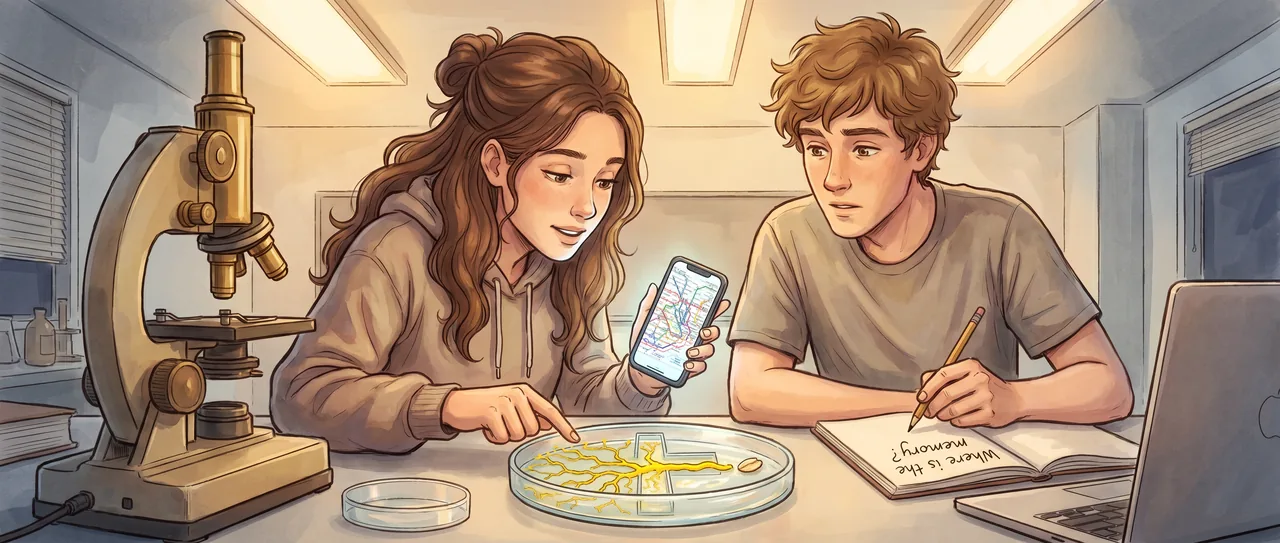
Maya stared at the dish. The yellow web of Physarum had pushed straight through the caffeine barrier on the sixth exposure, extending its veins into the arm of the maze where they'd placed an oat flake. It pulsed there now, feeding, the caffeine bridge gleaming wetly beneath it.
"It's not avoiding it at all anymore," Maya said.
Soren checked his notebook. He had the times written in a column, each one longer than the last. First exposure: the slime mold had recoiled in four seconds. Second: eleven seconds. Third: nineteen. By the fifth, it had taken nearly three minutes to begin retreating, and the retreat was sluggish, halfhearted. On the sixth, it had simply pushed through.
"That's habituation," Soren said. "That's what Dr. Vasquez said would happen."
"No. She said the avoidance response would diminish. She didn't say it would learn to walk through poison to get food."
"Caffeine isn't poison to it. It's just bitter. Unpleasant."
"Soren. It decided the unpleasant thing wasn't dangerous. How did it decide that?"
Soren looked at the slime mold. It had no eyes. It had no brain. It was, technically, one cell. One enormous, spreading, pulsing cell with thousands of nuclei but no neurons. No synapses. No nervous system of any kind.
"Maybe it's just chemistry," he said. "Some receptor gets saturated, stops firing."
"What receptor? It doesn't have receptors like that. It doesn't have a nervous system to fire."
"It has to have some chemical pathway."
"Sure. But a chemical pathway that does what? That remembers? Soren, where is the memory?"
He didn't answer. He was looking at the Physarum's network of veins. They weren't random. They pulsed in a rhythm, thickening along the path between the food and the main body, thinning where the slime mold had explored and found nothing.
Maya pulled up a photo on her phone, angling it so he could see. A map of the Tokyo rail system. Then she swiped to the next image: a Physarum culture that researchers had grown on a map of Japan, with oat flakes placed at the locations of major cities. The slime mold's network looked almost identical to the rail map.
"It optimizes," Maya said. "No brain. It just optimizes. It finds the most efficient network between food sources, and it matches what human engineers spent decades designing."
"I've seen this," Soren said. "But that's different from memory."
"Is it?"
He opened his mouth, then closed it.
Maya pointed at the caffeine bridge. "It tried crossing six times. Each time it learned something. What did it learn with? Where did it put what it learned?"
Soren wrote in his notebook: Where is the memory?
Then, under it: What counts as learning if you have no brain?
Dr. Vasquez came by fifteen minutes later. She glanced at their dish, nodded, said "Good, classic habituation curve," and moved on to the next table where two students were struggling to keep their Physarum from escaping the maze entirely.
Maya watched her go. "She already knows what this is."
"She knows what to call it," Soren said. "That's different."
Maya looked at him. He was reading his own notes, frowning at something.
"What?"
"The 2016 paper," he said. "The one Dr. Vasquez mentioned in the introduction. They fused two Physarum cultures together. One had been habituated to caffeine. One hadn't. And the fused organism behaved like it had been habituated."
"The memory transferred."
"Through direct contact. One cell flowed into the other and the combined organism remembered something only one of them had experienced. And nobody knows how."
"Nobody knows how," Maya repeated.
They sat with that for a moment.
Soren said, "We think memory needs a brain because we have brains. We think learning needs neurons because we have neurons. But this thing learned before neurons existed. Neurons are, what, five hundred million years old? Slime molds are at least a billion. Maybe learning came first. Maybe brains are just one way to do something that life figured out long before brains existed."
Maya was very still. "Say that again."
"Brains didn't invent learning. Brains are just one solution to a problem that was already solved."
The Physarum pulsed in its dish. Its veins thickened and thinned in slow rhythm, shuttling cytoplasm back and forth, a tide with no moon to pull it. It had found the oat flake. It had crossed the barrier. It was, by any functional definition, satisfied.
But Maya was thinking about what it meant that a single cell with no brain could remember, could optimize, could solve a maze, could do all the things that textbooks said required a nervous system. Not because the textbooks were wrong about brains. Because they were incomplete about everything else.
"I want to run it again," she said.
"The habituation?"
"No. I want to give it a real maze. A harder one. I want to see the network it builds."
Soren was already sketching a more complex maze in his notebook, five arms, three food sources, two dead ends. "If we photograph the vein network every fifteen minutes, we can watch it optimize in real time."
"And then I want to cut it in half," Maya said. "And see if both halves remember the solution."
Soren stopped sketching. He looked at her. Then he looked at the Physarum, pulsing quietly in its dish, a billion years of something that wasn't intelligence but wasn't not intelligence either, spreading toward food it couldn't see with senses no one could name.
"Dr. Vasquez said we'd be done by lunch," he said.
"Dr. Vasquez was wrong."
He turned to a fresh page.
In the dish, the slime mold reached the end of the maze and kept going, spreading past the acetate walls, already searching for something that wasn't there yet.
Read the interactive version, listen to the narration, and earn a gold star →
A science-verified short story for curious kids · Curiosity Land