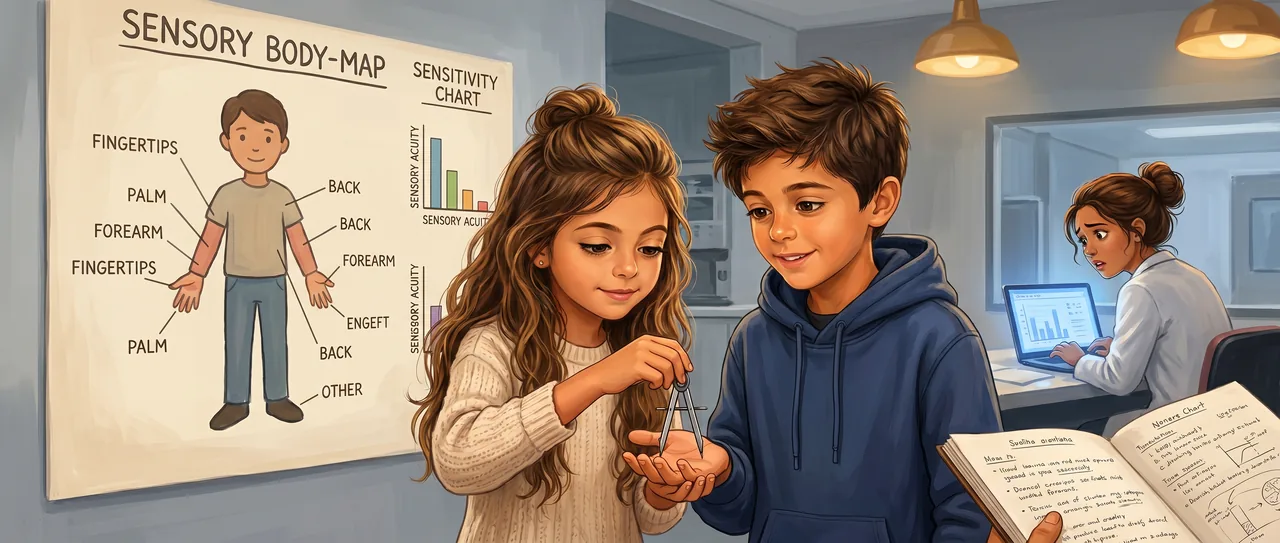
The Map That Lied
The poster on the wall was wrong.
Maya had been staring at it for three minutes while the other kids from the field trip clustered around the brain-in-a-jar display. The poster showed a human figure stretched along a curved surface, like a person draped over a banana. But the figure was grotesque. Its hands were the size of its torso. Its lips were swollen and enormous. Its feet were small, its arms were small, its whole back was a thin sliver barely wider than a finger.
"That's not what a person looks like," she said.
Soren was beside her. He had his notebook out but hadn't written anything yet. "It says it's a map. Of the brain."
"A map of what the brain thinks a person looks like?"
"A map of how much brain is dedicated to each body part." Soren read the label beneath. "Cortical homunculus. The amount of sensory cortex devoted to each region of the body, shown proportionally."
Maya put her hand flat against the poster, next to the homunculus's massive hand. Her hand was smaller than one of its fingers.
"So my brain spends as much time thinking about my hands as my entire back."
"Not thinking about them. Processing them. There's a difference, maybe."
A graduate student named Priya was running the demonstration table nearby. She had electrodes, a laptop, and the frazzled look of someone who had already explained the same thing forty times that morning. She was talking to three kids about reflexes and clearly wanted to be back in her own lab.
"Can we try the mapping thing?" Maya asked her.
Priya glanced over. "The two-point discrimination test? Sure. Give me a second." She finished with the other kids, then pulled out a small device that looked like a compass with two blunt points instead of a pencil and a needle.
"I'm going to touch you with either one point or two. You close your eyes and tell me which. We'll see how close the two points can be before you can't tell them apart anymore."
Soren went first. Priya touched the back of his forearm. "One or two?"
"One," Soren said.
"Two, actually. The points are thirty millimeters apart." Priya adjusted the compass wider. "How about now?"
"Two. Barely."
Priya wrote something down, then moved to his fingertip. She set the points close together, just a couple of millimeters. "One or two?"
"Two," Soren said instantly.
Priya nodded like this was unremarkable. "Fingertips can discriminate at about two to three millimeters. The back of your arm needs around forty. Your fingertip is roughly twenty times more sensitive to spatial detail."
She said it flatly, already glancing at her laptop.
But Soren opened his eyes. "Wait. Twenty times?"
Maya took the compass from Priya's hand. "Can I try it on him?"
Priya hesitated, then shrugged. "Don't poke. Gentle pressure."
Maya touched the two points to the center of Soren's back. "How many?"
"One."
She didn't tell him he was wrong. She moved to his palm. Same distance between the points. "How many?"
"Two. Obviously two."
Soren opened his eyes again. He looked at his own hand like he had never seen it before.
"Your back is huge," he said slowly. "And your hand is small. But your brain treats the hand like it's bigger."
"Not bigger," Maya said. "More important."
Soren looked at the homunculus poster again. Those giant hands. That tiny trunk. "It's not what the brain thinks we look like. It's what the brain thinks matters."
Priya had turned back to her laptop, but she paused at that. She didn't say anything. She just paused.
Maya touched her own fingertips together, thumb to forefinger, the way she did when she was thinking. She could feel every ridge, every tiny catch of skin. She pressed her elbow against the table edge. It was blunt. Vague. Like a word she couldn't quite remember.
"Priya, why is it like this?" Soren asked. "Why would the brain give so much space to the hands?"
Priya looked up from her screen. "Think about what your hands do."
"Everything," Maya said.
"Not everything. Your legs walk. Your eyes see. But your hands." Priya wiggled her fingers. "Thread a needle. Play a chord. Crack an egg with one hand. Feel the difference between silk and cotton in the dark. Sign a word. Read Braille. Perform surgery. Knap a stone tool."
She stopped herself, visibly pulling back from her own enthusiasm. "Anyway. It's a lot of cortical real estate. More than the entire trunk. The motor cortex has the same bias. Huge hand area. It's been that way for a long time, evolutionarily."
Soren was writing in his notebook, fast. Then he stopped.
"Maya. The homunculus. It's not a distortion. It's the real map."
"What do you mean?"
"I mean the normal picture of a person, the one with everything the right size, that's the distortion. That's the lie. The homunculus is what your brain actually built. The weird one is the true one."
"It's like a secret," she said. "Everyone has these giant invisible hands."
Soren held his hand up, fingers spread. Same hand as always. Five fingers, a few calluses from his pencil, a scrape on his knuckle from his bike chain.
"Not invisible," he said. "We just never knew how to look."
Priya had gone back to her laptop. The other field trip kids were moving toward the exit, their teacher calling out a five-minute warning. The brain in its jar sat on its shelf, pale and ridged and quiet.
Maya picked up the two-point compass from the table. She brought the points close together, barely a gap between them, and pressed them gently to the pad of her thumb.
Two points. Clear as a bell. She could feel each one separately, precisely, the way you can hear two different notes in a chord.
Read the interactive version, listen to the narration, and earn a gold star →
A science-verified short story for curious kids · Curiosity Land