The Longest Conversation
The argument started because Maya said the whale was talking to nobody.
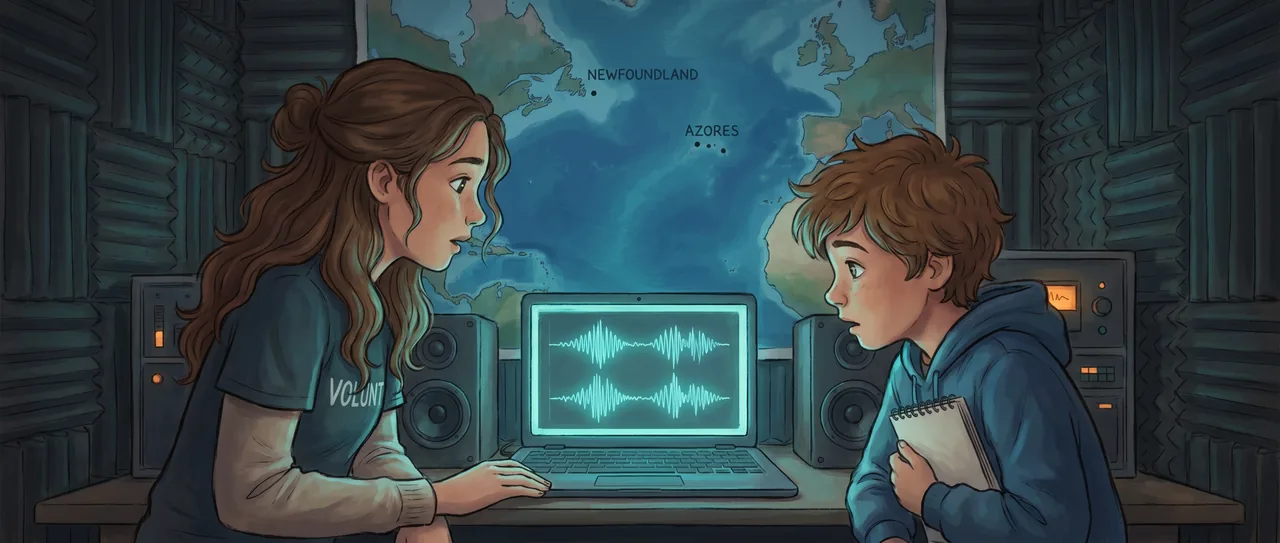
They were in the listening lab, which was really just a repurposed shipping container with foam on the walls and too many cables. Dr. Vasquez had left them with four hours of hydrophone recordings and a frequency chart and instructions to mark anything below twenty hertz. Then she had gone to fix the satellite uplink, which had been broken since Tuesday.
Soren had his notebook open. He'd been marking timestamps for eleven minutes when Maya pulled off her headphones.
"That one," she said. "Play it back."
He rewound. The sound came through the speakers this time, pitched up so human ears could hear it. A long, low moan that rose and fell and rose again. It sounded like someone dragging a cello bow across the bottom of the world.
"Blue whale," Soren said. He checked the frequency. Fourteen hertz. He wrote it down.
"Play the next one."
He did. Another call, almost identical. Same pitch, same pattern. Timestamp: forty-one minutes later.
"And the next."
Same call. Fifty-three minutes after the second.
"She's repeating herself," Maya said.
"They do that. The males repeat songs for hours."
"No, listen. It's not a song. Songs change. This is the same phrase, exactly, three times. She's calling and nobody's answering."
Soren played all three again. Maya was right about the repetition. Each call was nearly identical, like someone saying hello into a phone, waiting, saying hello again.
"Maybe the answer is on a different hydrophone," he said.
"Maybe. Or maybe she's too far away from any other whale to get an answer."
That was the moment Soren should have agreed, but something bothered him. He looked at the frequency chart Dr. Vasquez had pinned to the wall. Fourteen hertz. He looked at the map next to it, which showed the locations of hydrophone stations across the Atlantic.
"How far can a blue whale call travel?" he asked.
"Far. Hundreds of kilometers, I think."
"Then what does too far away mean?"
Maya paused. She did that thing where her eyes went slightly unfocused, which meant she was rearranging something in her head.
Soren pulled up the station's reference files on the laptop. He found it in a document about the SOFAR channel. He read parts of it aloud, slowly, because the numbers didn't seem right.
"There's a layer in the ocean, about a thousand meters down, where the water is cold enough and pressured enough that sound gets trapped. It bends back in before it can escape up or down. Like a pipe. And sound in that layer can travel..." He stopped.
"How far?"
"Thousands of kilometers. Across entire ocean basins."
Maya pulled her chair closer to the laptop. "Say that again."
"Sound moves about four times faster in water than in air. And in this channel, it barely loses energy. A whale calling near the Azores could be heard by a hydrophone near the Caribbean."
They both looked at the map. The Azores sat in the middle of the Atlantic like a period in the center of a sentence. The hydrophone stations were scattered from Newfoundland to West Africa to the Mid-Atlantic Ridge.
"So she's not talking to nobody," Maya said.
"We don't know that."
"We don't know the opposite either. We've only got our hydrophones. She might be in a conversation with a whale three thousand kilometers away, and we'd only hear her half of it."
Soren wrote that down. Then he stopped writing and stared at what he'd written.
"Play the third call again," he said.
Maya played it. The moan filled the container, vibrating the foam on the walls.
"If another whale answered from, say, the coast of Newfoundland, how long would the sound take to reach here?"
They did the math together on the back of Soren's notebook page. Speed of sound in seawater, roughly fifteen hundred meters per second. Distance from Newfoundland to the Azores, roughly two thousand kilometers. They divided, converted.
"About twenty-two minutes," Soren said.
"The gap between her first and second call was forty-one minutes," Maya said. She was already adding. "So if someone answered immediately, the reply would arrive in twenty-two minutes, and then she'd wait a bit before calling again..."
"That fits."
"That fits exactly."
They stared at each other.
"We can't prove it," Soren said.
"No."
"We'd need the Newfoundland hydrophone data to see if there's a call in between."
"Yes."
Maya leaned back. Then she leaned forward again. "Soren. She's having a conversation across an entire ocean. The words take twenty-two minutes to arrive. And she waits. And she calls again. And it's been going on all morning."
He didn't say anything. He was thinking about what it would feel like to say one sentence, then drift through dark water for twenty-two minutes, not knowing if anyone heard, not knowing if an answer was already traveling toward you through a hidden channel a thousand meters down, moving at fifteen hundred meters per second through a layer of ocean that bends sound the way a lens bends light.
Dr. Vasquez came back, smelling like coffee and frustration. "Uplink's still down. How's the catalog going?"
"We need the Newfoundland station data from this morning," Maya said.
"That's not what I asked you to do."
"We think we found a conversation."
Dr. Vasquez looked at the timestamps in Soren's notebook. She looked at the math on the back of the page. She looked at the map.
"That's a stretch," she said. But she sat down. She pulled up the database for the western Atlantic array, and because the satellite was down, she had to route through a backup connection that took forever. Maya stood behind her, completely still. Soren watched the progress bar.
The file loaded. Newfoundland hydrophone, that morning's recording. Dr. Vasquez scrubbed to the timestamp between the first and second Azores calls.
A sound filled the shipping container. Low. Long. Fourteen hertz. A different whale. A different voice. Answering.
Dr. Vasquez leaned back in her chair, very slowly.
Soren looked at the map on the wall, at the tiny dot of the Azores and the tiny dot of Newfoundland and the vast blue nothing between them that was not nothing at all, that was full of sound traveling in a hidden corridor, patient and enormous.
Maya reached over and pressed play on the Azores recording again, the third call, and the two voices overlapped in the shipping container, one from each side of the Atlantic, both of them fourteen hertz.
Outside, the ocean went on in every direction, and somewhere a thousand meters beneath its surface, another sentence was on its way.
Read the interactive version, listen to the narration, and earn a gold star →
A science-verified short story for curious kids · Curiosity Land