The List That Grew
Soren's uncle handed him a clipboard with a photocopied chart of forty-two fish species and said, "Check off what you see in the net. I'll be on the phone."
Then he walked back to the truck, already talking to someone about permit numbers.
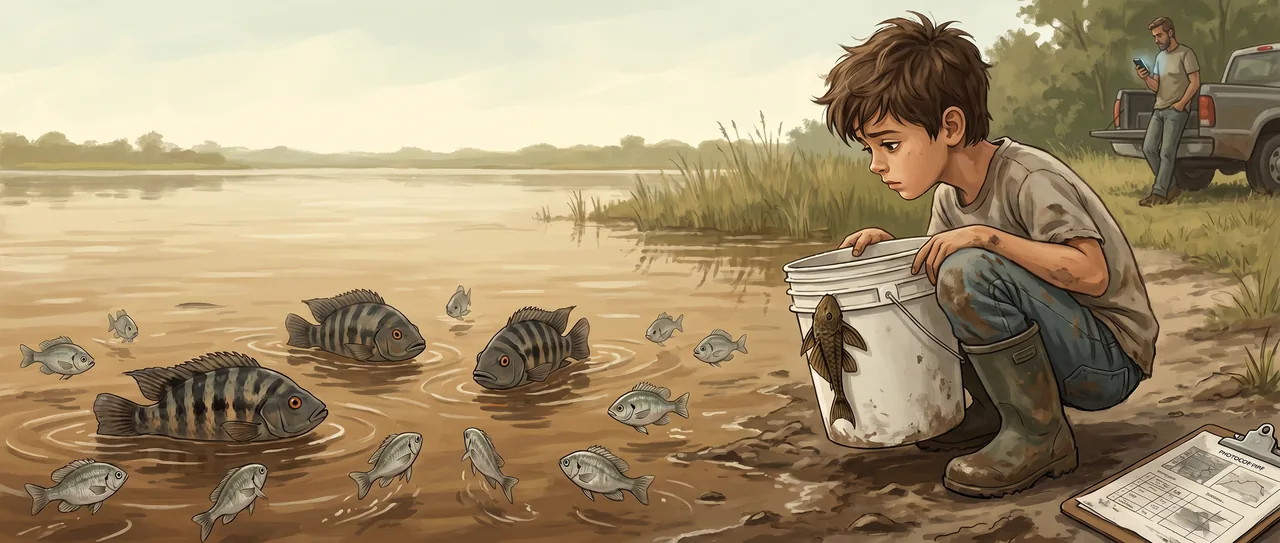
Soren stood at the edge of the lake in rubber boots two sizes too large. The seine net was already set in the shallows, staked at both ends, and things were moving in it. He could see flashes of silver and bronze and one strange, slow shape near the bottom that didn't flash at all.
He started with what he recognized. Bluegill. He found it on the chart and checked the box. Largemouth bass, small one, maybe four inches. Check. A mosquitofish, tiny and darting. Check.
Then he pulled up the thing that wasn't flashing.
It was a fish, obviously, but it looked wrong for the net. Dark vertical stripes. A heavy, almost rectangular body. A mouth that opened and closed slowly, like it was tasting the air. He held it in both hands, and it barely struggled. It just watched him with flat orange eyes.
He looked at the chart. Forty-two species. He went through every one. Redear sunfish, no. Channel catfish, no. Spotted gar, no. He went through the chart twice. The fish in his hands was not on it.
Soren set it gently in the bucket and wrote in his notebook: Dark stripes. Orange eyes. Not on the list. Doesn't struggle.
He caught three more in the next twenty minutes. Two were identical to the first. The third was smaller, younger, same stripes, same calm stare. He lined them up in the bucket and counted the native fish in the net. Seven bluegill, two bass, the mosquitofish. And four of these.
Four out of fourteen. Almost a third.
His uncle came back, still distracted, glancing at his phone. "Getting anything good?"
"There's a fish that's not on the list," Soren said.
His uncle looked in the bucket. His face changed. Not alarm exactly, but something tighter, like he was doing math he didn't want to do.
"That's a Mayan cichlid," he said.
"It's not on the chart."
"No. It wouldn't be. The chart is native species." His uncle picked one up, turned it over, set it back. "Aquarium fish. People dump them when they get too big. They're from Central America originally."
"There are four of them," Soren said. "And seven bluegill."
His uncle nodded, already looking at his phone again. "Yeah, they're everywhere now. Put them in the invasive column if there is one. I need to make one more call."
There was no invasive column.
Soren stood there with the clipboard and the bucket and the four calm fish staring up at him. He looked at the chart again. Forty-two species. A whole sheet dedicated to what was supposed to be here. And nothing, not a single box, for what actually was.
He pulled the net again. This time he counted everything. He made two columns in his notebook: LISTED and NOT LISTED.
In the next haul: five bluegill, one bass, six Mayan cichlids, and something else. Something with whiskers and a sucker mouth that attached itself to the side of the bucket and would not let go. Brown armored plates along its body. He had seen pictures of these. A pleco. Another aquarium fish.
LISTED: 6. NOT LISTED: 7.
He stared at the numbers. Then he pulled the net again.
LISTED: 4. NOT LISTED: 9.
Again.
LISTED: 3. NOT LISTED: 8.
The ratio was getting worse. Or rather, the ratio had always been this. He was just pulling the net enough times to see it. The lake had more fish that weren't supposed to be here than fish that were.
He sat down on the bank, boots in the mud, and thought about what that meant. Not as a number. As a place.
The bluegill had been here for thousands of years. They knew this lake. They knew what ate them and what they ate and where to hide when the herons came. They had evolved here, fitted to this exact water, these exact reeds, this exact mud.
The Mayan cichlids had been here for maybe twenty years. Dumped from a tank. And they were winning.
Not because they were better. Because the bluegill had never met them before. The bluegill had defenses against bass, against gar, against every predator and competitor they'd shared this lake with for millennia. But they had no defense against a fish from Guatemala. No recognition. No strategy. No evolved behavior that said: this thing is dangerous, avoid it, outcompete it, survive.
The cichlids didn't have to be superior. They just had to be unfamiliar.
Soren looked at the bucket. The cichlids were still calm. The bluegill were frantic, darting, burning energy against the walls. Even in a bucket, the natives were behaving like prey animals that couldn't identify the threat. The cichlids just sat there, unbothered, because nothing in this lake had ever taught them to be afraid.
His uncle came back. "Last net?"
"I've been pulling it every ten minutes," Soren said. "The listed species are outnumbered. In every single pull."
His uncle looked at the notebook. At the columns. At the ratios, each one circled, each one telling the same story.
"Huh," his uncle said. He wasn't looking at his phone anymore. "That's. Yeah. That tracks with what we've been seeing at other sites but nobody's been counting it like this. With the ratio."
"The chart doesn't have a column for them," Soren said.
"No."
"It should."
His uncle took the clipboard from him and looked at the photocopied chart, the neat boxes, the forty-two species that were supposed to define this lake. He turned it over to the blank side.
"Yeah," he said quietly. "It really should."
Soren took the clipboard back. On the blank side he drew two new columns. He wrote the headers carefully. Then he walked back to the net, because the lake was still full of things that weren't on any list yet, and someone had to count what was actually there.
The water was warm around his boots. A Mayan cichlid drifted past his ankle, completely unafraid.
Read the interactive version, listen to the narration, and earn a gold star →
A science-verified short story for curious kids · Curiosity Land