The Library That Remembers You
The old woman was arguing with the graduate student, and she was winning.
"I am not confused," she said. "I am telling you that the sample labeled Huang, R. is mine, and the date is wrong by one year. I was born in nineteen twenty-six, not nineteen twenty-seven. My mother was very clear about this."
The graduate student looked helpless. He kept glancing at his laptop like it might rescue him. It did not.
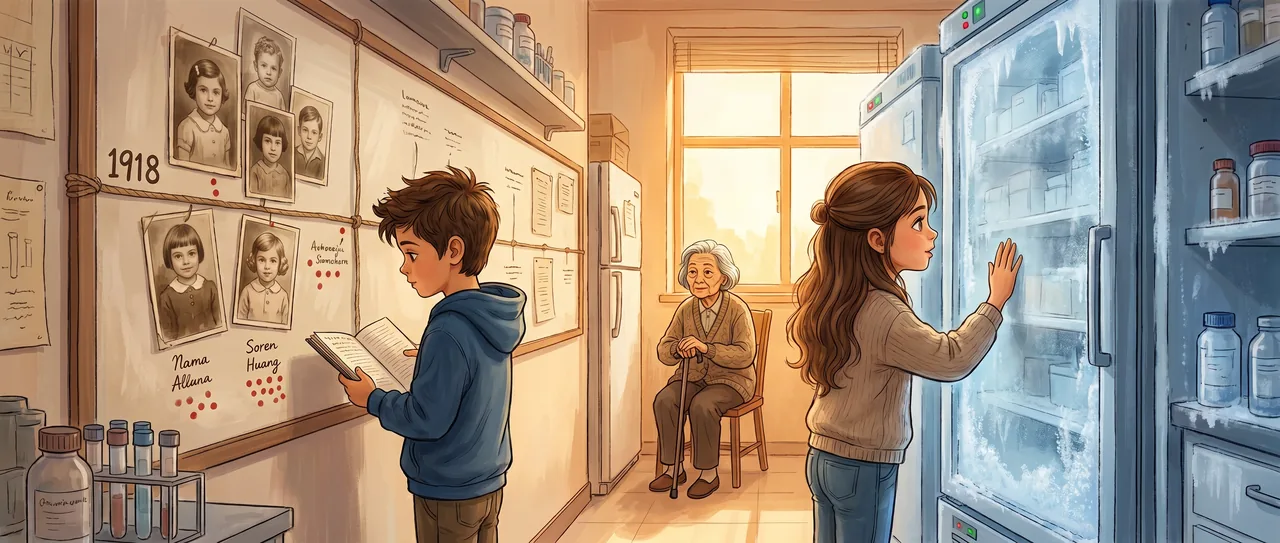
Maya and Soren had wandered away from the open house tour group twelve minutes ago, drawn by a hallway lined with freezers that hummed at slightly different pitches. Now they stood in the doorway of a lab where the walls were covered in timelines. Dates going back over a hundred years. Names. Tiny red dots.
"What are all these?" Soren asked, not to anyone in particular, just to the room.
The old woman turned. She had a cane with a rubber tip and eyes that moved faster than the rest of her. "Blood," she said. "Exposed and unexposed. They have been studying mine for eleven years now."
"Studying it for what?" Maya said.
"For what I remember."
The graduate student, whose name tag said Dev, finally closed his laptop. "Mrs. Huang is one of our longitudinal participants. She's part of a study on immune memory. Her mother survived the nineteen eighteen influenza pandemic, and Mrs. Huang herself was vaccinated against several strains in the nineteen fifties."
"I was not vaccinated in the fifties," Mrs. Huang said. "It was nineteen sixty-one. The details matter, young man."
Dev opened his mouth, then closed it.
Soren was already at the wall, reading the timeline. "Wait. Some of these samples are from people born in nineteen ten. Nineteen oh eight. Are they still alive?"
"No," Dev said. "But their blood samples are. Frozen. And the antibodies in those samples still react. That's the point. We can take blood drawn from someone who survived the nineteen eighteen flu, thaw it ninety years later, and their immune cells still recognize the virus. Their body wrote a memory of that infection and it lasted their entire life."
Maya had gone still in the way she did when two things were connecting. "Their whole life," she repeated.
"Longer," Mrs. Huang said. She tapped her cane once on the floor. "My mother died in nineteen eighty-nine. The blood they drew from her in nineteen eighty-four still fights that virus in a dish. She is gone. Her memory is not."
The room got quiet except for the freezers.
Soren pulled out his notebook. "How does that work, though? Cells die. Blood cells only last a few months. How does the memory survive if the cells don't?"
Dev looked almost grateful to be asked a straightforward question. "Memory B cells. When your immune system encounters a pathogen, or a vaccine, it creates specialized cells that basically retire to your bone marrow. They can live there for decades. Some of them, we think, for your entire life. And if they ever encounter that same pathogen again, they wake up and start producing antibodies within hours. Faster than the first time. Much faster."
"Like they've been waiting," Maya said.
"They have been waiting," Mrs. Huang said. "That is their only job. To wait and remember."
Maya walked to the section of the timeline marked nineteen eighteen. Photographs were pinned above certain names. Young faces. "These people got sick over a hundred years ago. And the soldiers in their blood are still standing guard in frozen tubes in this lab."
"Not soldiers," Soren said, but he said it slowly, like he was testing the word against what he actually meant. "More like librarians. They don't fight. They remember how to fight. And when the right signal comes, they teach new cells how."
Dev pointed at him. "That is remarkably close to accurate."
Mrs. Huang had lowered herself into a chair near the window. "They tell me that because my mother survived the nineteen eighteen flu, and because her immune memory was so specific, studying her blood helped them understand how certain flu vaccines should be designed. She died before she knew that. I did not."
She said it plainly, like a weather report, but Maya noticed her hand tighten on the cane.
"Is that why you keep coming back?" Maya asked. "For eleven years?"
"I keep coming back because my own blood is interesting too. I was vaccinated against influenza strains that no longer circulate. The memory is still in me. They take my blood every six months and they find that my body still remembers viruses it met sixty years ago. Viruses that do not exist in the wild anymore. My immune system is a library of extinct things."
Soren stopped writing.
Maya said, "A library of things that don't exist anymore."
"Yes."
"And if one of them came back. If a virus from nineteen sixty-one somehow appeared again. Your body would already know."
"Within hours, they tell me. Perhaps faster. The memory does not fade the way other memories do. It does not become unreliable. It waits, and it is precise."
Soren looked down at his notebook, at the notes he had taken in his own handwriting. He thought about how he sometimes forgot what he had written, had to reread his own pages to remember what he once understood. And here was a woman whose bone marrow remembered a virus it met once, sixty years ago, perfectly, without trying, without writing anything down.
"Do you know how many different memories your immune system is holding right now?" he asked Dev.
"Estimates vary. But a healthy adult might carry memory cells for every pathogen they have ever encountered. Hundreds. Maybe thousands of distinct memories, all stored, all ready."
"And they never get confused? They never activate for the wrong thing?"
"Almost never. The specificity is extraordinary. A memory B cell that remembers the nineteen eighteen flu does not activate for a common cold. It waits for exactly what it knows."
Maya turned to Mrs. Huang. "Your mother's cells. In the freezer. Could they still teach us things nobody has thought to ask yet?"
Mrs. Huang smiled. It was not a gentle smile. It was sharp and bright and it belonged to someone who had been underestimated many times. "That is why they are in the freezer, child. Not because of what we know to ask today. Because of what someone will know to ask in fifty years."
The freezers hummed. A slightly different pitch in each one, like they were each holding a different conversation with the things inside them.
Soren counted them. Fourteen freezers in this room alone. Each one full of small tubes of blood, each tube full of cells that remembered something the world had tried to forget.
Maya pressed her palm flat against the nearest freezer door, and it was so cold it almost burned.
Read the interactive version, listen to the narration, and earn a gold star →
A science-verified short story for curious kids · Curiosity Land