The Lake That Remembered
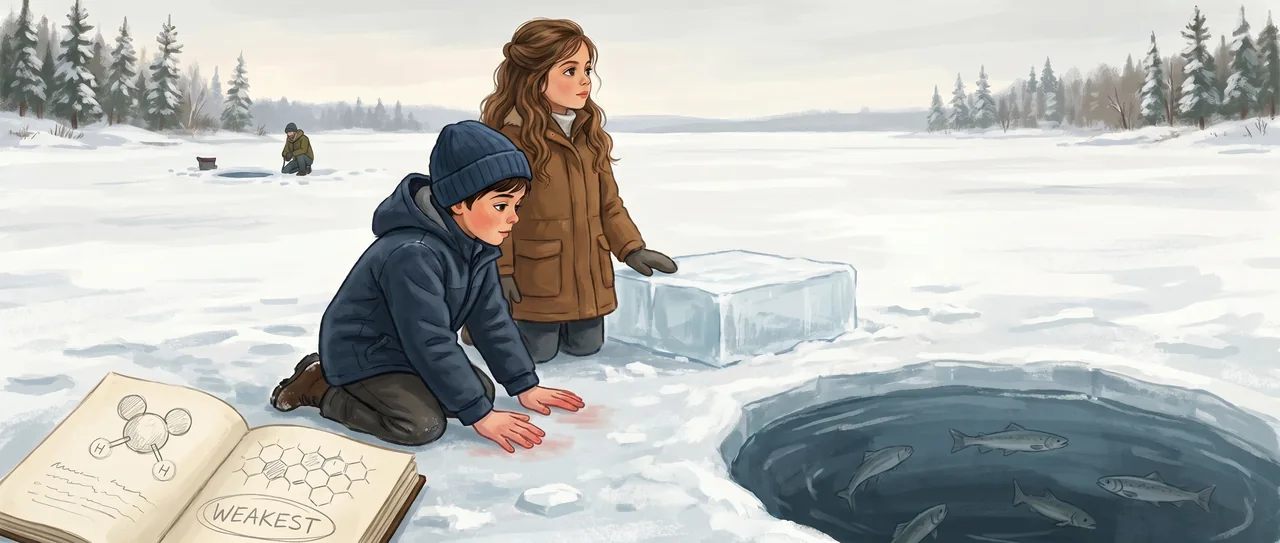
The saw screamed through the ice and Soren's uncle pulled out a perfect rectangle, thick as a dictionary, and set it on the surface beside the hole.
"Twelve inches," Uncle Kev said, satisfied. He was already walking to the next spot he'd marked with orange flags, measuring tape dragging behind him. He did not look back.
Maya crouched beside the block.
The ice was clear in some places and cloudy in others. She could see the dark water through the hole, and she touched the surface of the block Kev had pulled out. Cold bit into her fingertips. Below the hole, the lake water moved, slow and alive.
"Soren."
"Yeah."
"This doesn't make sense."
Soren was already writing something in his notebook, his gloves off, his fingers red. He looked up.
"The ice is on top," Maya said.
Soren blinked. "Where else would ice be?"
"Think about it. Everything else that freezes gets heavier. Candle wax sinks in melted wax. You freeze metal, it sinks in its own liquid. Solid is supposed to be denser than liquid. That's the rule."
Soren stared at the hole. Then at the block sitting on the surface beside it. Twelve inches of frozen water, just sitting there on top of the rest of the water, like that was normal.
"So why does ice float?" he said.
"Right."
They both looked at the lake. It went on for miles, white and flat, holding snowmobile tracks and the pressure cracks that boomed at night like something enormous turning over in its sleep. All of it floating. The entire frozen surface of the lake was lighter than the water below it.
Soren pulled his gloves back on, then pulled them off again. He flipped to a blank page.
"Okay. Water is H two O. Two hydrogens, one oxygen."
"And they're not in a straight line," Maya said. "They're bent. Like a Mickey Mouse head. The oxygen is the face and the hydrogens are the ears."
Soren drew it. Two small circles above a larger one, angled. "So one end of the molecule has more pull on the electrons than the other. The oxygen side is a little negative. The hydrogen side is a little positive."
"So they stick to each other," Maya said. "Positive end of one to negative end of the next."
"But weakly. Really weakly." Soren tapped the page. "Each one is tiny. Almost nothing."
Maya pressed her whole palm flat against the surface of the lake. "Almost nothing is holding up all of this."
From fifty yards away, Uncle Kev's saw started again, whining through ice. He was not paying attention to them. He was paying attention to walleye.
"When it freezes," Soren said slowly, working through it, "the molecules lock into a pattern. A crystal. And the crystal has gaps in it."
"Because of the angle," Maya said. "The Mickey Mouse angle. They can't pack tight. They lock into hexagons instead, and hexagons have space in the middle."
Soren wrote HEXAGONS and then drew one, then drew another next to it, then saw the gaps between them. More space. Less dense. Lighter than liquid water, where the molecules tumbled loose and could crowd together.
"So ice floats because water is bent," he said.
Maya stood up. She was quiet for a moment, which was unusual.
"Soren. What would happen if it didn't?"
He didn't answer immediately. He was following the thought.
"If ice sank," he said. "It would freeze on top, sink to the bottom. More water would be exposed on top. That would freeze. Sink. More water exposed."
"The lake would freeze solid," Maya said. "From the bottom up."
"Every lake," Soren said. "Every ocean. Once it started, it wouldn't stop. Not in winter. Nothing living at the bottom would survive."
They both looked at the hole again. The dark water below was four degrees Celsius, warmer than the ice above it, warmer than the air. Fish moved down there. Tiny things they couldn't see moved down there. The ice was a roof. A lid. A blanket that floated because water molecules were bent at one hundred and four point five degrees instead of one hundred and eighty, and because the bond between them was almost nothing.
Almost nothing, repeated across trillions and trillions of molecules, becoming everything.
"It's the same bond," Maya said. "The same kind of attraction. Hydrogen bonds hold DNA together. The two strands. That's what lets them unzip and copy. And proteins fold because of it. The shape of every enzyme in your body is held together by the same force that's holding up this ice."
Soren put his pen down. He stared at the page where he'd drawn Mickey Mouse ears on a circle.
"One kind of bond," he said. "And it's not even a strong one."
"No. It's the weakest one that matters."
A crack rang across the lake, deep and resonant, the sound of ice adjusting to temperature. It traveled under their feet and kept going, a vibration they felt in their bones before they heard it fade.
Uncle Kev called from his second hole. "You two gonna fish or you gonna stare at water all day?"
"Both," Maya called back.
Soren looked at what he'd written. Mickey Mouse heads linked in chains. Hexagons with gaps. The word WEAKEST circled three times.
The thing was, he had known about hydrogen bonds before today. He'd read about them. He could have answered a test question. But knowing something and standing on top of it were different. Standing on top of it while fish swam underneath because a molecule was bent instead of straight.
Maya was already walking toward Uncle Kev and the second hole, her boots crunching on the surface of something that should have sunk but didn't.
Soren closed the notebook. He pressed his bare hand flat against the ice the way Maya had, feeling the cold flood his palm, feeling twelve inches of frozen crystal between himself and the dark water where things lived because the weakest bond in chemistry had said: you will float.
The lake boomed again, farther away this time, and he felt it travel through his hand.
Read the interactive version, listen to the narration, and earn a gold star →
A science-verified short story for curious kids · Curiosity Land