The Hungry Week
The caterpillars were wrong.
Maya stood at the base of the oak and watched them drop on silk threads, dozens of them, lowering themselves from branches that were already thick with leaves. Inchworms, mostly. Green loopers curling and stretching through empty air, reaching for something that wasn't there.
No. Not wrong. Early.
Or the birds were late.
She pulled her phone out and opened the research station's phenocam archive, the twenty-three years of daily photographs taken from the same steel pole bolted to the same ridge, aimed at the same patch of canopy. She had been scrolling through them for two days now, ever since Dr. Vasquez had told her she could use the archive for her school project but then gotten pulled into a funding call and basically forgotten Maya existed.
That was fine. Maya worked better when no one was narrating.
She flicked through April fifteenth across the years. Two thousand two: bare branches, a haze of pink buds just starting. Two thousand twelve: pale green, halfway. Two thousand twenty-four: full canopy, dark green, done.
The same date. The same trees. But the leaves kept arriving sooner.
She already knew this. Dr. Vasquez had mentioned it on the first day, between bites of a granola bar, like it was just a fact you learn and move past. Four to six days earlier per decade. The forest greening up ahead of schedule. Maya had nodded and written it down and then spent two days not being able to stop thinking about it, because the number was not the interesting part.
The interesting part was what the number broke.
She looked up at the caterpillars again. They had hatched to eat the new oak leaves, the way they always did. Tender leaves, just unfurling, full of nitrogen, easy to chew. But the leaves had unfurled weeks ago. They were already toughening, already flooding with tannins that made them bitter and hard to digest. The caterpillars were on time. The leaves had left without them.
And the birds.
Maya opened her notebook app and checked the date the wood warblers usually arrived at this latitude. She had pulled it from three different studies yesterday. They came when the days got long enough and warm enough, migrating north from Central America on a schedule written into their genes. They came to eat the caterpillars. They came to feed caterpillars to their nestlings.
But if the caterpillars peaked before the birds arrived, there would be less food during the exact week the nestlings needed the most of it.
Not no food. Less food. At exactly the worst time.
Maya sat down on the root of the oak and felt something shift in her chest. Not sadness, exactly. Something more like vertigo. She was looking at a machine with a gear slipping. The oak and the caterpillar and the warbler had been locked together for thousands of years, each one's timing calibrated to the others, and now one gear was accelerating and the rest couldn't keep up.
She pulled up the phenocam feed for today. Full canopy. Lush, impossibly green. From up on the ridge it would look like the healthiest forest in the world.
That was the part that got her. It looked fine. The green-up looked like success. More leaves meant more carbon dioxide pulled from the air. More shade cooling the forest floor. More water cycling through roots and trunks and out through stomata into the sky. The earlier spring looked, from a distance, like a gift.
But a gift to whom.
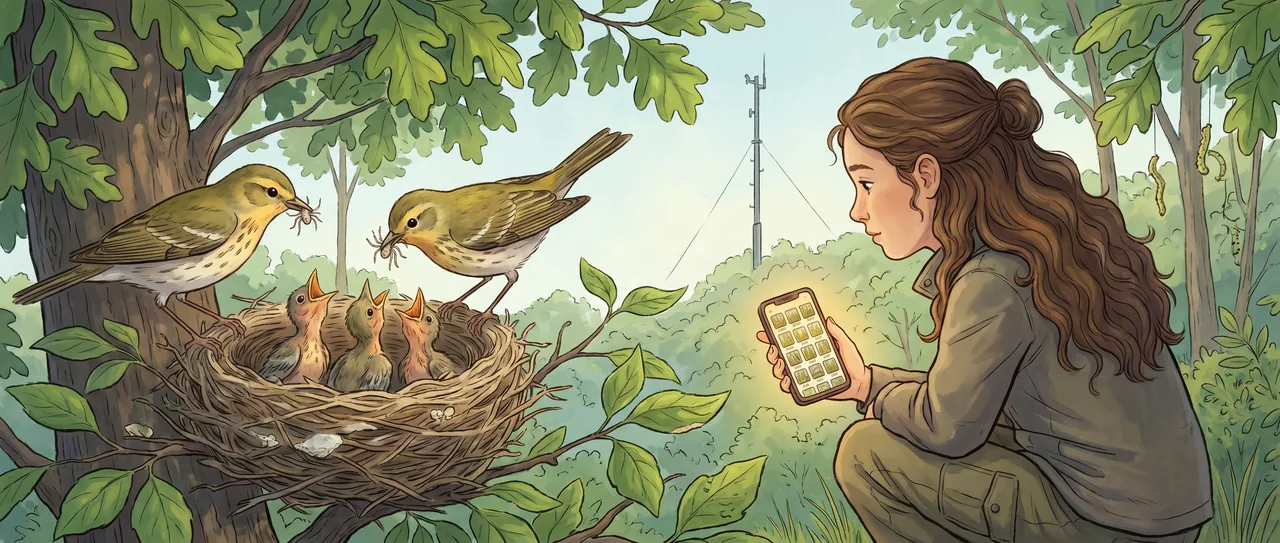
She stood up and walked to the next oak, and the next. At the fourth tree she found what she was looking for. A warbler nest, low in a dogwood, tucked in a fork she could just barely see into if she stood on the root and stretched. Four nestlings, mouths open. The female darting back and forth with food.
Maya watched for ten minutes. She counted trips. She counted what the mother carried. Small caterpillars, mostly, but not many. Beetles. A spider. The female was working hard, searching wide, bringing back whatever she could find.
Six trips in ten minutes.
Maya pulled up a study on her phone. Optimal provisioning rate for wood warbler nestlings during peak growth: twelve to fifteen trips per ten minutes. Almost all caterpillars.
Half. The mother was running at half.
Maya looked at the nest again. The nestlings were alive. They were hungry, but they were alive. This wasn't a catastrophe. It was a mismatch. A week where there should be abundance and instead there was just enough. A week where growing bodies got fed but maybe not quite enough to build the fat reserves they'd need for their own first migration south.
A week that used to not exist.
She thought about Dr. Vasquez saying four to six days per decade, and she thought about how that sounded small. Less than a week. Nothing. Except a week was everything if you were a nestling, if that week was the week between plenty and not-quite.
Maya opened the phenocam archive one more time. She lined up all twenty-three Aprils side by side in a grid on her screen. The green crept earlier and earlier, a slow wave moving left across the years, and she could see it now not as a picture of leaves but as a picture of time itself compressing, the spring folding in on itself, all the events that used to be synchronized now staggered, pulled apart, each species responding to a different cue and arriving at a different moment in a concert that used to play in unison.
And below it, a mother warbler landed on the edge of her nest with a single pale spider, and four nestlings lunged for it, and one of them got it, and the other three sat back with their mouths still open, waiting.
Read the interactive version, listen to the narration, and earn a gold star →
A science-verified short story for curious kids · Curiosity Land