The Hundred-Year Gift
The first thing Soren noticed was that the map was wrong.
Not wrong exactly. The bathymetric chart on the research vessel's monitor showed a flat stretch of abyssal plain at two thousand meters depth. Sediment. Nothing. But the sonar return was showing a bump, and clustered around that bump, a haze of biological signal that Dr. Reyes had scrolled right past.
"There," Soren said.
Dr. Reyes was already three screens ahead, tracking the tagged octopus that was the whole reason they'd been given time on the remotely operated vehicle. She was typing with one hand and eating cold rice with the other. "Hmm?"
"That return. There's something on the bottom."
"Probably a boulder. We'll note it." She kept typing.
Maya, sitting at the secondary monitor where the live camera feed played, leaned forward. The ROV's lights carved a pale cone through black water. Sediment drifted like slow snow, falling upward in the vehicle's wake. Then something entered the frame that was not sediment.
Bone.
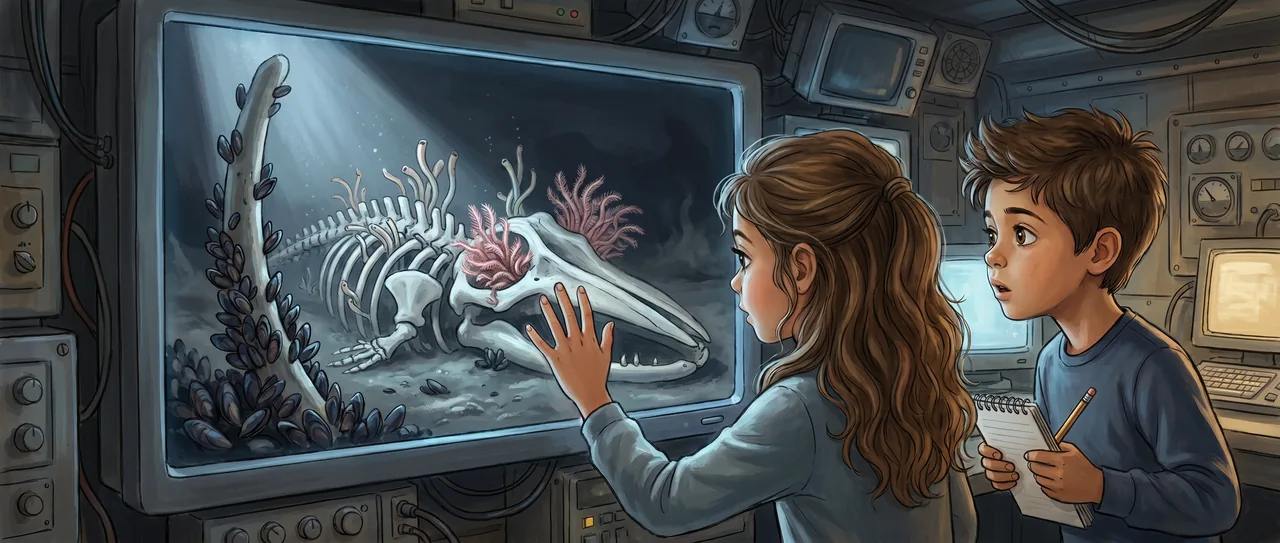
A curve of bone, massive and white, half-buried in gray mud. And growing from it, covering it, clinging to every surface: life. So much life that the bone was almost invisible beneath it.
"Soren," Maya said. "Come here."
He crossed the cramped lab in two steps. On screen, the ROV drifted over a landscape that should not have existed. The seafloor here was supposed to be a desert. Two thousand meters down, no sunlight, barely any food drifting from above. But spread across an area the size of a basketball court was a riot of creatures so dense it looked like a garden.
"Those are mussels," Soren said. Thousands of them, clustered in white and brown colonies along what he now recognized as a rib. A rib that was taller than he was.
"And those." Maya pointed to pale, feathery things swaying in the current. "Tube worms?"
Dr. Reyes finally looked over. Her chopsticks stopped halfway to her mouth.
"Oh," she said softly. "Oh, that's a whale fall."
She put her rice down. She did not pick it up again for a long time.
They learned the basics quickly. When a whale dies and sinks, its body becomes an island. Dr. Reyes explained the first stage in clipped, excited fragments while adjusting the ROV's heading: sleeper sharks, hagfish, crabs, all tearing at soft tissue, a feast that could last two years. But this whale fall was clearly past that. The flesh was gone. What remained was skeleton, and the skeleton was its own world.
"We're looking at stage two, maybe into stage three," Dr. Reyes said. "The enrichment opportunists have colonized the bones and sediment. Polychaete worms, crustaceans. They're feeding on the organic material that soaked into the mud around the carcass."
Maya watched the screen. Something was bothering her. "How old is this?"
"Could be a few years. Could be decades. Hard to say without sampling."
"But those." Maya tapped the glass gently, near a cluster of tube worms growing directly from a vertebra. "Those aren't eating scraps. They're not scavengers."
Dr. Reyes looked at her with sudden sharpness. "No. They're not."
"So what are they eating?"
Dr. Reyes smiled, but it was the smile of someone who wanted to see what would happen next. She said nothing.
Soren was writing in his notebook. He'd listed what he could identify: mussels, tube worms, snails he couldn't name, a white crab picking its way along a jawbone. The density was staggering. He started counting species and gave up at fourteen.
"Bones are full of lipids," he said, half to himself. "Fats. Oils. Whale bones especially."
Maya looked at him.
"Bacteria could break those down," he continued. "And if the bacteria are using sulfate from the seawater to do it, they'd produce hydrogen sulfide."
"Like at hydrothermal vents," Maya said.
Soren nodded slowly. "Chemosynthesis. The tube worms aren't eating the whale. They're living off the bacteria that are eating the whale. The bones are like a chemical engine."
On the screen, the ROV's lights swept across the skull. It was enormous and alien. Its eye socket was filled with a bouquet of something feathered and pink, waving gently, alive.
Maya said, very quietly, "How long does the engine run?"
Dr. Reyes answered this one. "Fifty years. Sometimes longer. There are whale falls that have sustained communities for close to a hundred years."
The lab went silent except for the hum of electronics and the faint groan of the ship.
A hundred years. Soren wrote the number and then stared at it. A whale alive for maybe sixty, seventy years. Then dead. Then feeding a world for another hundred. The death was longer than the life. And it was not empty. It was the opposite of empty.
Maya pressed her hand flat against the monitor, fingers spread over the image of the skull. Creatures she had no names for moved between her fingers.
"Some of these species," she said. "They only live on whale falls. Right? They can't survive anywhere else."
Dr. Reyes nodded.
"So they have to find the next one. In the dark. On the bottom of the ocean." Maya pulled her hand back and looked at the vast black water surrounding the ROV's small cone of light. "How far apart are whale falls?"
"We don't know exactly. Maybe five to sixteen kilometers in productive waters."
"So there are animals out there right now, crossing miles of empty seafloor in total darkness, looking for the next dead whale."
"Larvae, mostly. Drifting in currents. Yes."
Soren stopped writing. He was thinking about the spaces between. Miles of nothing, and then an island of bone and bacteria and warmth, holding out against the cold and the dark and the pressure for a century. And creatures so specialized, so perfectly adapted to this one improbable gift, that they staked their entire existence on finding it.
Maya turned back to the screen. The ROV was pulling away now, Dr. Reyes guiding it back toward the tagged octopus, back to the planned mission. The whale fall shrank in the frame. The mussels and the tube worms and the pink feathered things in the eye socket grew smaller and smaller until the whole hundred-year island was just a faint pale smudge, and then the dark water closed over it like a curtain.
But it was still there.
Soren looked at the sonar display, where the biological signal still pulsed, a quiet bright cluster surrounded by miles of empty plain, and he watched it glow.
Read the interactive version, listen to the narration, and earn a gold star →
A science-verified short story for curious kids · Curiosity Land