The Honest Clock
The marble missed the cup by four inches.
"That counted," Maya said.
"It didn't," Soren said. He wrote the number down. Trial forty-one. Miss.
They had been awake since six the previous morning, which made it twenty-two hours now, and the science fair was at nine, and the project was almost done. The project was about reaction time. They had built a simple rig: a ruler dropped between open fingers, and how many centimeters it fell before you caught it told you your reaction speed. They had tested every kid in sixth grade during lunch periods for two weeks. They had graphed it. They had color-coded it. It was good.
But at midnight Maya had said, "We should test ourselves every hour. Through the night. Add a sleep deprivation section."
Soren had agreed because it was a genuinely good idea.
Now Maya was also trying to bounce marbles into a paper cup, a game she had invented around two AM to stay awake, and she kept insisting the misses were hits.
"I'm fine," she said, for maybe the sixth time in an hour. She dropped the ruler between Soren's fingers. He caught it at twenty-eight centimeters.
At six PM yesterday, he had caught it at fourteen.
He looked at the column of numbers in his notebook. The decline was so clean it almost looked fake. Both of them had started the evening sharp. By midnight, they were a little slower. By two AM, noticeably slower. Now, at four AM, their reaction times had nearly doubled.
"Your turn," Soren said. He held the ruler above her open hand.
He dropped it. It clattered on the table.
"My fingers are cold," Maya said.
Soren wrote it down. "Maya. Look at the numbers."
"I'm looking."
"What do you see?"
She squinted at the notebook. "We're a little slower. It's four in the morning, that's normal."
"A little slower," he repeated. He pointed to the graph they had started sketching. "At six PM, you were catching the ruler at twelve centimeters. You were the fastest person we tested all week. Right now you're at twenty-nine. You just dropped it completely. And five minutes ago you told me you felt pretty sharp."
"I do feel pretty sharp."
Soren put the pen down. Something was bothering him, and it was not the tiredness, or not only the tiredness. It was the gap. The gap between what the numbers said and what Maya reported feeling. He flipped back through the hourly logs. Every hour, he had written down their reaction times and also asked Maya and himself the same question: On a scale of one to ten, how impaired do you feel?
At midnight, when their reaction times had already slowed by thirty percent, Maya had said three. Soren had said four.
At two AM, when they were performing like the slowest kids in the lunch-period tests, Maya had said four. Soren had said five.
Now, when their reaction times were worse than any sixth grader they had tested, Maya said three. Soren had just been about to say four, and he stopped himself, because the numbers said it should be nine or ten.
"Maya," he said. "I think the interesting part isn't the reaction time."
"What do you mean?"
"The interesting part is that we can't tell."
She bounced another marble. It hit the table leg. "Can't tell what?"
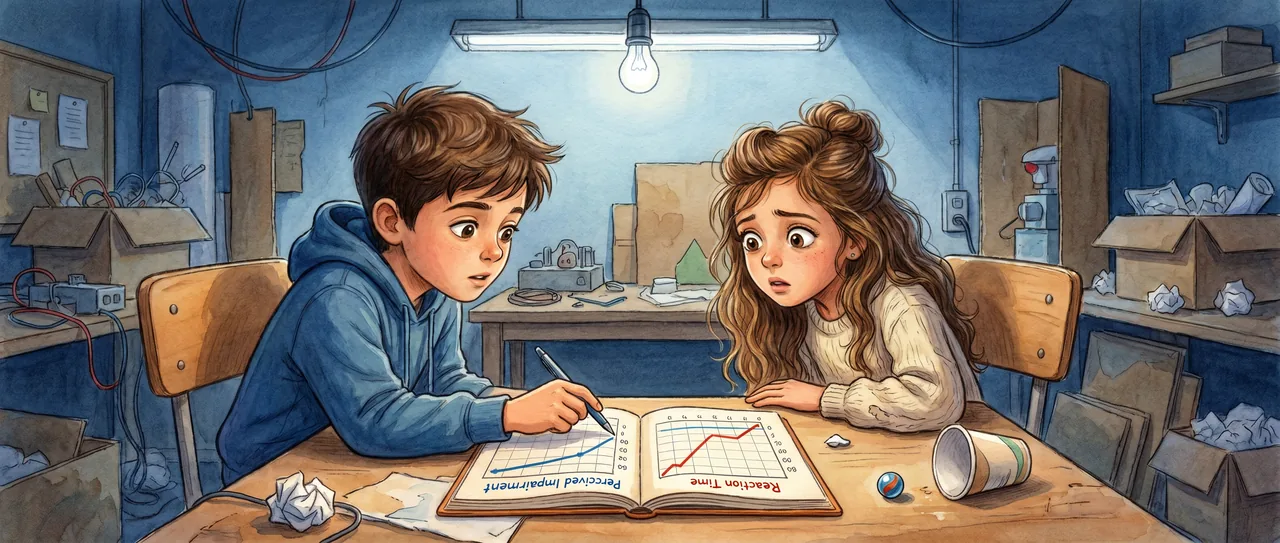
"How bad we are. Right now. Look." He turned the notebook toward her and pointed at two lines he had been tracking. One was their actual measured reaction time. The other was their self-reported impairment rating. The reaction time line climbed steeply upward. The self-report line was nearly flat.
"So we think we're fine," Maya said slowly.
"We think we're fine. We are not fine. I just watched you miss a cup that is eight inches wide from a distance of one foot."
"My fingers are," she started, and then stopped. She stared at the two lines on the graph. "Oh."
"Yeah."
"That's. That's actually scary."
"Seventeen hours of being awake," Soren said. He had read this once and not quite believed it. "Someone tested it. After seventeen to nineteen hours without sleep, your cognitive impairment is equivalent to having a blood alcohol level of point zero five. That's close to legally drunk."
"But a drunk person knows they're drunk," Maya said.
"That's exactly it. That's exactly the thing." Soren tapped the flat line of self-reported impairment. "A drunk person feels it. Their body tells them. Sleepiness doesn't work the same way. The part of your brain that would notice how impaired you are is itself impaired. So you feel fine. You feel basically normal. And you are not."
Maya sat very still for a moment. Then she picked up a marble and held it over the cup and dropped it straight down from three inches above the rim. It bounced out.
"I just want to point out," she said, "that I was trying to get that in the cup."
Soren started laughing. Maya started laughing. They laughed too long and too loud for a room at four in the morning, the kind of laughing that is itself evidence of the thing you are laughing about.
When they stopped, Maya pulled the notebook over and looked at the two diverging lines again. "This is the project," she said. "Not the reaction times. This. The gap. The thing your own brain hides from you."
"The self-assessment failure," Soren said.
"Every single person who drives home late at night," Maya said. "Every surgeon on a long shift. Every pilot. They all feel fine."
"They all feel fine," Soren repeated.
Maya picked up the pen. Under the graph she wrote, in large letters that wobbled only slightly: HOW IMPAIRED DO YOU FEEL RIGHT NOW? She drew ten boxes, a scale from one to ten. She was going to make this the centerpiece of their display. Soren could see it already. They would let every person who visited their board take the test. Reaction time first, then the question. Then they would show people their own gap.
"We should sleep," Soren said. "We have five hours."
"We should sleep," Maya agreed. "But I don't feel tired at all. I feel completely fine. Isn't that something."
She set the pen down, placed both palms flat on the table, and missed.
Read the interactive version, listen to the narration, and earn a gold star →
A science-verified short story for curious kids · Curiosity Land