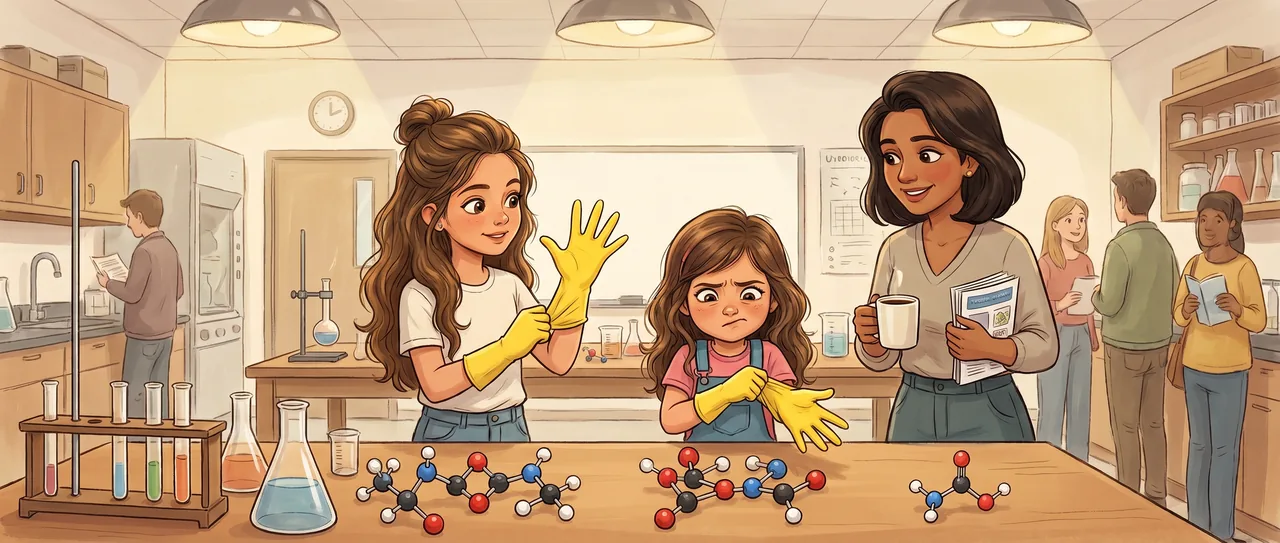
The Glove That Didn't Fit
Maya's aunt Priya was running late, which meant Maya was alone at the demonstration table with thirty plastic molecular models, a pair of rubber gloves, and a sign that read MIRROR MOLECULES: CAN YOU TELL THE DIFFERENCE?
The open house visitors wouldn't arrive for another twenty minutes. Maya picked up two of the models. They looked the same. Four colored balls arranged around a central black one, like tiny sculptures of atoms. She rotated one, then the other. Same colors. Same bonds. Same angles.
But they wouldn't stack.
She tried again, lining them up carefully, and no matter how she turned them, the two models refused to match. It was like trying to put a left shoe on a right foot. Close, but wrong in every orientation.
She held one in each hand and stared at them the way she stared at anything that bothered her, which was directly and for slightly too long.
They were reflections of each other.
She put them down and picked up the rubber gloves from the table. Left glove, right glove. She turned the left glove inside out. Now its thumb pointed the other way. She could force it onto her right hand, but the seams pressed against her fingers wrong. It was a glove. It fit a hand. But it was not a right glove no matter what she did to it.
Maya looked at the molecular models again.
"Okay," she said to nobody.
She began sorting all thirty models into two piles, lefts and rights, working quickly. Some were easy. Some she had to hold up to their partners and rotate through every position before she was sure. When Priya arrived, breathless, holding coffees, Maya had twenty eight sorted and was frowning at the last two.
"These aren't mirrors of each other," Maya said. "These are actually the same."
Priya set the coffees down and looked. "Yeah, those are glycine. The one amino acid that isn't chiral. No mirror version. Good catch."
"Why not?"
"Because all four groups around the central carbon aren't different. Two of them are just hydrogen. So the mirror image is the same molecule. You can rotate it to match."
Maya rotated it. It matched. She put glycine aside with a tiny nod, like closing a tab in her mind.
"The sign says these mirror molecules do different things," Maya said. "Different how?"
Priya sipped her coffee. "You know spearmint and caraway? Spearmint in gum, caraway in rye bread?"
"They don't taste anything alike."
"Same molecule. Mirror versions. One is left handed, one is right handed. Your tongue has receptors shaped to fit one way, and the other way fits differently. Like your glove trick there."
Maya looked down at the inside out left glove still crumpled on the table. "So the receptor is like a hand, and the molecule is like a glove, and the left glove doesn't fit the right hand."
"Close enough for the demo," Priya said, and started arranging pamphlets.
But Maya wasn't done. She was quiet for a while, moving models around, fitting them against each other. Then she said, "What about medicines?"
Priya's hands stopped moving.
"If a drug molecule is handed," Maya said, "and the receptor it's trying to fit is handed, then the mirror version of the drug would fit wrong. It would do something different."
She wasn't asking.
"Yes," Priya said. Her voice had changed, gotten careful the way adults' voices get when they're deciding how much to say. "There was a drug called thalidomide. One mirror version treated nausea in pregnant women. The other mirror version caused terrible harm to developing babies. And when they manufactured it, they got both versions mixed together. They didn't know, at first, that it mattered."
"But it mattered," Maya said.
"It mattered enormously."
Maya picked up two of the sorted models, one from each pile. Held them side by side. Identical atoms, identical bonds, identical in every way except the one way that couldn't be fixed by turning or flipping. Left and right. The difference that no rotation could undo.
"Is that why it's hard to make medicines?" Maya asked. "Because you have to get the right hand?"
Priya sat down on the stool next to her. "It's one of the big reasons. For a long time, chemists couldn't easily make just one mirror version. They'd synthesize a drug and get a fifty fifty mix of left and right. Separating them was incredibly difficult. Some of the most important work in modern chemistry has been figuring out how to build just the version you want."
"Who figured it out?"
"Several people. There's a whole Nobel Prize about it. Asymmetric catalysis. Using special helper molecules that act like a left handed mold, so only the left handed product forms."
"A mold," Maya said. She pulled the right rubber glove onto her right hand and flexed her fingers. "Like if I dipped this glove in plaster. I'd get a shape that only a right hand could fit into."
"That's actually a very good way to think about it."
The first visitors were coming through the door now, a father and two younger kids. Priya stood up and put on her welcome face. Maya started to step back from the table, but then she didn't.
"Can I run the demo?" she asked.
Priya hesitated. Maya could see her aunt calculating whether an eleven year old should be the face of the chemistry department's open house. Then Priya looked at the models, already perfectly sorted into two groups with glycine set aside in its own category, and she handed Maya the stack of pamphlets.
The younger of the two kids, a girl maybe seven, walked up and pointed at the models. "What are those?"
Maya held up a left and a right. "These are the same molecule," she said. "Except they're not. Try to make them match."
The girl took both models and began rotating them, her face scrunching up the way faces do when something is wrong but you can't name it yet.
"They won't go," the girl said.
Maya pulled a glove onto her left hand and held it up, fingers spread.
"Try putting this on your right hand," she said.
The girl tugged at the left glove, laughing as the thumb bent the wrong way.
"Now imagine," Maya said, "that your body is full of right hands. And a molecule shows up shaped like a left glove."
The girl stopped laughing and looked at the two models she was holding, one in each palm, and her eyes went wide the way eyes go wide when the world has just gotten bigger than it was a second ago.
Maya watched it happen.
Read the interactive version, listen to the narration, and earn a gold star →
A science-verified short story for curious kids · Curiosity Land