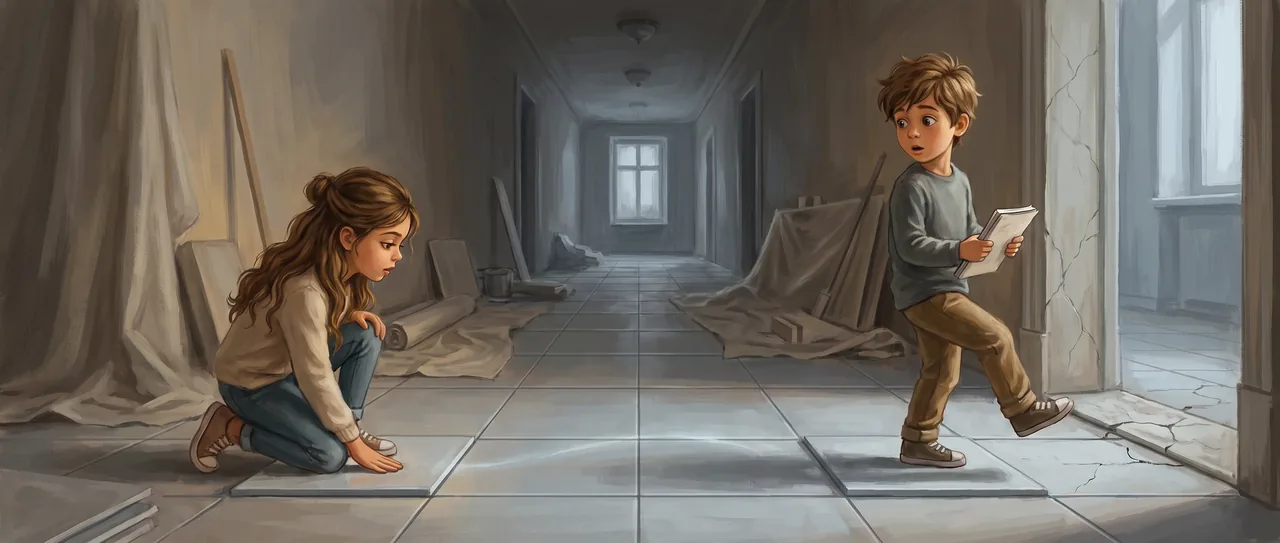
The Floor That Listened
The floor was wrong.
Maya knew it the second she stepped into the corridor. The museum had closed this wing for renovation, but her mom was on the electrical crew and had left them in the hallway with sandwiches and instructions not to touch the wiring. So of course Maya was standing on the new floor, and it was wrong.
Not broken wrong. Not ugly wrong. Wrong like a note played slightly flat.
"Walk on this," she said.
Soren stepped off the old marble threshold onto the new surface. It looked like ordinary tile, pale gray with faint gridlines. He walked three steps, stopped, and walked back.
"It pushes," he said.
"It pushes back," Maya corrected.
He crouched down and pressed his palm flat against a tile. When he lifted his hand, he felt something. Not vibration exactly. More like the floor had an opinion about being touched. "There's a little click. Like static but physical."
"These are the piezoelectric tiles," Maya said. "The ones from the newsletter. They're supposed to power the lights in this hallway from people walking on them."
Soren pressed the tile again, slower this time. He watched the nearest overhead fixture. Nothing. The hallway lights were off and stayed off. "Your mom's crew hasn't connected them yet?"
"She said they're connected. She said they don't work. The charge is too small or something goes wrong between the floor and the lights. That's why they called in more electricians."
Soren sat down cross-legged on the tile and pulled out his notebook. "Okay. So piezoelectric means pressure-electric. Quartz does it. When you squeeze certain crystals, the structure shifts and pushes charges to opposite faces. You get a tiny voltage."
"Like a gas lighter," Maya said. She was already walking the length of the corridor, stepping hard, then soft, then hard. Watching the ceiling.
"Exactly like a gas lighter. You press the button, a spring hits a piezoelectric crystal, and the voltage is enough to make a spark." He wrote SPARK, then underlined it. "But that's a sudden hit. Walking is different. Walking is slower pressure, spread across a bigger area."
"Soren. Come here."
He stood up and found her at the far end of the hallway, where the new tiles met the old marble again. She was rocking back and forth on one foot, right on the seam between old floor and new floor.
"Listen," she said.
He listened. When her weight shifted onto the new tile, there was a faint, high sound. Not a creak. Not a click. A tiny crystalline whine, almost too high to hear.
"The tile is making noise," he said.
"The tile is vibrating."
They stared at each other.
"That's the other direction," Soren said slowly. "Piezoelectric works both ways. Squeeze the crystal, get electricity. But also, run electricity through the crystal, and it changes shape. It physically moves. That's how ultrasound machines work. They send electricity into a piezoelectric element and it vibrates millions of times a second, pushing sound waves into your body."
"So if the tile is vibrating," Maya said, "something is sending electricity into it."
"But the lights aren't on. The circuit isn't completed. Where would the electricity come from?"
Maya dropped to her knees and pressed her ear against the tile. "Walk," she said.
Soren walked. Heavy steps, heel to toe, the way his dad walked when he was thinking.
Maya held up her hand for him to stop. "When you step on the tile at this end, the tile under my ear buzzes. Not the one you're stepping on. This one."
"They're connected underneath," Soren said. "There must be wiring between the tiles. So when you compress one tile and it generates a charge, that charge flows through the wire to another tile, and that tile deforms. It vibrates."
"It's feeding itself," Maya said, standing up. "One tile's electricity is going into the next tile and making it flex, and that flex generates more electricity, and that goes into the next one."
Soren wrote fast, then stopped. "But that can't keep going forever. Each conversion loses energy. It should die out in a couple of tiles."
"Which is why the lights don't turn on. The floor is eating its own electricity."
They stood in the middle of the wrong floor, thinking.
"The wiring between the tiles," Soren said. "It's supposed to collect the charge and send it up to the lights. But instead it's sending charge sideways, tile to tile. The tiles are talking to each other instead of to the ceiling."
"So the fix isn't about getting more power from each step," Maya said. "It's about where the charge goes after."
"Diodes," Soren said. "One-way gates for electricity. If you put diodes in the connections between tiles, the charge can only flow up toward the lights. It can't flow sideways into the next tile."
"That's why your mom's crew can't figure it out," he added. "They're looking for a power problem. Not enough charge, not enough steps. But the power is there. It's just going in circles."
Maya was already pulling out her phone, texting her mom. She typed fast with both thumbs, then put the phone away and stepped back onto the floor.
"But here's the thing," she said quietly.
Soren waited.
"The floor that talks to itself is more interesting than the floor that powers lights."
He looked at her.
"I mean it. Press one tile and another tile moves. That's not a power source. That's a signal. You could send information through a floor. You could make a surface that responds to where you step. A floor that knows where you are in a room. A floor that shapes itself under your feet."
Soren opened his notebook to a fresh page and did not write anything yet. He was thinking about quartz watches, where a tiny piezoelectric crystal vibrates thirty-two thousand seven hundred sixty-eight times per second to keep time. He was thinking about how the same crystal that tells you what time it is could also sense your footsteps and talk to the crystal next to it and make a floor that was alive with tiny conversations.
His phone buzzed. Maya's mom: "Diodes. Tell Maya she might be right. Also don't touch the wiring."
Maya was pacing the corridor again, but slowly now. Each step deliberate. Listening to the tiles answer each other down the line, a chain of whispers running through crystal after crystal under her feet.
"If every floor in this museum worked like this," she said. "If every sidewalk did."
She stopped at the far end and pressed down with one foot, hard, and Soren, twenty meters away, felt the tile beneath him hum.
Read the interactive version, listen to the narration, and earn a gold star →
A science-verified short story for curious kids · Curiosity Land