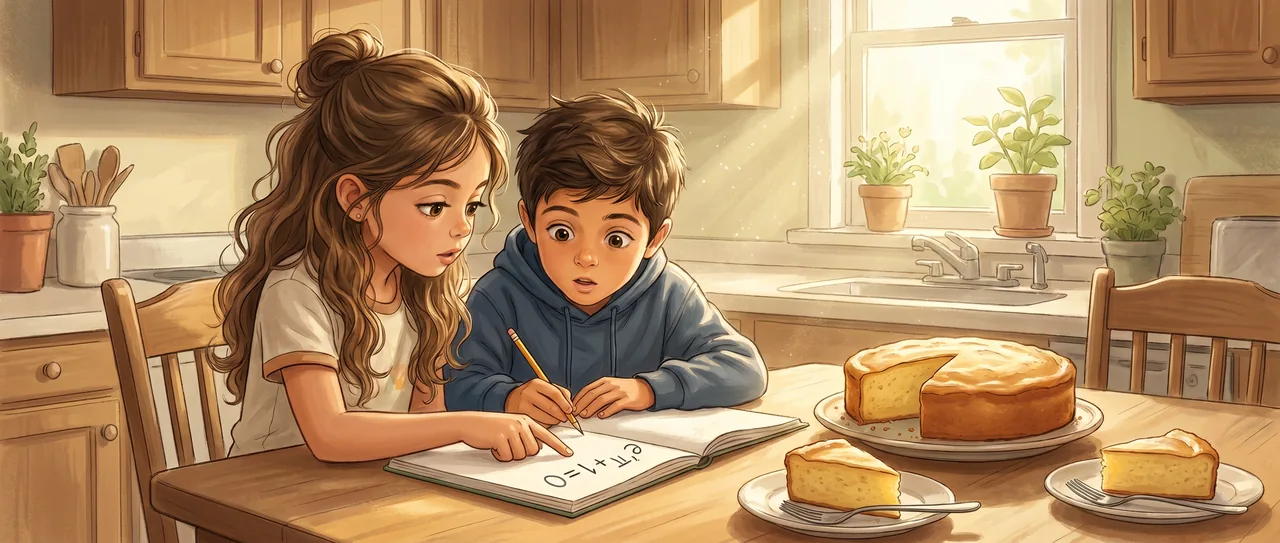
The Five Friends
The cake was wrong.
Not wrong the way cakes are usually wrong. Not lopsided or burnt or sunken in the middle. Maya pulled it from the oven and it was perfect, golden, exactly the right height. She set it on the counter and stared at it.
"It smells incredible," Soren said from the kitchen table, where he had his notebook open to a page of math homework. "Why do you look like that?"
"I doubled the recipe," Maya said. "But I only used one egg."
Soren put down his pencil. "You used half the eggs you needed."
"And it's perfect. That's the problem."
Soren came over and looked at it. He poked it gently. It sprang back. "Maybe eggs don't matter as much as people think."
"Eggs hold cakes together," Maya said. "Eggs are the whole point. This should be a disaster."
She cut two slices. They ate in silence. It was, genuinely, one of the best cakes Maya had ever made.
"I hate this," she said happily.
Soren laughed. He pushed his homework across the table. "Since you like things that don't make sense. Look at this."
Maya looked. At the top of the page, their teacher had written a bonus problem. Not really a problem. Just an equation, with the instruction: Research this. Tell me what you find.
e to the power of i times pi, plus one, equals zero.
"So?" Maya said.
"So I've been staring at it for two days," Soren said. "I looked up every part. And the more I look at it the less I understand why it works."
Maya sat down. "Walk me through it."
"Okay. You know pi."
"Three point one four forever. Circles."
"Right. And e is another number like that. Two point seven one eight forever. It shows up in growth. Like if something is growing continuously, e is always there. Population, compound interest, radioactive decay."
"So one number is about circles and one number is about growing."
"And i is the square root of negative one," Soren said. "Which doesn't exist."
"What do you mean it doesn't exist?"
"There's no real number that gives you negative one when you multiply it by itself. So mathematicians just said, okay, we'll imagine one. They called it i. Imaginary."
Maya pulled the paper closer. "So we've got a circle number, a growth number, and an imaginary number. And then just one and zero."
"One. The thing that doesn't change anything when you multiply. Zero. The thing that doesn't change anything when you add. And somehow, when you put all five of them together in this exact way, they balance perfectly."
"Why?"
"That's what I've been trying to figure out," Soren said. He flipped back three pages in his notebook. Maya saw diagrams, crossed out sentences, a small circle with arrows on it. "I found out that e to the power of i times some angle is a way of moving around a circle. Like, in the complex plane, which is this place where imaginary numbers live, raising e to an imaginary power makes you rotate."
"Growth makes you rotate?"
Soren nodded. "If the growth is imaginary. If you grow in an imaginary direction, you don't get bigger. You turn."
Maya sat very still.
"And if you turn by exactly pi," Soren continued, "you've gone halfway around the circle. You end up at negative one."
"So e to the i pi equals negative one."
"And negative one plus one equals zero."
They both looked at the equation.
"But that's five completely different ideas," Maya said. "Pi comes from geometry. From measuring circles thousands of years ago. And e comes from calculating interest, or tracking how things grow and shrink. And i is something mathematicians invented because they needed it, even though it's not real. And one and zero are so basic that babies understand them. These five things have nothing to do with each other."
"Except they do," Soren said.
Maya picked up his pencil and pointed at each symbol in turn. "It's like they were always connected. Before anyone discovered any of them. Before anyone even had the idea of a circle or the idea of growth or the idea of imaginary. The connection was already there, waiting."
Soren took a slow breath. "I keep thinking about it like this. Imagine five people who live in different countries. They speak different languages. They've never met. They have completely different jobs. And one day someone puts them in a room together and they finish each other's sentences."
"Because they were always part of the same conversation," Maya said. "They just didn't know it."
The kitchen was very quiet. Somewhere outside, a neighbor was mowing a lawn.
"That's why mathematicians call it beautiful," Soren said.
Maya looked at the cake. Perfect, with half the eggs it needed.
"You know what gets me?" she said. "Nobody designed this equation. Euler found it. It was already true. It was true before humans existed. It was true before the Earth existed. It was true before there was anything to count or any circles to measure."
"Before there was even a zero of anything," Soren said.
"So what else is connected?" Maya asked. "What other things look completely separate but are actually part of the same thing, and we just haven't found the equation yet?"
Soren opened his notebook to a blank page and did not write anything.
"Because here's the thing," Maya said, talking faster now. "This equation means mathematics isn't just rules people invented. It's structure. It's already out there. And we've only found this much of it." She held her thumb and finger a centimeter apart.
"If that," Soren said.
Maya looked at the five symbols on the homework page. Growth, rotation, impossibility, everything, and nothing, holding hands in a single line.
She pushed the cake toward Soren. "Have another slice."
He picked up his pencil and held it over the blank page, and then set it down again, because some things need to just sit in your chest for a while before you have any idea what to write.
Outside, the lawn mower stopped, and in the sudden quiet they could hear a cardinal singing two notes over and over, the interval between them exactly the same every time.
Read the interactive version, listen to the narration, and earn a gold star →
A science-verified short story for curious kids · Curiosity Land