The Fifth Postulate
Soren had been staring at problem fourteen for twenty minutes, and he was almost certain the textbook was lying to him.
The problem said: Prove that two parallel lines will never meet.
He had written the first line of the proof three times. Each time he crossed it out, not because it was wrong, but because something about it felt like cheating. The textbook wanted him to start with Euclid's fifth postulate, the parallel postulate, and use it to prove that parallel lines never meet. But the parallel postulate basically said that parallel lines never meet. You were using the answer to prove the answer.
He wrote in his notebook: This isn't a proof. This is a circle.
The library's second floor was almost empty. An old man in a fishing hat was asleep in the periodicals section. A librarian was reshelfing books with the intense focus of someone trying to finish before her shift ended. She had already walked past Soren's table twice without looking at him.
Soren flipped to the back of the textbook. No help. He flipped to the glossary. Postulate: a statement accepted as true without proof.
Without proof.
He underlined it. Then he stared at what he had underlined.
If the parallel postulate was accepted without proof, that meant no one had ever proved it. And if no one had proved it, then maybe it wasn't the only option. Maybe you could accept something else instead.
He turned to a blank page. At the top he wrote: What if parallel lines could meet?
He didn't know if this was a stupid question. It felt like a stupid question. Two lines going the same direction, same distance apart forever, suddenly touching. That was like saying two plus two could equal five. But the textbook had just told him, right there in the glossary, that nobody had ever proved it couldn't happen. They just agreed to believe it.
Soren drew two straight lines on the page, perfectly parallel. They didn't meet. Obviously. But the page was flat.
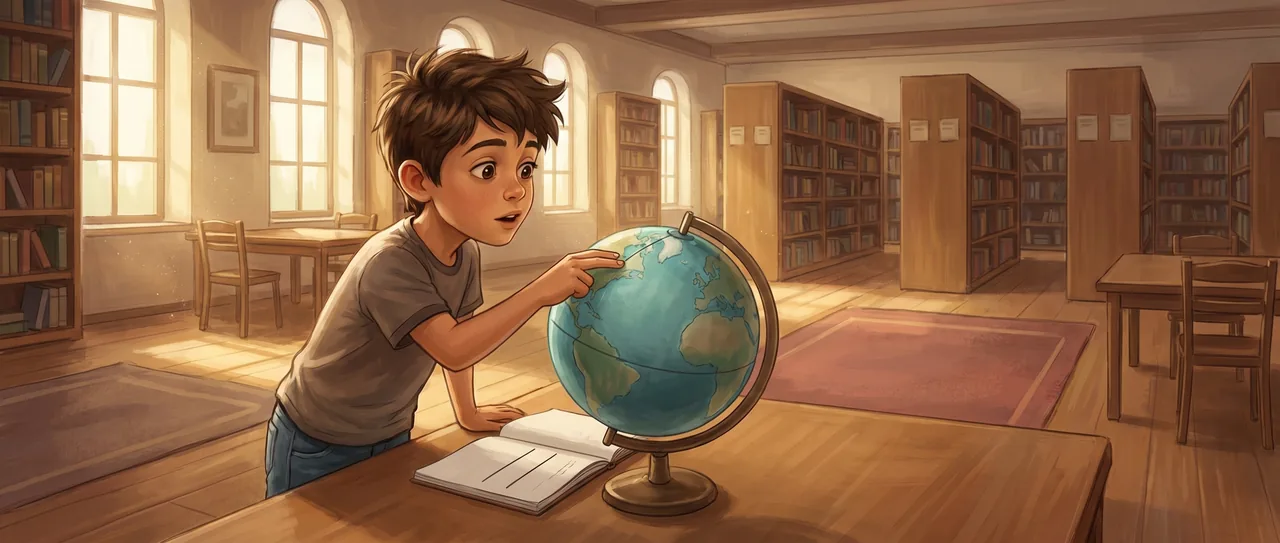
He looked at the globe on the reference shelf across the room. He had seen globes a thousand times. But he was looking at it differently now, and he got up and brought it back to his table.
He put his finger on the equator and traced a line straight up to the North Pole. Then he put his finger back on the equator, a few inches to the right, and traced another line straight up.
Both lines left the equator at exactly ninety degrees. That meant at the equator they were parallel. Perfectly, completely parallel. Pointing the same direction. Same distance apart.
His fingers met at the North Pole.
Soren sat back. He looked at the page with his two flat parallel lines. He looked at the globe where his two parallel lines had just touched. Both were real. Both were geometry. The difference was the surface.
On a flat surface, parallel lines never met. On a curved surface, they could.
He picked up his pencil and wrote, very carefully: The parallel postulate is only true on flat surfaces.
Then, underneath: Is anything actually flat?
The librarian passed his table again. This time she glanced at the globe and the open textbook and his notebook, and she paused.
"Globe project?" she asked.
"No," Soren said. "I'm trying to figure out if parallel lines can meet."
She looked at him for a second too long, the way people did when they were deciding whether he was serious. "They can't," she said. "That's the definition."
"It's not a definition," Soren said. "It's a postulate. Nobody ever proved it."
The librarian opened her mouth, then closed it. Then she said, "Reference section, row seven. There should be a book on the history of mathematics. Big red one. If they haven't moved it."
She walked away. Soren found the book in row eight, not row seven. It was heavy and smelled like dust and someone else's coffee.
He didn't read it front to back. He went to the index and looked up parallel postulate. The book sent him to page three hundred and twelve.
For two thousand years, the page said, mathematicians tried to prove Euclid's fifth postulate from the other four. Every single one of them failed. Some spent their entire careers on it. Then, in the early eighteen hundreds, three mathematicians in three different countries asked the same question Soren had just written in his notebook: what if you didn't have to accept it at all?
Lobachevsky in Russia. Bolyai in Hungary. Gauss in Germany, who figured it out first but was afraid to publish because he thought people would think he was crazy.
They built entire geometries where parallel lines could diverge, spreading apart forever. Riemann built one where parallel lines always met, like on the globe, like Soren's fingers meeting at the pole. And these weren't just games. They were consistent. They worked. They were as logically sound as Euclid. They just described different surfaces.
Soren read the next part twice.
Seventy years after Riemann, Einstein used non-Euclidean geometry to describe gravity. Not as a force pulling objects together, but as curves in the shape of space itself. Mass bends the geometry of the universe. A straight line near a star is not the same as a straight line in empty space, because the surface those lines exist on is not flat. It is curved by everything in it.
The geometry of the actual universe is not Euclidean.
Soren put his hands flat on the table. The table felt flat. The floor felt flat. But the book was telling him that the space the table sat in, the space his hands moved through, was curved. Bent by the Earth beneath him. Bent by the sun beyond that. Bent by everything.
An annoying proof that felt circular. And it was the same question that had haunted mathematicians for two thousand years. The same one that three people on three different parts of the planet answered at the same time. The same one that turned out to describe the shape of the universe.
He looked at problem fourteen again. Prove that two parallel lines will never meet.
He picked up his pencil.
He wrote: This proof only works if space is flat. Space is not flat. The answer depends on where you are.
He knew it wouldn't get full marks. He wrote it anyway.
Then he turned to a fresh page, pressed the globe's cool surface with his thumb, and began drawing every kind of line he could imagine on a surface that curved.
Read the interactive version, listen to the narration, and earn a gold star →
A science-verified short story for curious kids · Curiosity Land