The Dry Quarter
The quarter should not have been silver.
It was underwater, sitting on the bottom of the deep end, and it was silver. Not the dull pewter of a coin that had been submerged for three minutes. Silver like it had just fallen out of someone's pocket. Silver like the water wasn't there.
Maya pulled it out and it was dry.
She held it between two fingers and turned it in the September light, and her thumb left a wet smear across George Washington's face. The rest of the coin was completely, impossibly dry.
"Soren," she said.
He was already walking over from the poolside table where he'd been organizing supplies. Soren's cousin Dev had left them with a box of materials and a three-page instruction sheet and a speech about responsibility, then gone inside to finish his slides for the university showcase tomorrow. The instruction sheet said SUPERHYDROPHOBIC COATING TEST, PHASE ONE in Dev's blocky handwriting.
"Feel this," Maya said.
Soren took the quarter. Rubbed it. Looked at it. Looked at the pool.
"I coated it twenty minutes ago," Maya said. "I dropped it in as a test. Three minutes underwater and it's dry."
"It can't be dry. It was underwater."
"And yet."
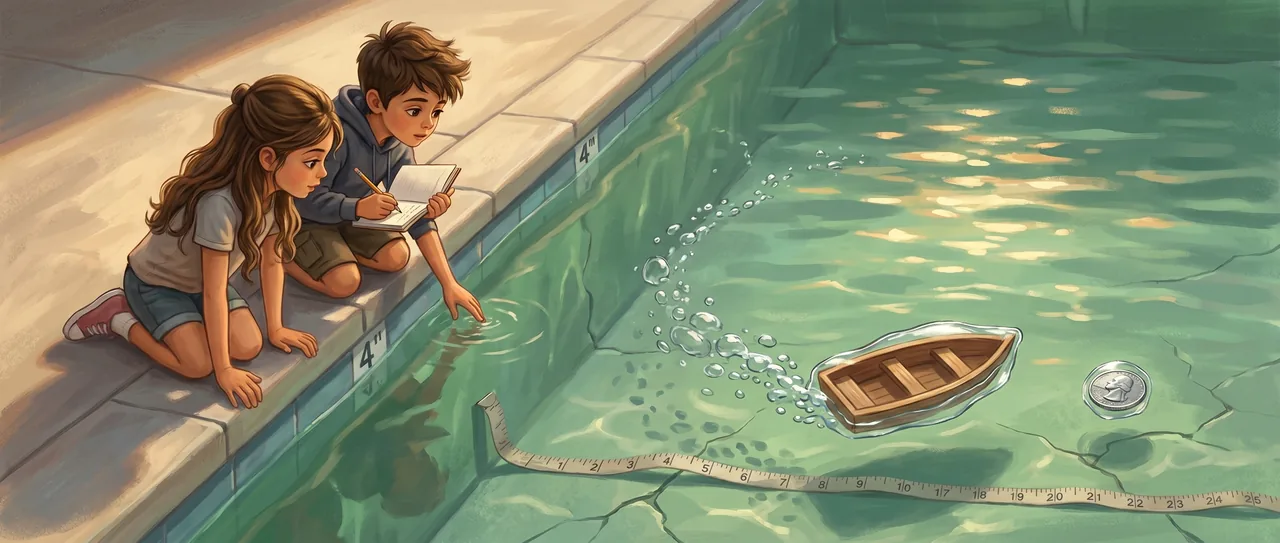
Soren walked to the edge and crouched. The pool had been drained to four feet for the renovation, and the water was still and greenish in the afternoon light. He held the quarter between his thumb and forefinger, then slowly pushed his hand in.
The quarter went under. Soren stared. He pulled it out.
"It's dry," he said. His voice was flat, the way it got when he was running something through his head twice.
Maya pointed to the instruction sheet. "Dev's notes say the coating creates a texture so rough at the nanoscale that air gets trapped in the tiny spaces. The water can't push the air out. So it never actually touches the surface."
"The water never touches it," Soren repeated. He was looking at the coin like it had done something personally offensive.
He submerged it again, holding it at an angle where the light hit right. And then they both saw it.
The quarter, underwater, was wrapped in a thin skin of silver light. A mirror sheen. The air layer. It looked like the coin was wearing its own tiny atmosphere.
"That's the air," Maya said. "It's still there. The water is sitting on top of the air and never reaching the metal."
Soren pulled it out. Dry. He put it in again. That impossible silver glow.
"So the water thinks the coin isn't there," he said.
"The water doesn't think anything. The water just can't get a grip."
Soren set the quarter on the concrete and opened his notebook. He drew the quarter, the water, and tiny arrows showing where the air sat. Then he stopped drawing and looked at the box of supplies Dev had left.
There were six more quarters. A piece of aluminum sheeting. A small wooden boat hull, the kind you'd buy from a hobby shop. And four bottles of the coating solution.
"Dev's presentation is about drag reduction," Soren said. "Ship hulls. If the hull never actually contacts the water..."
"Then there's less friction. The ship moves faster on less fuel."
They looked at each other and then at the little wooden hull.
Dev's instruction sheet said, in step seven: COAT THE HULL. LET DRY FOR THIRTY MINUTES. COMPARE GLIDE DISTANCE TO UNCOATED HULL. But it didn't say how to compare. And Dev was inside, probably forgetting they existed.
Maya picked up the uncoated hull and set it in the water at one end of the pool. She gave it a push. It glided about six feet and stopped, rocking.
"We need to measure that," Soren said.
He found a tape measure in Dev's box, and they marked the distance. Six feet, two inches.
Maya was already coating the second hull, brushing the solution on the way Dev's sheet described, in thin, even layers. They waited.
Soren spent the time submerging different objects. He coated a penny. A bottle cap. A scrap of the aluminum sheeting. Each one, underwater, developed that silver shell of trapped air. Each one came out dry.
"The aluminum is weird," he said. "Watch."
He tilted the coated aluminum sheet into the water, and a stream of bubbles raced off its surface. Tiny, frantic bubbles. He pulled it out. Dry.
"The air layer is so slippery that when you push it in at an angle, the water just slides off and takes the bubbles with it," Maya said. "It's like the material is allergic to water."
"It's not allergic. It just holds on to air harder than water can push."
"Same thing."
"Completely different thing."
The hull was dry. Maya set it in the water at the same starting point and gave it the same push. They had argued for five minutes about how to standardize the push and settled on Maya's flat palm, same height, same motion.
The coated hull shot forward. It passed the six-foot mark. It passed the eight-foot mark. It was still going at ten feet, barely slowing, and it finally drifted to a stop at thirteen feet, one inch.
Soren measured it twice.
"More than double," he said.
"Same push," Maya said.
They both looked at the little hull floating there. Underwater, its bottom shimmered with that silver air layer. It was sitting in the water but not quite of the water. Sailing on a skin of air so thin you could barely see it, but so complete that the water could not close the gap.
Soren picked up the hull and turned it over. Dry.
"Dev's going to present this tomorrow like it's about saving fuel for cargo ships," Maya said.
"It is about that."
"It's about more than that. If you can make a surface the water can't grab, you can make a surface nothing can grab. No ice. No rust. No bacteria."
Soren was quiet for a moment. Then he coated another quarter and held it under. That silver glow appeared, the coin's own captive sky.
"Every ship in the world," he said, "dragging an atmosphere along its belly."
Maya leaned over the pool's edge and pushed the little hull again, and it sailed the length of the remaining water on a cushion of air so thin it was almost nothing, almost nothing, and completely enough.
Read the interactive version, listen to the narration, and earn a gold star →
A science-verified short story for curious kids · Curiosity Land