The Color That Came Back Wrong
Maya's aunt had been wrong about the reef, and she knew it. That was the part that mattered.
They were three days into the visit when Aunt Risa came back from her morning dive looking like someone had told her a joke in a language she almost understood. She pulled off her mask and sat on the dock and said, to no one in particular, "The Table is white."
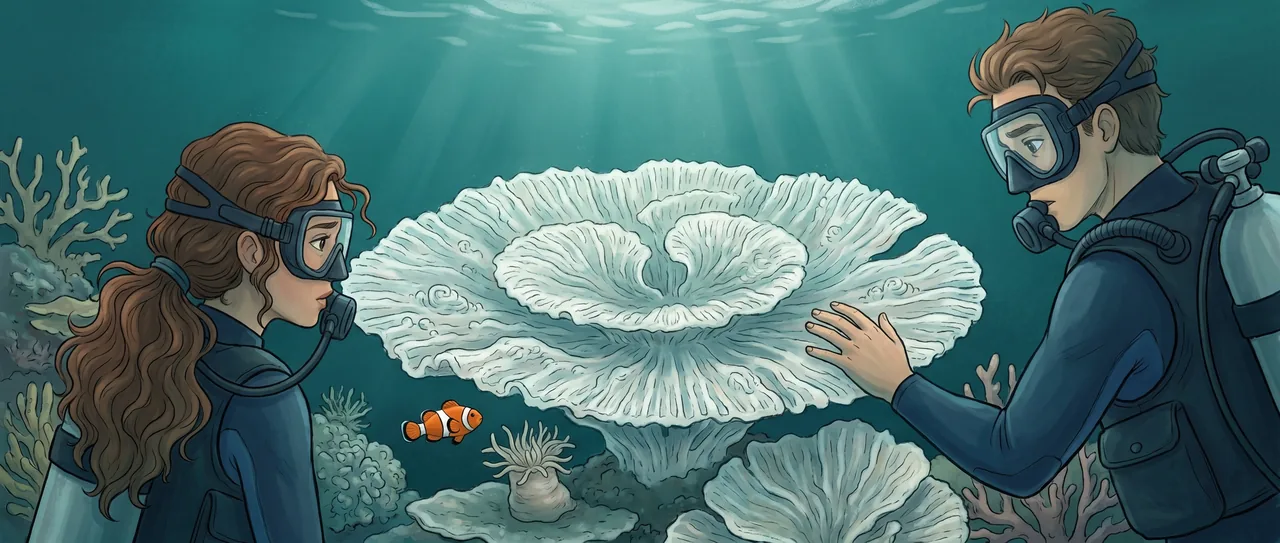
The Table was what the research team called a massive plate coral the size of a dining table, seventy meters offshore, twelve meters down. Aunt Risa had been monitoring it for four years. She had papers published about it. She had named the individual clownfish that lived in the anemone beside it.
"White as bone," she said. She was already pulling up temperature logs on her laptop. "This shouldn't be happening yet. My models said we had until March."
Soren, sitting on the dock with his notebook, said, "How hot does it have to get?"
"One degree Celsius above the summer maximum. Sustained. That's all it takes. One degree for a few weeks and the coral gets stressed enough to kick out its own algae." Aunt Risa was scrolling fast. "The zooxanthellae. Tiny algae that live inside the coral tissue. They do the photosynthesis, they make the food, they give the coral its color. And when the water stays too warm, the coral expels them."
"Why would it get rid of its own food source?" Maya asked.
"Because the algae start producing toxins under heat stress. The coral is trying to survive by ejecting what's hurting it. But without the algae, it's also ejecting what feeds it. It's got weeks. If the temperature drops, new algae can recolonize. If it doesn't drop." She didn't finish.
Maya looked at Soren. Soren wrote something down.
That afternoon, Aunt Risa let them snorkel the shallow reef while she dove deeper with her team. The shallow corals were still colored. Purples and tans and a green so bright it looked artificial. Fish everywhere. Maya floated face down and watched a parrotfish bite a chunk of coral and chew it, a tiny cloud of white sand drifting from its gills.
Soren surfaced and spat out his snorkel. "Some of these are pale."
Maya looked where he pointed. He was right. Not white. Not dead. But lighter than the corals around them, like someone had started erasing them.
"She said the shallow ones were fine," Maya said.
"She said that yesterday."
They mapped it. Soren's idea. He drew a grid of the snorkeling area in his notebook and Maya swam each section, calling out which corals looked pale. By the time Aunt Risa's team came back, Soren had a page of X marks and O marks and a pattern neither of them expected.
The pale corals weren't random. They clustered on the north side of every coral head.
"That doesn't make sense," Maya said. "If it's temperature, it should be even."
Soren stared at his grid. "Unless it's not even."
They showed Aunt Risa. She looked at the grid for a long time, and then she said, "Interesting," the way adults say interesting when they're actually thinking about something else. She went back to her temperature data.
Maya stood at the railing of the research station that night and felt annoyed in the specific way she felt annoyed when someone older looked at evidence and saw their own problem instead of the actual one.
"She's focused on The Table," Soren said, beside her. "It's her study organism."
"But the shallow ones are starting too. And they're starting on one side."
"Current," Soren said. Then he stopped. "No. Wait. Current would move. It wouldn't always be the north side."
Maya said nothing for a while. Then: "What's north of the reef?"
They checked the station's charts. North of the reef was the shallow lagoon. And the shallow lagoon had been sitting in direct sun all summer, barely circulating, heating up like a bathtub.
Warm water. Flowing south over the reef. Hitting the north face of every coral head first.
"It's not one degree everywhere," Maya said slowly. "It's one degree on the north side. The lagoon water is pushing it just past the threshold. Just on that side. Just enough."
Soren was already writing. "If that's right, then the corals on the south side are still below the threshold. They still have their algae. They still have time."
"And if the lagoon cools even a little."
"Then the north sides might get recolonized too. If it's fast enough."
They told Aunt Risa the next morning. She listened differently this time. She pulled up her current flow data and overlaid it on Soren's grid and went quiet for almost a full minute.
"I've been measuring temperature at the deep site," she said. "I didn't have sensors in the shallows on a directional grid. I was looking at the wrong resolution." She sat back. "You two just told me where to put the sensors."
But that wasn't the part that made Maya's chest feel strange.
The part that made her chest feel strange was the dive they did that afternoon. Aunt Risa took them down to The Table with proper tanks and a safety diver. Twelve meters. The water was warm even at depth, warmer than it should have been.
The Table was white.
Not white like snow. White like absence. Like the ghost of what a thing used to be. The structure was still there, every ridge and whorl of calcium carbonate, intricate as lace. But the color, the life that made the color, was gone. The tissue was translucent. Maya could see the skeleton through it.
A clownfish hovered near the neighboring anemone, which was also bleached, its tentacles pale and shrunken.
Soren reached out and held his hand near the coral without touching it. The water around it was bath warm.
Maya thought about one degree. She thought about how small that was. She thought about the algae, expelled, drifting, and the coral waiting, alive but starving, its whole structure built by a partnership that had lasted millions of years, now interrupted by a warmth so slight you could not feel it on your skin.
But the coral could feel it.
She looked at the white table of bone and lace. She looked at the fish still swimming above it, not knowing that the foundation of everything they ate was, right now, deciding whether to live or die based on a number so small it barely qualified as a change.
Soren wrote in his notebook that night. Maya did not ask what.
She stood on the dock instead, her feet in the black water, feeling the warmth of it against her ankles, and she could not tell if it was normal or not.
Read the interactive version, listen to the narration, and earn a gold star →
A science-verified short story for curious kids · Curiosity Land