The Color of Nothing
Maya's aunt had already gone to find the judges, leaving them alone with fourteen glass jars of milk and one problem.
"It's not white enough," Maya said.
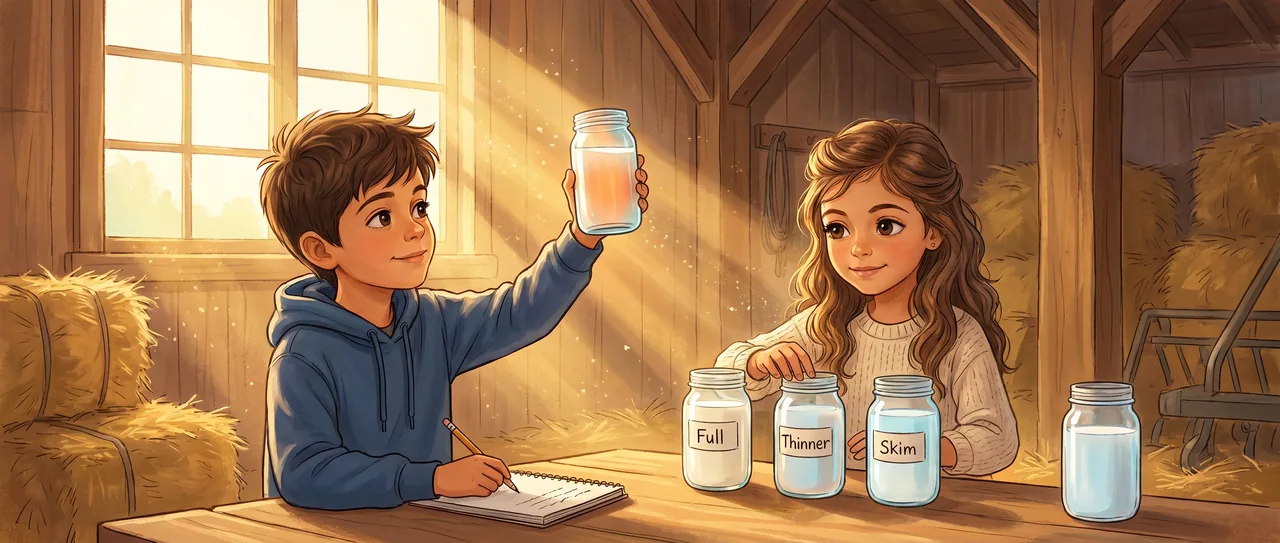
Soren looked at the jar she was holding up to the window. Late afternoon light cut through the dairy barn in a golden slab, and where it passed through the milk, the edges glowed. Not white. Something else.
"It looks fine to me," he said.
"Hold it up. Right there, in the light."
He took the jar. She was right. The thin parts, where the milk was closest to the glass, looked almost bluish. The thicker parts glowed warm, almost orange. He tilted the jar and the colors shifted.
"Okay," he said. "That's strange."
"Now look at this one." Maya held up a jar from the second row. Same milk, same cow, same morning. But the color at the edges was different. More yellow. Less blue.
"Your aunt's going to lose points if the color isn't consistent," Soren said.
"Forget the points. Why is milk white?"
Soren almost answered. Then he stopped. He actually thought about it. Milk wasn't dyed. Milk came out of a cow and it was white. Grass was green because of chlorophyll. Carrots were orange because of carotene. But milk. What was the white thing in milk?
"Fat?" he tried. "Fat's white. Like, butter is kind of yellow, but."
Maya shook her head. "Skim milk is white too. They take the fat out and it's still white."
"Okay. So it's not the fat."
"It's not anything. I looked this up once. There is no white molecule in milk."
Soren set the jar down carefully. "That can't be right."
"Casein is clear. Lactose is clear. Water is clear. You mix clear things together and you get white. Explain that."
He couldn't. He picked the jar back up and held it in the light again, watching the blue edges and the warm center. "So where is this color coming from?"
Maya pulled a second jar close and positioned it so the light hit it from behind. She pointed. "Look through the milk at the light. What color is it?"
"Yellowish. Reddish."
"Now look at the milk from the side, where the light is scattering off it sideways."
He moved his head. The side-scattered light was bluer.
"Maya. That's like the sky."
"That's exactly like the sky."
They stared at each other across the jars.
"The sky isn't blue because of blue stuff in the air," Soren said slowly. "It's blue because of scattering. The tiny molecules scatter short wavelengths more than long ones. Blue scatters sideways, red goes straight through. That's why sunsets are red. You're looking through more atmosphere so more blue has scattered away."
"So what if milk is doing the same thing? Not with molecules. With something bigger."
"The fat globules," Soren said. "Or the protein clumps. They're tiny, but they're bigger than molecules. They're just floating in there."
"Suspended," Maya said. "They never settle out. They're too small to settle and too big to dissolve. They just hang there in the water, billions of them, and every single one of them scatters light."
Soren held the jar up one more time. The light passing through it turned golden. The light bouncing off the sides turned blue. Every wavelength went somewhere. Nothing was absorbed. Nothing was lost. It all just went in different directions, and the sum of all those scattered directions, all those wavelengths bouncing and rebounding off billions of particles too small to see, was white.
"White isn't a color," he said. "White is every color, going everywhere at once."
"Because of things too small to see."
He grabbed his notebook from the table and started writing, fast. Not the conclusion. The thing that was bothering him. "Wait. If the particles were smaller, like air molecules, you get blue sky and red sunsets. If they're bigger, like in milk, you get white. What about in between?"
Maya was already moving. She held one jar up, then another. "These two jars look different because the particle sizes are different. Different fat content, different protein clustering, different amounts of scattering. Soren, every jar in this row is going to look a slightly different kind of white."
"Your aunt's problem," Soren said.
"Forget my aunt's problem. Think about what this means." Maya lined up three jars. One with full milk, one with the slightly thinner milk, one with the skim that her aunt had brought as a comparison. Each had a different blue tinge at the edges. Each turned a different shade of gold when you looked through it at the light.
"You could read the size of the particles by the color of the scattering," Soren said.
"You could read the size of anything. Anything suspended in anything. Fog. Smoke. Nebulae."
The word sat between them.
"Nebulae are clouds of dust," Soren said. "Particles suspended in space."
"And astronomers figure out what size the dust grains are by what color the nebula scatters. Same physics. Milk and nebulae, same physics."
Soren looked down at the jar in his hands. Warm from the afternoon light. Heavy with ordinary milk from an ordinary cow at an ordinary county fair. And it was doing the same thing as a cloud of dust four thousand light years away.
The barn door opened. Maya's aunt came in, slightly out of breath, holding a clipboard. "Judges are running late. Did you two figure out the color consistency problem?"
"Homogenization," Maya said without hesitating. "The jars that look bluer have larger fat globules because they weren't mixed as long. If you stir them the same way for the same time, the particles will be the same size, and the color will match."
Her aunt blinked. "How did you know that?"
"We read the milk," Soren said.
Her aunt looked at him like she was deciding whether he was being weird. She took the clipboard and went to check the jars.
Maya picked up the jar of skim milk and held it in the last slanting light from the window. The thinnest white. The faintest blue at the edges. She tilted it, and a small bright patch of orange slid across the glass where the light passed straight through.
Soren leaned forward and looked at the patch of orange, then up through the barn's open window at the sky, which was just beginning to turn the same color.
Read the interactive version, listen to the narration, and earn a gold star →
A science-verified short story for curious kids · Curiosity Land