The Color of Leaving
The argument had been going on for six days.
It started because Soren said the universe was expanding and Maya said that was obvious, everyone knew that, and Soren said fine, then explain the evidence, and Maya said redshift, and Soren said what does that actually mean though, and Maya said it means galaxies are moving away from us so their light gets stretched, and Soren said but how do you know what color the light was supposed to be, and Maya went quiet.
That was six days ago. She still did not have a good answer.
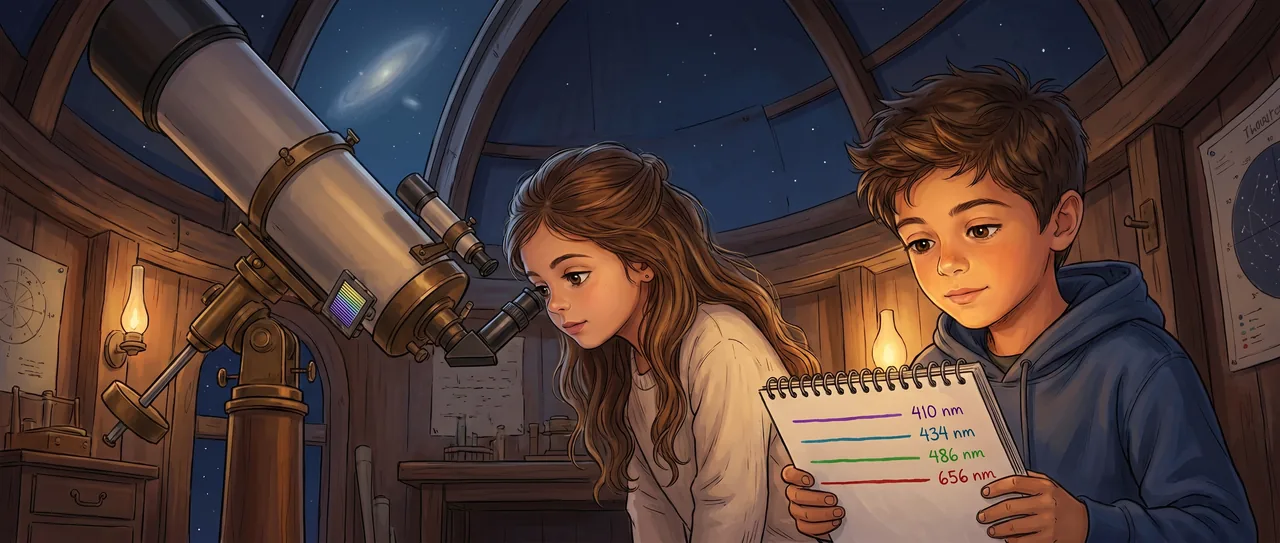
Now they were at the Hargrove Community Observatory, which was really just a retrofitted barn with a fourteen-inch telescope and a diffraction grating Mrs. Okoro had ordered from a catalog. Mrs. Okoro was the observatory's only staff member. She was currently in the back room arguing with someone on the phone about a shipment of eyepieces that had arrived cracked.
Maya had the grating clipped to the eyepiece. Soren had his notebook open to a page where he had drawn, very carefully, the spectrum of hydrogen. Four lines. Violet, blue-green, red, deep red. He had copied them from a textbook and labeled their wavelengths in nanometers.
"These are the fingerprints," he said.
"I know what they are."
"I'm not explaining it to you. I'm explaining it to me."
Maya looked through the eyepiece at the overhead fluorescent light first, just to make sure the grating was working. A smear of rainbow fanned out from the bright bar. She could see dark lines in it, gaps where specific colors were missing. The light looked complete to the naked eye, but it was not. It had holes in it.
"Okay," she said. "Those gaps. Every element makes its own gaps."
"Every element absorbs its own specific wavelengths," Soren said, writing. "Hydrogen always absorbs the same four. Like a barcode."
"So if you look at a galaxy and you find hydrogen's barcode, but the whole barcode is shifted toward the red end of the spectrum..."
"Then the light got stretched on its way to you."
Maya pulled back from the eyepiece. "That's the part that gets me. The light gets physically stretched. The actual waves get longer."
"Because the space between us and the galaxy is getting bigger while the light is traveling through it."
They looked at each other.
"Not like the galaxy is flying away through space," Maya said slowly. "Like space itself is stretching."
"Like dots on a balloon," Soren said.
"Everyone says that. Dots on a balloon."
"Because it works. You draw two dots. You inflate the balloon. The dots move apart but neither one moved. The rubber between them expanded."
Maya swung the telescope toward the window. The dome slit was open and she could see Andromeda, a pale smudge barely distinguishable from the dark sky around it. She centered it and looked through the grating.
The light was too faint. She could see a glow but no spectrum lines. She made a sound of frustration.
"We'd need a camera and a long exposure," Soren said. "Hours, probably. Real observatories use spectrographs."
"But they've done it. They've looked at galaxy after galaxy and the barcodes are always shifted red."
"Almost always. Andromeda is actually blueshifted. It's moving toward us."
Maya stared at him. "What?"
"Andromeda is falling toward the Milky Way. Local gravity is stronger than the expansion at that distance. They'll collide in about four billion years."
"You just had that ready? You just had a galaxy collision in your back pocket?"
Soren almost smiled. "I read ahead."
Maya turned back to the eyepiece. She could not see Andromeda's blueshift. She could not see any galaxy's redshift. All she could see was a faint glow and the darkness around it. But she sat with what she knew.
Every galaxy beyond the local group: redshifted. The farther away, the more shifted. The most distant galaxies they had ever measured were so redshifted that light which started as ultraviolet arrived as infrared. Their visible light had been stretched completely out of the visible spectrum. They were shining in colors human eyes could not detect, and those colors were wrong anyway, were stretched versions of the original colors, and the stretching had happened because the universe itself was getting larger during the millions and billions of years the light was en route.
She sat back.
"It's not just that they're moving away," she said.
"No."
"It's that the farther away they are, the faster they're moving away. Because there's more space between us to do the expanding."
Soren put his pen down. "Edwin Hubble figured that out in nineteen twenty-nine. He measured the redshifts and the distances and they were proportional. Every megaparsec farther away, the recession velocity increased by the same amount."
"Which means if you run it backward..."
"Everything was closer together."
"Everything was the same point."
The barn was quiet. Through the back wall, they could hear Mrs. Okoro saying, "No, I ordered the thirty-two millimeter, not the twenty-five." The telescope hummed faintly in its tracking mount, following the sky.
Maya looked at the smudge of Andromeda. Two and a half million light-years away. The photons entering the telescope right now had left that galaxy before humans existed. And those photons were slightly bluer than they should have been because, against the general expansion of everything, Andromeda was falling toward them.
Almost everything in the universe was moving apart. Almost everything was getting farther from almost everything else, and had been since the beginning. But here and there, gravity pulled things together. The Milky Way and Andromeda, drawn to each other across the void.
She wanted to say something about that but could not find the shape of it.
Soren was writing in his notebook. He stopped and looked up.
"The weird thing," he said, "is that the expansion is accelerating. It's getting faster. And nobody knows why."
"Nobody?"
"They call it dark energy. Which is a name for not knowing."
Maya leaned forward and put her eye back to the telescope. The glow of Andromeda sat in the dark, two and a half million years old, bluer than it should have been, getting closer.
Behind it, if she could have seen them, ten thousand galaxies were reddening as they ran.
Read the interactive version, listen to the narration, and earn a gold star →
A science-verified short story for curious kids · Curiosity Land