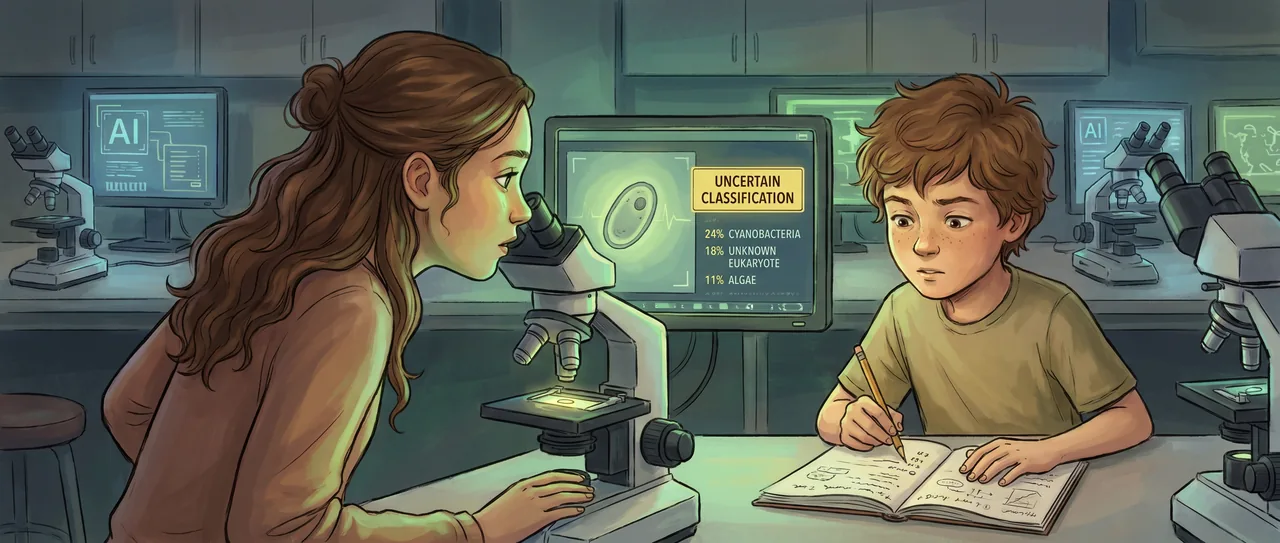
The Cell That Wouldn't Sit Down
The AI said "diatom" before Maya even finished focusing the lens.
It kept doing that. She would nudge the fine adjustment knob on the microscope, and the screen beside it would flash a label in green text with a confidence percentage. Diatom, ninety-seven percent. Rotifer, ninety-four percent. Green alga, genus Spirogyra, ninety-nine percent. Each time, a little outline appeared around the organism on the screen, neat as a gift box.
Soren, at the next microscope station, had his notebook open but hadn't written anything yet. He was watching his own screen cycle through identifications of the pond water they'd scooped from the retention pond behind the parking garage. Not the prettiest collection site. The graduate student supervising the open lab day had winced when they told her.
"It's classifying faster than I can look," Soren said.
"That's sort of the point," Maya said. She didn't mean it dismissively. She meant it as a fact that was bothering her too. The AI had been trained on eleven million microscopy images. It could identify over nine hundred cell types from shape and texture alone, more accurately than trained biologists in blind tests. The graduate student, whose name was Priya, had told them this proudly, like she was introducing a favorite dog.
Maya moved her slide. Green label. Green label. Green label.
"Everything in our pond is ordinary," she said.
"Parking garage pond," Soren said, as if this explained it.
Maya shifted the stage again, sliding the sample to a new region. Green label. Green label.
Then yellow.
The outline on the screen drew itself around something near the center of the field of view, and instead of a name and a percentage, the text read: UNCERTAIN CLASSIFICATION. Below it, a string of partial matches scrolled past. Amoeba proteus, thirty-one percent. Euglenoid, twelve percent. Macrophage, eight percent. The eight percent made no sense. Macrophages were immune cells. They lived in human bodies, not parking garage ponds.
"Soren."
He was already looking. He'd heard her voice change.
They both leaned toward her screen. The cell was roughly oval, but the edges kept shifting. Not like an amoeba, which extends and retracts pseudopods in a slow, blobby way. This was more like the whole membrane was shivering. And the texture inside was strange. Most cells under a light microscope look like bags of varying translucency. This one had a graininess to it, almost crystalline, that caught the light differently when Maya nudged the focus.
"Is it dead?" Soren asked. "Like, is it a broken cell?"
"Broken cells don't shiver," Maya said.
"Could be Brownian motion. Stuff bumping into it."
Maya shook her head. "Brownian motion would be random jitter. This is rhythmic. Watch."
They watched. The membrane pulsed. Not randomly. There was a beat to it, maybe once every two seconds, though Maya wasn't counting precisely enough to be sure.
Soren started counting. He tapped his pencil on the notebook. One, two, pulse. One, two, pulse. One, two, three, pulse. One, two, pulse.
"Almost rhythmic," he said. "Not exactly."
"Close enough to be biological," Maya said.
Priya walked by. She was carrying a tray of backup slides and looked like she was thinking about six things at once. "How's it going over here?"
"The AI can't classify this one," Maya said.
Priya glanced at the screen. "Oh, that happens. Usually it's an artifact. Air bubble, debris, overlapping cells that look like one thing. The software gets confused." She set down her tray at the next table and started sorting slides.
"It's pulsing," Soren said.
"Hmm?" Priya looked back. "Pulsing?"
"Rhythmically. Almost rhythmically."
Priya came closer. She looked at the screen for about five seconds, then at the eyepiece. Then back at the screen. "Huh," she said. "That's probably a contractile vacuole. Some protists have them. They pump out excess water."
"But the AI already knows about contractile vacuoles," Maya said. "It still can't match it."
Priya opened her mouth, then closed it. She looked at the partial match list scrolling on the side of the screen. Thirty-one percent. Twelve percent. Eight percent. Nothing above fifty.
"I mean, it could just be an artifact," Priya said again, but she said it differently this time. She pulled out her phone, took a photo of the screen, and walked away texting someone.
Maya and Soren looked at each other.
"She's asking somebody," Soren said.
"Which means she doesn't know," Maya said.
Soren wrote the time in his notebook. He wrote the partial match percentages. He wrote "pulsing, roughly two-second interval, slightly irregular." Then he looked through Maya's eyepiece again while she watched the screen.
"The graininess," he said. "Can you see it on the screen?"
"Sort of. It's better through the lens."
"It looks like it has structure. Like, internal structure that isn't organelles. It's too regular."
Maya thought about that. The AI had been trained to recognize cells by shape and texture. Eleven million images. Nine hundred cell types. If this cell's internal texture didn't match anything in those eleven million images, that meant one of two things. Either the cell was a messy accident, debris and bubbles and overlapping junk that only looked alive. Or the cell had a texture that eleven million images had never contained.
Because it was something those images had never seen.
"We need to keep tracking it," Maya said. "If it's an artifact, it'll stop pulsing. Or it'll break apart. If it's real, it'll do something."
"Do something like what?"
"I don't know. That's why we watch."
So they watched. Soren counted pulses and wrote them down. Maya tracked its movement across the slide, which was slow but deliberate, not the random drift of debris. It moved toward a cluster of algae, paused, and then moved away. It did this twice.
"It's avoiding them," Soren said.
"Or tasting them and deciding no," Maya said.
Priya came back. She had a different expression now. Not the supervising-the-kids expression. The one underneath it.
"Dr. Wen wants to see the sample," she said. "Can I take your slide?"
"Who's Dr. Wen?" Soren asked.
"My advisor. She does protist taxonomy."
Maya looked at Soren. Protist taxonomy. The study of classifying organisms that didn't fit neatly into animal, plant, or fungus. Organisms that were still being discovered, still being sorted, still arguing about where they belonged.
Organisms that sometimes turned up in parking garage ponds and made eleven-million-image databases say: I don't know what this is.
"You can take the slide," Maya said, "if we can come with it."
Priya almost said no. They could both see it. Then she looked at the notebook, at the columns of pulse intervals, at the movement notes, at the careful record of something nobody else in the open lab had bothered to keep.
"Yeah," Priya said. "Yeah, actually. Bring the notebook."
Soren closed it and held it against his chest, and they followed her out of the open lab and down a hallway where the lights buzzed at a different pitch and the doors had combination locks.
Read the interactive version, listen to the narration, and earn a gold star →
A science-verified short story for curious kids · Curiosity Land