The Bolder Ones
The white clover was the problem.
Maya had photographed forty seven plants in the last two hours for the BioBlitz, and she was good at photographing plants, and she did not care about plants. She cared about the coyote scat she had found near the drainage culvert, which was full of takeout chicken bones instead of rabbit fur, and which the adult volunteers had said was interesting and then walked away from.
But the clover was the problem because it was wrong.
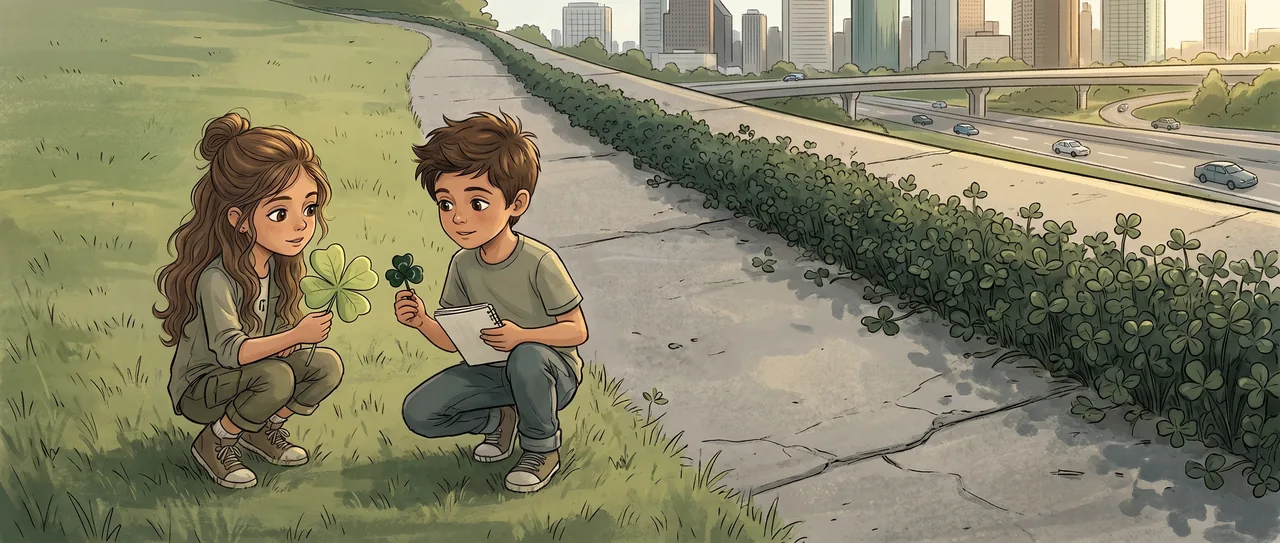
She crouched at the edge of the park trail where the mowed grass met the cracked sidewalk. The clover growing along the sidewalk was different from the clover growing six feet away in the grass. Not a different species. The same species. But the sidewalk clover had leaves that were somehow darker, thicker, more waxy-looking. And there was a lot of it, a whole dense stripe running along the concrete, looking almost like a different plant from its cousins just a few steps into the lawn.
"Soren."
He was twenty feet away, on his knees, trying to get a photo of an ant colony entrance for the invertebrate category. He had been trying for eleven minutes. She knew because she had been watching the clover for eleven minutes and had noticed him when she started.
"Soren, come look at this."
He came. He crouched. He looked where she pointed.
"Same species," he said.
"Same species," she said.
"But they look different."
"Really different."
Soren pulled a leaf from the sidewalk strip and a leaf from the lawn. He held them side by side. The sidewalk leaf was noticeably smaller, the edges curling slightly inward, the surface almost shiny. The lawn leaf was broader, flatter, a lighter green.
"Maybe it's just the concrete," he said. "Like, the soil is different there. Less water."
"Then they'd be wilting. These aren't wilting. They look healthy. They look like they're doing it on purpose."
"Plants don't do things on purpose."
"You know what I mean."
He did. He wrote something in his notebook, then drew both leaves, carefully, with measurements he estimated by holding them against his thumbnail.
"The coyote scat," Maya said.
"What about it?"
"Chicken bones. Fast food chicken. That's not a coyote that's struggling. That's a coyote that's eating takeout."
Soren looked at her. "And?"
"And the pigeons here are fatter than the pigeons at my grandmother's farm. And the sparrows at the bus station don't fly away when you walk past. And this clover is doing something different right next to the sidewalk. In the same park. In the same dirt."
Soren didn't answer right away. He was looking at the two leaves in his hand. Then he said, "Dr. Kapoor might know."
Dr. Kapoor was not a mentor. Dr. Kapoor was the BioBlitz organizer, a university researcher who was currently arguing with someone on her phone about parking permits while simultaneously eating a granola bar and dropping crumbs on her tablet. When Maya and Soren approached her with two clover leaves and a theory, she glanced at the leaves, said "Cyanogenesis," and went back to her phone call.
Then she paused. Covered the phone with her hand. "Actually. Yes. The sidewalk ones. They've lost the cyanide."
She went back to her call.
Maya and Soren stood there.
"Cyanide," Soren said.
"She said cyanide."
They found a bench. Soren pulled out his phone and Maya pulled out hers and for four minutes they read everything they could find about white clover and hydrogen cyanide.
The rural ones made it. A chemical defense. If something tried to eat them, the cyanide in their tissues made the animal sick. Good trick. Worked for thousands of years.
But in cities, something had changed. In cities, where the winters were warmer because of all the concrete and exhaust and buildings holding heat, the clover along roads and sidewalks had stopped producing cyanide. Not all of them. But measurably, statistically, more of the urban ones had lost it. Because the cyanide defense had a cost in cold weather. It made the plant more vulnerable to frost. And in the countryside, the cold winters were worth the tradeoff because there were so many herbivores. But in the city, with fewer grazing animals and more warmth radiating from pavement, the math had flipped. The plants that dropped the poison did better.
The same species. Different answers.
"This is happening right now," Soren said. "Not fossils. Not millions of years ago. Right now. Under our feet."
"The coyotes too," Maya said. "I looked it up. Urban coyotes are nocturnal in cities but not in the wild. Their skulls are different. Shorter snouts. Wider. Like they're becoming a different kind of coyote."
"How fast?"
"Decades. Some of the mosquito studies said it happens in like, a few generations."
They sat with that. Around them, the BioBlitz volunteers spread through the park with their phones and their collection kits. A pigeon landed on the bench next to Soren, close enough to touch, and did not leave. It looked at him with one orange eye.
Maya said, "Every city is its own island."
Soren looked at her.
"Like the Galapagos," she said. "Darwin's finches. Different islands, different beaks. But these are cities. And it's not taking millions of years. Every city is pushing its animals and plants in a different direction, and it's happening now, and nobody designed it, and the cities don't even know they're doing it."
The pigeon shifted closer to Soren. He held very still.
"We're the environment," he said. "We built the islands. We're the selection pressure. Us. Parking lots. Streetlights. Dumpsters."
Maya pulled up the BioBlitz app on her phone. Forty seven plants. One coyote scat. Twelve birds. She looked at the sidewalk clover, that dark waxy stripe running along the concrete like a border between two countries that used to be one.
Dr. Kapoor walked past, still on her phone, and dropped a pin flag next to a dandelion without breaking stride.
The pigeon on the bench ruffled once, resettled, and stayed.
Read the interactive version, listen to the narration, and earn a gold star →
A science-verified short story for curious kids · Curiosity Land