Move Thirty-Seven
The old laptop hummed on the table between them like it was thinking too hard, which, Soren supposed, it was.
Mr. Pak had set it up before the Saturday tournament, loading the Go training program he'd been tinkering with for months. "It's not AlphaGo," he'd said, laughing, already halfway back to the front desk where three people were waiting to check out books. "But it's learned some things. Play it. Tell me what you think."
Then he was gone, and Maya was already placing her first stone.
They were playing as a team against the program, alternating moves, which was not standard Go but was the only way Soren could stand it. He was the better reader of the board. Maya was the one who played moves that made him want to ask why, and then twenty moves later he'd see it.
By move thirty, they were winning. Soren could feel it in the shape of the board. Their stones controlled the center. The program's territory was fractured, scattered in small pockets along the edges. Maya leaned back in her chair and blew hair out of her face.
"It's going to resign," she said.
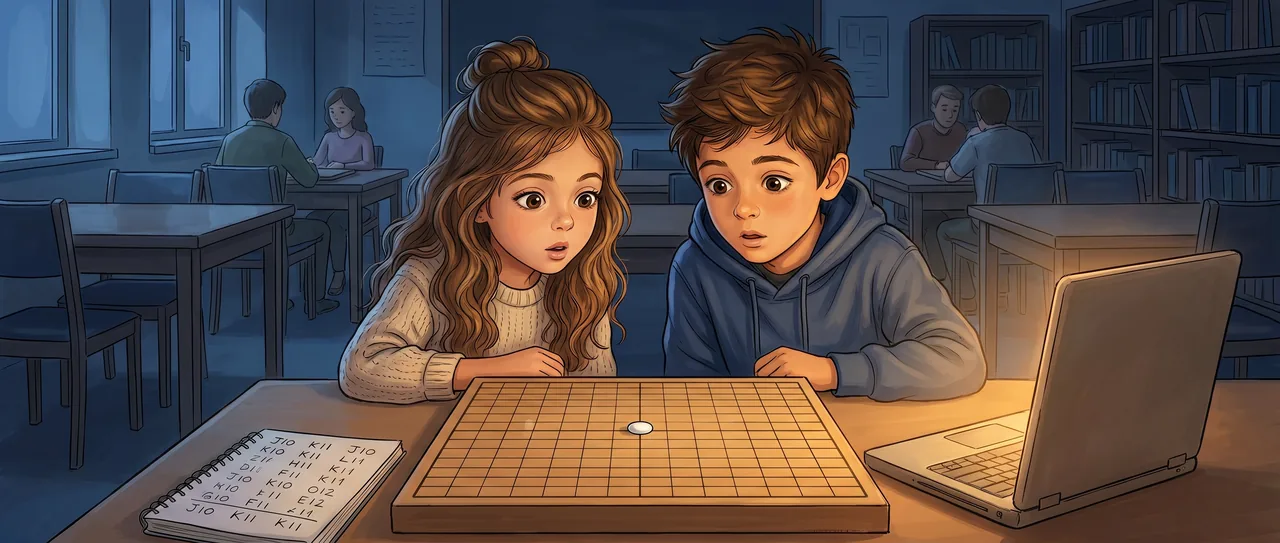
The program placed a stone on the upper right. Not in the corner. Not on the edge. Five lines from the top, five lines from the side. A strange, floating point in open space, connected to nothing the program owned.
Soren stared at it.
"That's a mistake," Maya said.
"Maybe."
"It's not close to anything. It's not defending. It's not attacking. It's just sitting there."
Soren wrote the coordinates in his notebook. He didn't know why yet. It just looked wrong in a way that felt like it might not be wrong.
They played their response. Then another. The program played what looked like another drifting, purposeless stone, this time on the lower left. Again in open space. Again connected to nothing.
"It's broken," Maya said. But she said it slowly, the way she said things when she was already doubting herself.
Soren counted liberties. He traced influence. The two floating stones were exactly as far from each other as they were from the nearest edge of the board. That couldn't be random. A random placement wouldn't be so perfectly spaced.
"Play here," he said, pointing to the intersection between the two floating stones.
Maya placed it. The program responded instantly this time, a stone that connected its upper group to the first floating stone through a thin, diagonal chain that hadn't existed three moves ago.
Soren's stomach did something.
"Maya. Look at the board. Don't look at our stones. Just look at the program's stones."
She tilted her head. She was quiet for ten seconds, which was a long time for Maya.
"Oh," she said.
"Yeah."
The program's scattered, broken territory wasn't scattered anymore. The two floating stones had become the joints of a skeleton. Every small pocket along the edges now connected through the center, through exactly the space they'd thought they controlled. Their stones were still there. They still had more territory on the surface. But underneath the surface, like roots threading through soil, the program's influence had reorganized itself around those two strange points.
"It was losing on purpose," Maya said. "It let us have the center so we'd spread thin."
Soren shook his head. "Not on purpose. Not the way we'd mean it. It doesn't know what losing is. It just played millions of games against itself and found a pattern. A shape that works. A shape no one taught it."
They played twelve more moves. Each one felt like sliding further down a slope they couldn't see the bottom of. Their territory kept looking fine. The numbers kept getting worse.
On move forty-nine, Maya stopped reaching for a stone and pulled her hand back.
"This is what happened in that game," she said. "The famous one. Move thirty-seven."
Soren nodded. He'd watched the documentary twice. In two thousand sixteen, a program called AlphaGo had played the world's greatest Go players and done something no one expected. Not in game one, which it won through solid play. In game two. Move thirty-seven. A stone placed on the fifth line, in a position that every professional commentator watching said was a mistake. One of them left the room. The others laughed nervously. It was a move that violated centuries of human Go knowledge, placed where no expert would place it.
And then it won the game.
Not because it was faster or because it calculated more moves ahead, though it did. Because it had found a strategy that existed in the game of Go, that had always existed, that was always available to any player in the three thousand year history of the game, and no human being had ever once seen it.
"It's not smarter than us," Soren said. "It's not even playing the same game as us. It's playing a game that has rules we know, on a board we can see, and it found a whole country in there that nobody knew was there."
Maya placed her next stone. They lost by eleven points.
She reset the board immediately.
"Again," she said.
"We're going to lose."
"Obviously we're going to lose. But I want to find the move. I want to see where the skeleton starts."
They played again. This time Soren watched differently. Not for what the program was building, but for the negative space. The places it was choosing not to play. The gaps it was leaving that looked like weakness but were shaped, he was starting to think, like invitations.
Move twenty-two. The program placed a stone in open space. Nobody watching would have understood it.
But Soren understood it, or the edge of it, the way you understand the size of the ocean when you see the horizon line and know it keeps going past what your eyes can hold.
"There," he said.
Maya leaned forward, both hands flat on the table.
"It's not new," she said quietly. "That move has been legal for three thousand years. Anyone could have played it."
"But nobody did."
"Nobody did. Because it looks like nothing. It looks like a mistake."
The library was emptying out. Mr. Pak was shelving returns and had forgotten about them entirely. The laptop screen glowed in the dimming room, the board half-filled with black and white stones, one of them sitting alone in open space, connected to nothing, waiting.
Maya pressed reset.
Read the interactive version, listen to the narration, and earn a gold star →
A science-verified short story for curious kids · Curiosity Land