Every Connection That Caused It
The robot arm dropped the green stone into the blue bin for the fourteenth time.
Maya pulled it out, set it back on the sorting table, and pressed the retry button. The arm whirred, tilted its camera down, paused for exactly one point three seconds, and dropped the green stone into the blue bin again.
Fifteen.
"You know it's green," she said to the arm. "I know you know. Your camera works fine."
The arm did not care about her frustration. It sat there, patient and wrong.
Across the workshop, Dev was soldering something and half-listening to a podcast through one earbud. He ran the community robotics space on Tuesday and Thursday evenings, and his policy was that he would answer exactly one question per session per kid, so you'd better make it a good one. Maya had used hers twenty minutes ago, asking about the learning rate, and his answer had been "try making it smaller," which she had, and it hadn't helped.
So she was on her own.
The neural network running on her laptop was small. Three layers. She could see the whole thing on the screen, a web of nodes and connections, each connection labeled with a tiny number. A weight. The network took in pixel values from the camera, pushed them through these weighted connections, and produced an answer at the other end: red bin, blue bin, green bin, white bin.
Every time the arm sorted a stone wrong, the network was supposed to learn. That was the whole point. It would look at its mistake, figure out what went wrong, and adjust.
But it kept putting green stones in the blue bin.
Maya stared at the error log on her screen. After each wrong answer, the program ran something called a backward pass. She'd read about it. She'd watched two videos. She understood, roughly, what it was supposed to do. The network made a guess. The guess was wrong. The backward pass started at the wrong answer and worked its way back through every single connection, asking: how much did you contribute to this mistake?
Every connection got a number. A tiny piece of the blame.
Then every weight shifted, just a little, in the direction that would have made the answer less wrong.
Maya had thought this was beautiful the first time she read about it. Not like a teacher pointing at one student and saying you got it wrong. More like the whole classroom turning and saying, each of us played a small part in the confusion. Let us each adjust.
But right now the classroom was not adjusting. The green stone sat on the table, smug and green, and the network was certain it was blue.
She opened the weight visualization and watched the backward pass happen in slow motion after the next error. Sixteen.
The error signal started at the output layer. It was large. The network was confident and wrong, which was the worst combination. Then the signal flowed backward, splitting at every node, traveling down every connection. She watched the blame spread. Most connections received a tiny nudge. A few received a larger one. The weights shifted.
But then she saw it.
In the second layer, one node was connected to almost everything. Its weight values were enormous compared to the others. And when the error signal reached it, the blame split so many ways that each individual connection barely moved. The node was like a loud voice in a crowded room. It was drowning everything else out, and because it was connected to so much, the backward pass could never assign it enough blame in any single direction to actually change it.
Maya leaned closer. She clicked on the node and looked at its history. Over the first hundred training rounds, this node had gotten very good at detecting brightness. Bright things went to the white bin. That was useful, early on. So its weights had grown large. But green stones and blue stones had similar brightness, and this node couldn't tell them apart. It just kept shouting BRIGHT or NOT BRIGHT so loudly that the smaller, subtler nodes, the ones that might have learned the difference between blue-green and green-green, could never get a word in.
The network had learned something true and then gotten stuck on it.
Maya sat back in her chair.
She thought about what the backward pass was actually doing. It wasn't just finding the mistake. It was tracing the mistake back through every path that caused it, proportionally, precisely, connection by connection. The math didn't care which node was loudest. It just asked: what did you contribute?
But if one node's contribution was so large that it dominated the output, the subtle contributions of the other nodes never had room to matter. The error signal was telling the truth. The problem was that one early truth had grown so large it was blocking all the later, smaller truths from forming.
She didn't need to fix the backward pass. The backward pass was already doing its job perfectly. She needed to stop that one node from hogging all the space.
Maya opened the training parameters. She found the weight decay setting, the one that gently shrank all weights a tiny amount each round, keeping any single connection from growing too dominant. She had left it at zero.
She set it to zero point zero zero one.
She reset the network. Cleared all the weights. Started training from scratch.
The arm sorted stone after stone, wrong at first, wildly wrong, guessing randomly. But this time, as the backward pass traced blame through the connections, no single node could run away with the answer. The loud node still formed. It still detected brightness. But it stayed a reasonable volume, and next to it, quieter nodes began to learn the difference between the particular green of river-washed stone and the particular blue of the ones Maya had pulled from the creek bed near her house.
After two hundred rounds, the arm picked up a green stone, paused, and placed it in the green bin.
Maya didn't cheer. She watched.
Three more green stones. Green bin. Green bin. Green bin.
A blue stone. Blue bin.
She let it run. She was thinking about the backward pass, how it moved through every connection assigning responsibility, not punishment. How it said: this is what each of you did. Now shift. How the whole system changed together, not because any single part understood the problem, but because every part adjusted by exactly the amount it had contributed to the error.
No one part understood.
Every part moved.
Dev glanced over. "Working?"
"Yeah," Maya said. "It needed room for the quiet ones."
Dev raised an eyebrow but went back to his soldering.
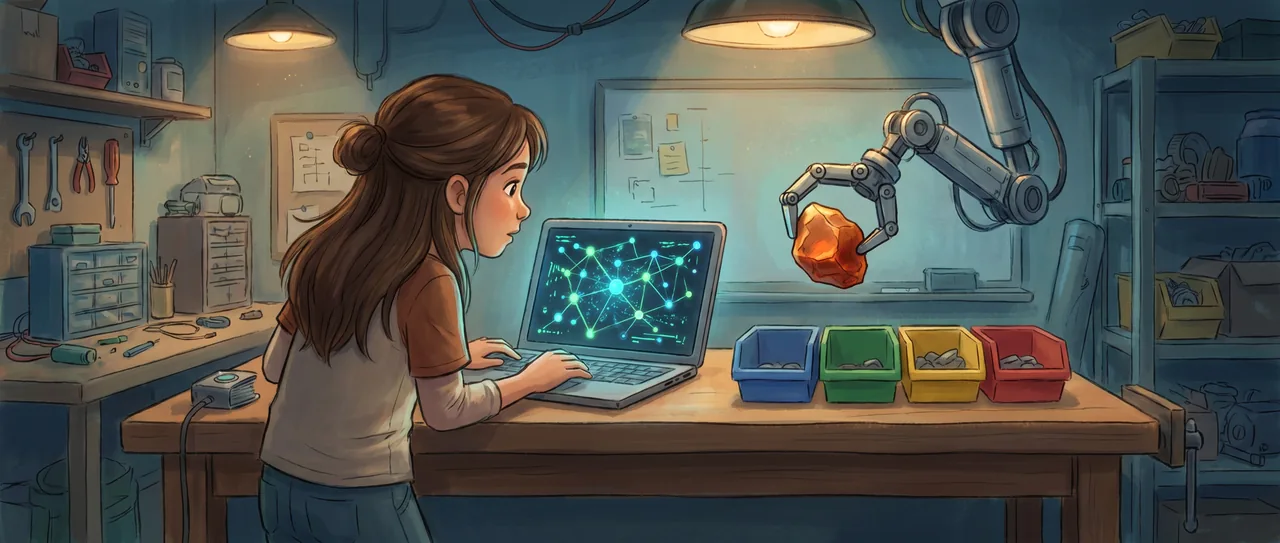
The arm picked up another stone. This one was a color Maya hadn't trained it on, a reddish-brown, almost amber. The arm held it over the table, tilted its camera, and stopped.
It stayed there, hovering, not choosing a bin, because it had never seen this color before and none of its answers fit.
Maya leaned forward and watched the weights flicker on her screen, every connection straining toward an answer that did not yet exist.
Read the interactive version, listen to the narration, and earn a gold star →
A science-verified short story for curious kids · Curiosity Land