Almost Nothing
The graduate student had already forgotten them.
She had waved Maya and Soren toward the table at the back of the lab, said "Don't touch the furnace, don't touch the vacuum chamber, the blue stuff is fair game," and then immediately turned back to her laptop, muttering about a grant deadline.
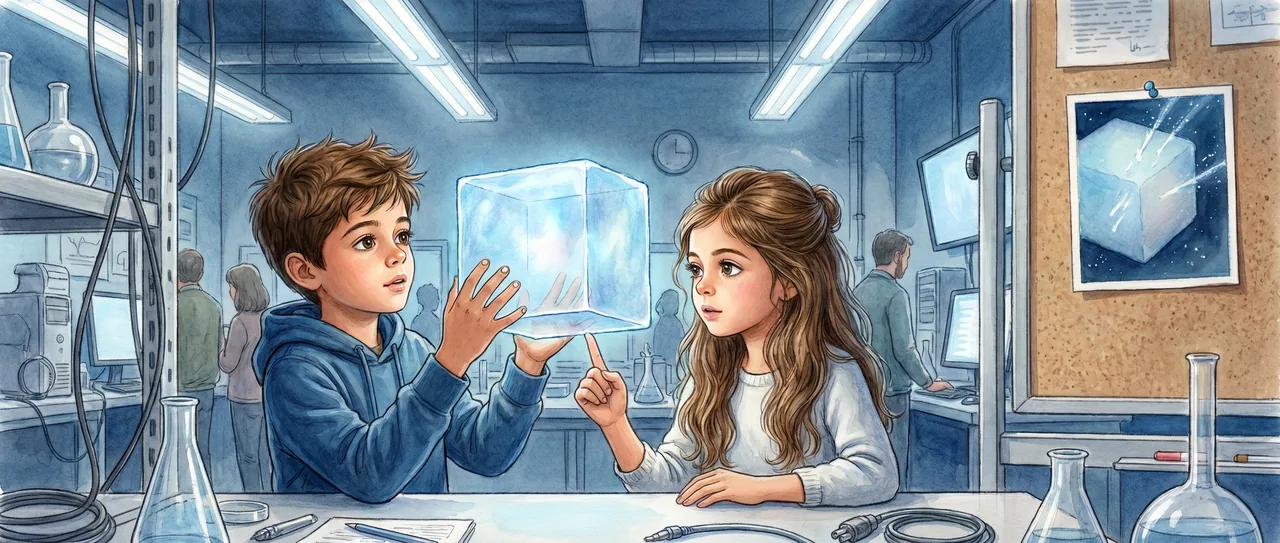
The blue stuff sat on the table under a fluorescent light. A block of it, roughly the size of a brick. It looked like frozen smoke. Like someone had caught a piece of sky at that precise moment between day and night and set it on a metal tray.
"That can't be solid," Maya said.
Soren was already reaching for it. He lifted it with both hands, then one hand, then two fingers.
"It weighs nothing."
"It weighs something," Maya said.
"Barely." He held it out to her. "Feel."
She took it. Her face changed. "Okay. Barely."
The small printed card on the table read: SILICA AEROGEL. 99.8% AIR BY VOLUME. She read it twice.
"Ninety-nine point eight," she said.
Soren took the card and studied it. "So the actual solid part, the glass part, is point two percent. That's like, two parts in a thousand."
"So what am I holding?"
"Air," Soren said. "You're holding a shape made of air."
"Air doesn't have a shape."
"This air does."
Maya turned the block slowly. It was real. It had edges and corners. When she set it back down it made a faint ticking sound against the metal tray. But it looked like it should dissolve. Like breathing on it too hard would scatter it into nothing.
The card had more lines. She read them aloud. "Can support four thousand times its own weight."
Soren looked at the block. He looked at the card. He looked at the block again.
"That doesn't work," he said.
"It says it right here."
"I know what it says. I'm saying it doesn't make sense. Feel how light that is. Something that light, that full of air, should crush like a meringue."
Maya pressed a finger gently against the surface. It was strange, slightly gritty, almost like touching a very fine powder that had decided to be solid. It did not give. She pressed harder. It did not give.
"Try standing on it," she said.
"I'm not going to stand on the university's aerogel."
"She said the blue stuff was fair game."
Soren looked over at the graduate student. She was now on the phone, pacing by the window, gesturing at no one. He looked back at the block.
"It would hold me?"
"Four thousand times its weight. That block is maybe three grams. Three grams times four thousand is twelve kilograms. You weigh more than twelve kilograms."
"So it wouldn't hold me."
"Probably not all of you. But think about what that means. Three grams of almost nothing holding twelve kilograms. That ratio is absurd."
Soren set the block on the floor. He put his hand on it, flat, and pressed. He leaned weight into it. The aerogel sat on the tile floor looking like frozen smoke and holding his weight without a sound.
"It's not even flexing," he said.
"It's a network," Maya said. She was reading the next card now. "Tiny strands of glass, nanometers across, connected in a structure. The air fills the gaps. But the structure carries the load."
"Nanometers," Soren repeated. He took his hand off the block and stared at it. "So the point two percent is doing all the work."
"All of it."
He picked the block up again. Held it at eye level. The fluorescent light passed through it, turning blue and hazy, like looking through deep water. "It's almost nothing. And almost nothing is enough."
Maya had found something else. A photograph pinned to a corkboard behind the table. It showed a piece of aerogel, pale and ghostly, with tiny bright tracks running through it, like frozen fireworks.
"Soren. Look at this."
The label underneath read: STARDUST MISSION, 2004. AEROGEL COLLECTOR. HYPERVELOCITY COMETARY PARTICLES CAPTURED AT 6.1 KM/S.
"They put this stuff in space?"
"They flew it through the tail of a comet." Maya was talking fast now. "The particles were hitting it at six kilometers per second. That's faster than a bullet. Way faster than a bullet. And the aerogel caught them. Caught them without shattering. Without destroying the particles. They brought them home."
Soren stared at the photograph. The bright tracks were the paths of cometary dust grains, slowed and captured in the gel, frozen in place like insects in amber. Except these insects had been screaming through space at twenty times the speed of sound.
"How," he said. It wasn't really a question. It was the sound of trying to fit something too large into his head.
"The structure gives way slowly," Maya said. "It's like catching an egg by moving your hand back. Except the hand is made of glass threads and air and it's in space and the egg is going six kilometers a second."
"And the egg is a piece of a comet that's older than the Earth."
They stood there.
The graduate student was still on the phone. The fluorescent light buzzed. Somewhere down the hall, a centrifuge hummed to life and spun up to a high thin whine.
Soren held the aerogel block up to the light one more time. Almost nothing. A structure so sparse it was ninety-nine point eight percent absence, and it had reached out past Mars and caught pieces of a comet and brought them home so gently they survived.
Maya reached out and put one finger underneath the block, supporting it. It sat on her fingertip like a piece of blue light.
"What else could you build," she said, "if almost nothing is enough?"
Soren opened his mouth, then closed it. The question was too big to answer. That was the whole point of it.
The graduate student hung up the phone and walked past them without looking, reaching for a binder on a shelf. Maya and Soren stayed where they were, the block of frozen smoke balanced between his hands and her single finger, the light passing through it and turning the color of deep sky.
Read the interactive version, listen to the narration, and earn a gold star →
A science-verified short story for curious kids · Curiosity Land