The Shape of Less
The cube frame was Soren's idea. Twelve edges of thin wire, soldered together into a perfect cube the size of his fist. When he dipped it into the bucket of soap solution and pulled it out, he expected flat walls. A cube of bubble.
He got something else entirely.
"Maya."
She was across the gymnasium, taping poster board to their display table. She looked up at his voice. Not at his words. At the sound underneath them.
"Bring the bucket," she said, already walking over.
"I have the bucket. Just come look at this."
Inside the wire cube, the soap film had not made six flat walls. It had made something impossible. Thin sheets of soap stretched between the edges, but they curved inward, meeting at the center in a small, warped square. Twelve surfaces, all pulling toward each other.
"That's not a cube," Maya said.
"No."
"Why isn't it a cube?"
Soren rotated it slowly. The overhead gym lights caught every surface and threw tiny rainbows against the floor. "I think it can't be."
Maya held her hand under it to catch any drips, but there were none. The thing was stable. Perfectly still. She leaned close enough to see her own distorted face in one of the films. "Try the triangle one."
Soren had made five frames. Cube, tetrahedron, triangular prism, a weird twelve-sided shape he'd found in a geometry book, and one that was just random. Bent wire, no pattern, like a crumpled coat hanger.
He dipped the tetrahedron. The soap found six films that met at the center in a single point. Not flat planes. Curves that connected every edge to every other edge using the least possible material.
"It's doing the same thing," Maya said. "It's always pulling inward."
"Surface tension," Soren said. "The soap is trying to use as little surface as it can. Every point on every film is pulling itself smaller."
"So the shape we're looking at. That's the answer to a math problem."
"I think it is the math problem. I read that mathematicians can describe what the bubble does, but for most frames, they can't calculate the answer themselves. The soap just finds it."
Maya took the crumpled coat hanger frame from the table. This one had no symmetry. No pattern. Just wire bent at seven or eight odd angles.
She dipped it.
The soap found surfaces that no human eye could have predicted. Films stretched between angles that seemed to have nothing to do with each other, connected by a tiny curved junction near the middle that twisted like a river seen from very high up.
"Soren. Nobody knows what this shape is."
"The soap knows."
"The soap doesn't know anything. It's soap and water and a little bit of glycerin. It has no brain. It can't do math."
"And yet."
She held the frame up and turned it.
"It's not solving it," Soren said. He had his notebook out. He was sketching the shape inside the cube frame, trying to capture where the surfaces met. "It's not calculating anything. Every tiny piece of the film is just pulling on its neighbors. That's all. Each piece doing one simple thing, and the whole shape falls into the answer."
"Like ants."
"Like everything."
"But this is geometry," Maya said. "This is three-dimensional optimization. People write entire dissertations on this and they still can't solve it for a random frame. And the soap does it in less than a second."
She dipped the crumpled frame again. It found the same shape. Exactly the same. She dipped it a third time. Identical.
Soren stopped drawing. "It's repeatable."
"Of course it's repeatable. It's the only answer. The minimum. There's only one minimum and the soap always finds it."
Maya set the crumpled frame down carefully. The soap film held. She looked at it from the side, then from above.
"This bothers you," Soren said.
"This amazes me. It bothers me that it amazes me. Because it shouldn't be amazing. It's just physics. It's just molecules doing what molecules do."
"But."
"But the answer is so complicated. The cause is so simple. How does simple make complicated?"
"I don't think the soap thinks it's complicated," Soren said.
Maya picked up the cube frame and held it beside the crumpled one. The cube's answer was strange and elegant. The crumpled frame's answer was strange and unnameable. Both were exactly, provably, minimal. As little surface as the laws of physics could manage.
"Here's what I keep thinking," she said. "We build computers to solve optimization problems. Delivery routes, airplane wings, bridge structures. We write algorithms. We spend millions of hours of computing time. And a soap bubble, which is literally a thin film of water with some soap in it, solves a harder version of the same kind of problem instantly. Every time. Without trying."
"It's not the soap that's smart," Soren said. "It's the universe that's structured so that the answer exists and a soap film can fall into it."
They stood there for a moment. The gymnasium was quiet except for Ms. Vasquez setting up tables on the far side.
"We need more frames," Maya said.
"I brought extra wire."
"No. Not regular shapes. I want to try weird ones. I want to find a frame where I think I know what the soap will do, and then see if I'm right."
"You won't be," Soren said.
"I know." She was already reaching for the wire cutters. "That's the whole point."
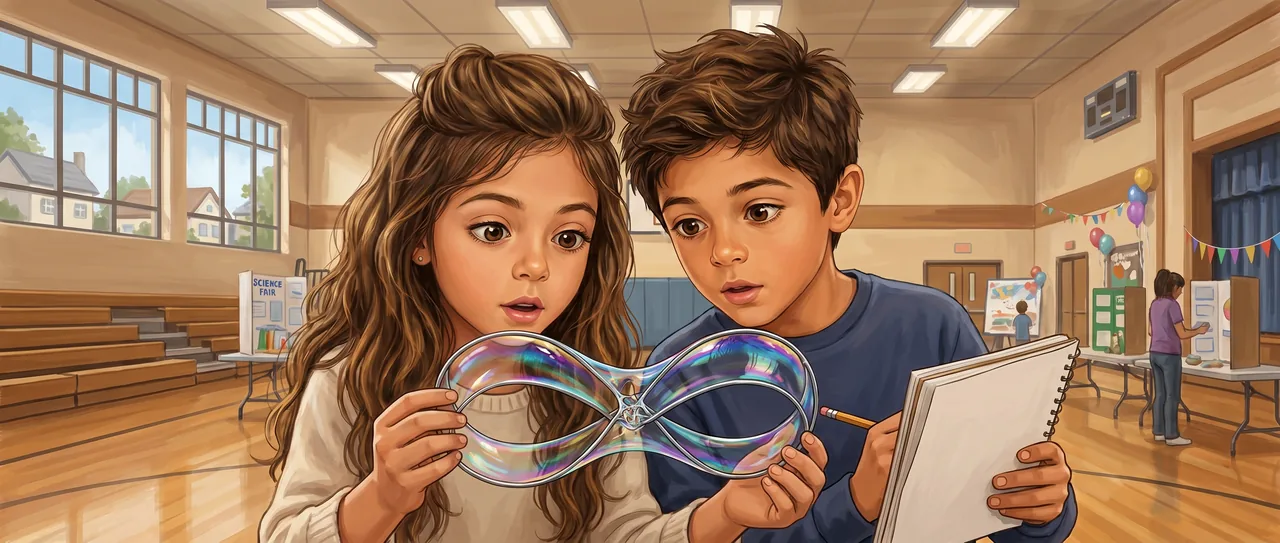
Soren bent a piece of wire into a shape like a figure eight that had been twisted into three dimensions, no two loops in the same plane. He handed it to Maya. She dipped it, and they both leaned in together as the soap stretched and pulled and settled into something neither of them had imagined.
Maya held it very still. She was trying to memorize the shape.
She couldn't. Her eyes could follow each surface, but the middle, where everything curved into everything else, kept slipping away from her. The shape was there. It was exact. It was the only answer.
She could not hold it in her head.
"Soren."
"I know." His notebook was open. The page was blank.
Read the interactive version, listen to the narration, and earn a gold star →
A science-verified short story for curious kids · Curiosity Land