The Other List
Maya's cousin Priya was already late.
The text said meet me at the east entrance at ten and it was ten fourteen and Maya had been standing in the lobby of the university genomics building watching people in lanyards walk past her like she was a coat rack. She didn't mind. The lobby had a timeline on the wall.
She was reading it.
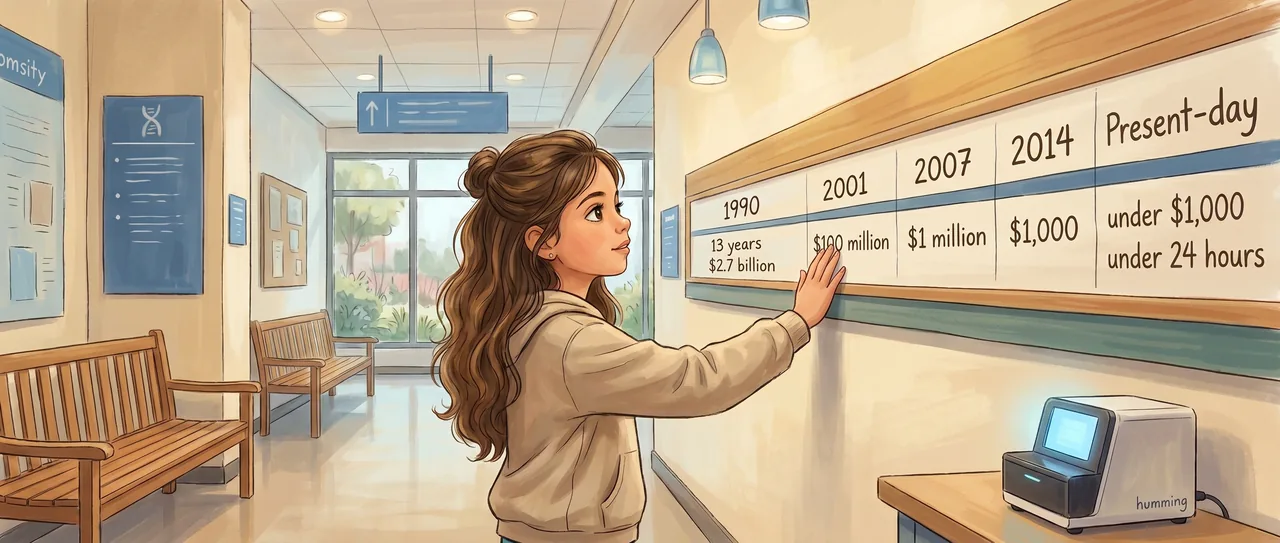
The timeline started in 1990. A project called the Human Genome Project. Thirteen years. Two point seven billion dollars. Thousands of scientists in six countries. All to read one human genome, start to finish. Three billion letters of DNA, one person's complete instruction set, and it took longer than Maya had been alive.
She followed the timeline with her finger. The cost dropped. Fast. Not like a ball rolling downhill. Like a ball falling off a cliff.
2001. One hundred million dollars.
2007. One million.
2014. One thousand.
The dates were getting closer together and the numbers were getting smaller and Maya's finger was moving faster along the wall and then the timeline ended at the present day. Under a thousand dollars. Under twenty four hours. One machine. One room.
Something about that made her chest feel tight. Not bad tight. Tight like a spring.
"Sorry, sorry, sorry." Priya came through the east door with her badge already out. "My PI wanted me to check on a run before the open house. Come on, I'll show you the actual lab."
Priya was twenty three and talked with her hands. Maya followed her through a door, down a hallway, into a room that was smaller than she expected.
There was a machine on the counter about the size of a large printer. It was humming.
"That's it?" Maya said.
"That's it."
"That does a whole genome."
"That does a whole genome." Priya patted the top of it. "We loaded a sample yesterday afternoon. Results should be done by this evening."
Maya walked around the machine. It had a small screen on the front and a slot where something had been inserted and it was, honestly, boring to look at. It looked like something you'd find in a dentist's office.
"The first time they did this, it took thirteen years," Maya said.
"Yep."
"And now it takes a day."
"Less than a day, usually."
Maya stood very still. She was adding something up in her head, not numbers exactly, but a shape. "Priya. When they started in 1990. Were the scientists who started it, were they going to be retired before it was done?"
"Some of them, yeah. Francis Collins led the project in his forties and it finished in his fifties. Some of the researchers spent their whole careers on it."
"Their whole careers. For one genome."
"For the first one."
Maya looked at the machine again. "How many genomes does your lab do in a week?"
Priya thought about it. "We run about twelve samples a week on this machine. More on the one in the other room."
Twelve a week. Maya multiplied. Six hundred a year, roughly, from one small lab. And there were thousands of labs.
She opened her mouth to say something and then stopped, because the thing she was trying to say didn't have a shape yet. She walked out of the lab and back to the lobby and stood in front of the timeline again.
Priya followed her. "You okay?"
"The people in 1990," Maya said. "They knew it would take thirteen years. They started anyway."
"They did."
"And they couldn't have known it would speed up this much. Right? Nobody in 1990 was saying in thirty years this will cost a thousandth of a percent of what it costs now."
"Honestly, no. The speed of the cost drop surprised everyone. It outpaced Moore's Law. You know Moore's Law?"
"Computers getting faster."
"Basically. Genome sequencing got cheaper faster than computers got faster. Nobody predicted that."
Maya pressed her palm against the wall where 1990 was. She slid her hand along the timeline to the end. About four feet of wall. Thirty three years. The first three feet covered the first genome. The last foot covered everything after.
All those scientists working in 1990, she thought. They just started. They could see the beginning and they couldn't see the end and they started.
"Priya," she said. "What does your lab do with the genomes once you read them?"
Priya leaned against the wall. "Right now? We're looking for genetic markers for a rare kidney disease. Trying to figure out why some people get it at age ten and some at age forty. We've sequenced about two hundred patients so far."
"And if you'd tried to do that in 1990?"
"We couldn't. Two hundred genomes in 1990 would have taken over two thousand years and cost six hundred billion dollars. It would have been literally impossible."
She pulled out her phone and opened her notes.
She added one question: why does the same disease start at ten in some people and forty in others?
Read the interactive version, listen to the narration, and earn a gold star →
A science-verified short story for curious kids · Curiosity Land