The Way Back from Static
The model was broken. That was the whole point of the Saturday workshop, to find bugs before the university released it, but Maya had been clicking Generate for twenty minutes and every output looked like a photograph of a blizzard.
"It's not even trying," she said.
Soren leaned over from the next workstation. His screen showed the same thing. White and gray and flecks of nothing. "Mine either. But look." He pointed at the progress bar. "It's running all fifty steps. It thinks it's finishing."
"Finishing what?"
"That's what I want to know."
The graduate student running the workshop, Priya, was across the room helping two younger kids whose laptop had frozen entirely. She'd told them at the start that this model was small, trained on only a fraction of the data that the big commercial ones used, and that it would be rough around the edges. She had not mentioned that the edges would be the entire picture.
Maya typed a new prompt. "Red bicycle on a gravel path." She hit Generate and watched the progress bar crawl. Step one. Step two. She pulled up the debug view Priya had shown them, the one that displayed each intermediate step as the model worked.
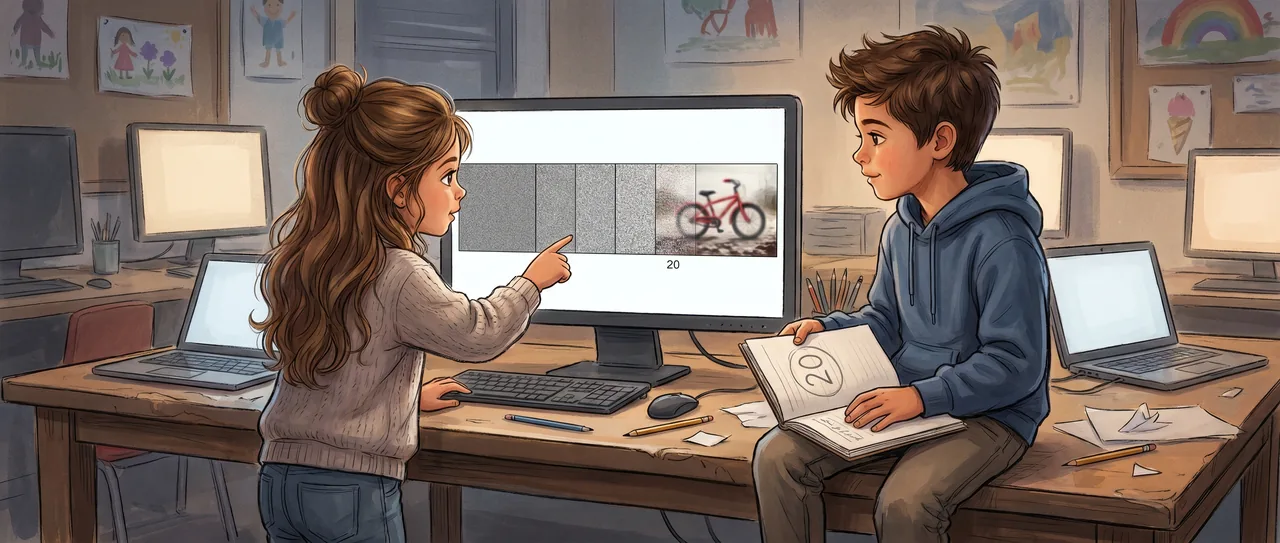
Step one looked like pure static. So did step two. And three. But at step four, something shifted. The static wasn't uniform anymore. There were darker clumps, lighter regions. By step ten, Maya could almost see a shape forming in the center, something curved. By step twenty, it was unmistakably round. A wheel.
Then it fell apart. Steps twenty-one through fifty dissolved the wheel back into noise, like watching someone erase a chalk drawing by rubbing harder and harder.
"Soren. Come here."
He brought his notebook, already open to a page where he'd been recording his own step numbers. He watched her replay the sequence.
"It finds it," he said slowly. "And then it loses it."
"Why would it un-find something?"
Soren sat down on the edge of her table. "Priya said the model learns by watching noise get added to real images. Millions of them. A clean photo gets a little noise, then more noise, then more, until it's pure static. The model learns to go backward. Take away the noise. Recover the image."
"So it knows what a bicycle looks like because it's seen a million bicycles get destroyed."
"Basically."
Maya stared at the frozen step twenty, the ghost wheel. "It's finding the bicycle. It knows where the bicycle is inside the static. And then something goes wrong in the second half."
Soren flipped to a clean page and drew a line from left to right. He marked step one on the left, step fifty on the right, and drew a little peak at step twenty. "Here's where it's closest. What if it's not going wrong? What if it just doesn't know how to finish?"
"What do you mean?"
"Priya said this model was trained on less data than normal. Way less. So maybe it learned the big shapes, the general idea of what a bicycle is. But it didn't see enough examples to learn the details. The spokes. The texture of the gravel. So when it gets past the rough shape and tries to add fine detail, it doesn't have anything to draw from. It's guessing. And the guesses are noise."
Maya pulled up the debug view on his screen too, and typed the same prompt. They watched together. The same ghost wheel appeared at step twenty and dissolved.
"Run it again," she said. "Different prompt. Try something simpler. Something with fewer details to get right."
Soren typed: "White circle on a black background."
They watched. By step fifteen the circle was there, wobbly but real. And this time it survived. Step thirty, step forty, step fifty. The final output was a slightly lumpy white circle on a dark gray background. Not perfect. But there.
"It can finish simple things," Soren said.
"Because it saw enough plain shapes to know how to get all the way back." Maya was already typing again. "Red circle on a black background."
The circle appeared. Survived. The red was more of an orange, but it held.
"Blue square."
It held.
"Bicycle."
Ghost wheel at step twenty. Static by step fifty.
Maya sat back. "It knows what things look like but it doesn't know enough to get all the way home."
Soren was quiet for a moment. He was reading over his notes, the step numbers, the results. Then he said, "What if we stopped it early?"
"What?"
"If step twenty is where it's closest to a real image, what if we just don't let it do the last thirty steps? We pull the picture out while it still looks like something."
Maya found the settings panel. There was a field for total diffusion steps. She changed fifty to twenty and typed "Red bicycle on a gravel path."
The output was blurry. Smeared. But there was a bicycle in it. Two wheels, a frame, a suggestion of red, a ground that was lighter than the sky. It looked like a painting done from memory by someone who had seen a bicycle once, years ago, through rain.
"That's beautiful," Soren said.
Priya appeared behind them. "Oh, you got output. Nice. Wait, that's only twenty steps? That's going to be really rough."
"We know," Maya said. "The model loses it after twenty. It finds the shape and then destroys it trying to add details it doesn't know."
Priya blinked. "That's. Actually that's a really precise diagnosis. The model is undertrained on high-frequency features. Low-frequency structure is intact." She said it like she was confirming something she already knew but hadn't expected them to find.
"Can I ask something?" Soren said. "The big models, the ones trained on millions and millions of images. They go all the way through. They finish. They get the spokes and the gravel and everything."
"Yes."
"So the only difference between this model and those is how many destroyed pictures they've watched."
Priya nodded.
"That's what understanding is? Just seeing enough things fall apart that you learn how to put them back together?"
Priya opened her mouth, then closed it. She looked at the blurry bicycle on the screen. "I'm going to think about that," she said, and walked back across the room.
Maya and Soren sat with the ghost bicycle between them. It shimmered in its twenty-step blur, a thing almost remembered, almost real, pulled back from pure noise by a machine that had watched enough destruction to learn the shape of creation but not enough to finish the job.
Soren picked up his pencil and wrote the number twenty in his notebook and circled it. Maya typed one more prompt.
"Ocean."
She set the steps to twenty and pressed Generate, and they both leaned forward to watch the static begin, so slowly, to remember what water looked like.
Read the interactive version, listen to the narration, and earn a gold star →
A science-verified short story for curious kids · Curiosity Land