The Thread That Would Not Break
Maya had already broken eleven threads.
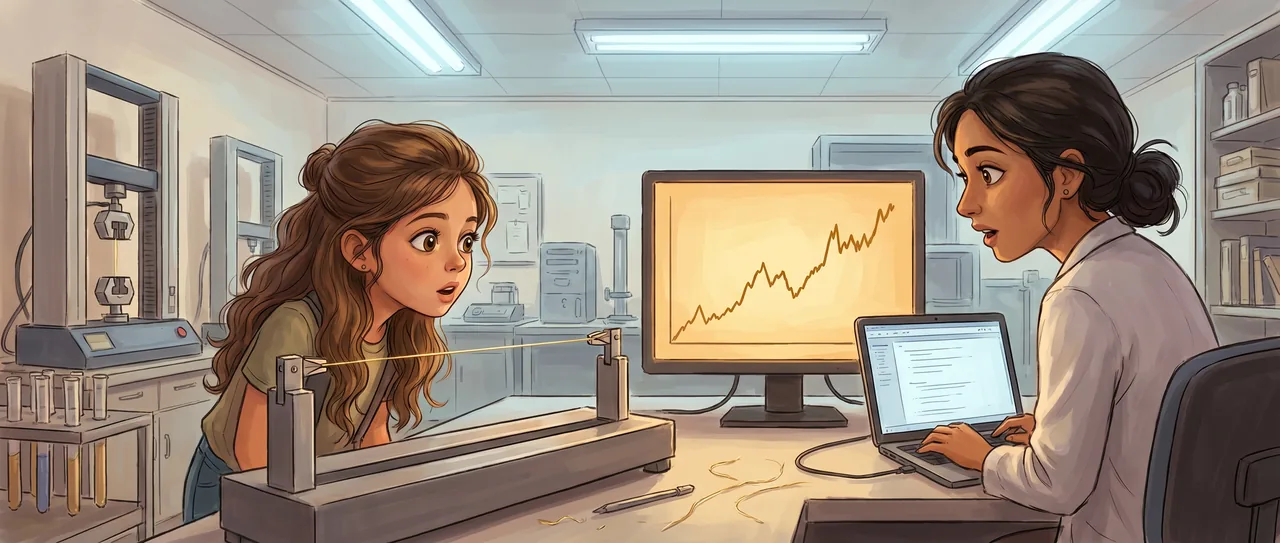
That was the whole point of the machine. You clamped a fiber between two tiny jaws, pressed the green button, and the jaws pulled apart, slowly, steadily, until the fiber snapped. The computer drew a curve on the screen: how much force, how much stretch, how much energy the thread absorbed before it gave up.
The university called it "Materials Weekend." Twelve kids got to use real equipment. Most of them were across the hall, firing lasers at crystals, which was admittedly more exciting-looking. Maya had chosen the tensile testing station because the sign said YOU WILL BREAK THINGS, which seemed honest.
Dr. Kapoor, the postdoc running the station, had set out a tray of labeled samples. Nylon. Kevlar. Steel wire. Carbon fiber. And, in a tiny glass vial with a handwritten label, something called Sample S.
"Work through them in order," Dr. Kapoor said, already turning back to her laptop. She was writing a grant proposal, Maya could tell, because she kept muttering numbers at her screen and forgetting Maya was there.
Maya worked through them in order.
Nylon stretched a lot before it broke. The curve on the screen was a slow hill. Steel barely stretched at all, then snapped, a cliff edge. Kevlar was impressive, steep and tall, absorbing enormous force. Carbon fiber was strong but brittle, the curve spiking high and then dropping straight down, like a building collapsing.
She wrote the numbers on the worksheet Dr. Kapoor had given her. Then she opened the glass vial.
Sample S was almost invisible. A single strand, thinner than a hair, coiled around a tiny cardboard spool. Maya held it up to the fluorescent light and could barely see it.
"Dr. Kapoor? What is Sample S?"
"Hmm?" Dr. Kapoor looked up. "Oh. Dragline silk. From a golden orb weaver. Nephila. One of my advisor's old samples."
"Spider silk."
"Yes. Be careful with it, it's the only one we have."
Maya clamped it between the jaws. It was so thin she had to hold her breath to keep it from drifting. She pressed the green button.
The jaws pulled. The curve began to rise.
It rose steeply, like steel. Then, where steel would have snapped, the silk kept going. It stretched. Not loosely, like nylon. It stretched while holding enormous tension, the curve bending but still climbing, still climbing. The number on the force readout kept ticking upward and Maya felt her shoulders tighten because everything else had broken by now.
The silk finally snapped at a stretch of almost thirty percent. The curve on the screen was unlike anything she had seen all morning. It was not a hill. It was not a cliff. It was a hill that kept deciding to become a cliff and then changed its mind, over and over, absorbing more energy each time.
Maya stared at the area under the curve. She had done enough of the worksheet to know what that area meant. It was toughness. Total energy absorbed before breaking.
"Dr. Kapoor."
"Hmm."
"This is wrong."
Dr. Kapoor looked at the screen. She stopped muttering. "No," she said, slowly. "That's right."
"But it's stronger than the steel. Per unit weight."
"About five times stronger, yes."
"And tougher than the Kevlar."
"About three times, yes."
Maya looked at the strand in the jaws. Both broken ends had curled slightly, like they were relaxing after a long effort. "So why is it in a glass vial with a handwritten label? Why isn't it in everything?"
Dr. Kapoor laughed, and for the first time she actually closed her laptop. "Now you're asking the question."
"What question?"
"The one my whole field has been stuck on for twenty years."
Dr. Kapoor pulled her stool over. "A spider makes this silk inside its body. It starts as a liquid protein, a kind of gel. It flows down a narrowing duct. The acidity changes along the duct. The water gets pulled away. The protein molecules fold, and they fold exactly right, into crystals connected by stretchy chains. The spider controls the speed it pulls the silk. The thickness. The molecular structure. It does this at room temperature, using water as a solvent, producing no waste. And the result is what you just saw on that screen."
"So copy it," Maya said.
"We've tried. Everyone has tried. We've put the spider silk genes into bacteria. Into goats. Into silkworms. We can make the proteins. We just can't spin them correctly. The fiber we produce is always worse. Weaker. Less tough. The spider does something during the spinning that we cannot replicate. The exact way the molecules fold, the exact transition from liquid to solid, under exactly the right forces at exactly the right moment."
Maya looked at the broken thread again. "The spider doesn't know any of this."
"No."
"It doesn't know it's doing materials science."
"No. Four hundred million years of evolution built that spinning process, and we cannot reverse-engineer it. We can map the genes. We can sequence the proteins. We can image the silk with electron microscopes. We still cannot make it."
Maya sat with that. She had come to the station expecting that breaking things would be the interesting part. But the interesting part was the thing she couldn't break enough. The thing that was, gram for gram, stronger than any material humans had ever manufactured, and it was made by an animal that weighed less than a paperclip, from a body that ran on insects and dew.
She thought about the curve on the screen. The way it kept not-breaking. The way it stretched and held, stretched and held, absorbing energy that would have shattered carbon fiber, that would have snapped steel.
"What if the problem isn't the protein," Maya said. "What if the problem is that we're trying to build a factory that does what a body does."
"That is exactly the problem," Dr. Kapoor said. "And whoever solves it will change everything. Buildings. Bridges. Surgical thread. Space tethers. Everything."
"Has anyone tried letting the spider teach us? Not copying the gene, but copying the duct? The physics of the duct?"
"Some labs are starting to. Microfluidic spinners. It's early."
Dr. Kapoor opened her laptop again. Maya barely noticed.
She was looking at the two curled ends of the broken silk, each one thinner than thought, each one still holding its shape in the metal jaws like it remembered what it was supposed to be.
Read the interactive version, listen to the narration, and earn a gold star →
A science-verified short story for curious kids · Curiosity Land