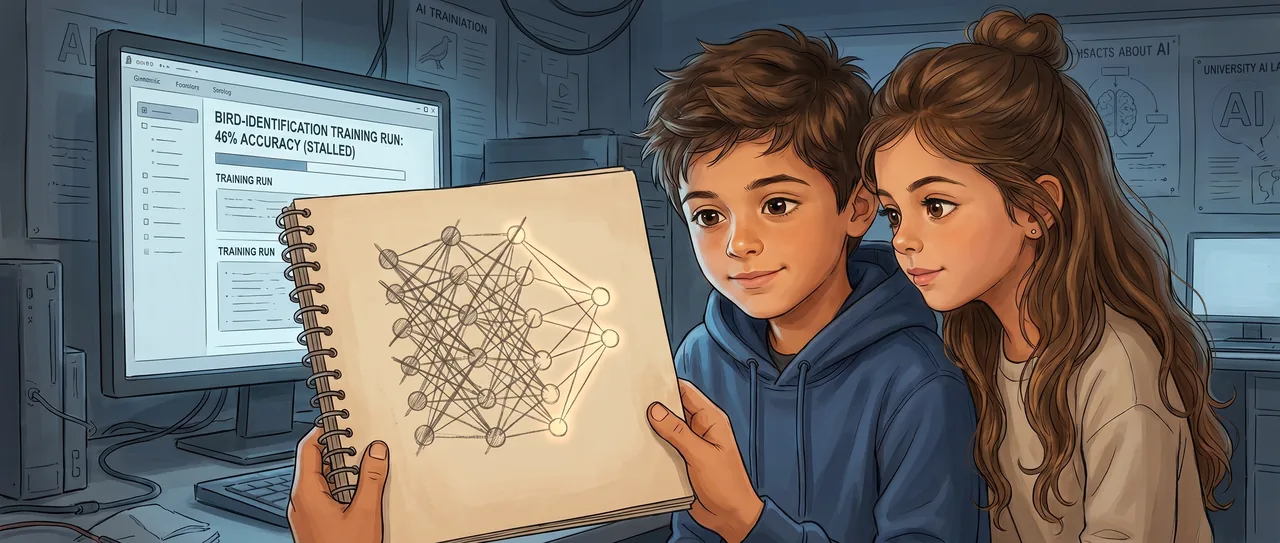
The Smaller Net
The neural network on the screen had fourteen million connections, and it was failing.
Dr. Vasquez didn't seem bothered. She was eating a granola bar and scrolling through error logs with her other hand, barely glancing at Maya and Soren, who had been assigned to shadow her lab for the afternoon. The university's open house program was supposed to pair middle schoolers with researchers. Dr. Vasquez had apparently forgotten they were coming.
"So it's learning to identify birds," Soren said, reading the project description taped to the monitor.
"Trying to," Dr. Vasquez said. "Give it a minute."
Maya watched the training run. Each cycle, the network processed thousands of bird photos, adjusted its millions of connections, and reported its accuracy. Forty-one percent. Forty-three. Forty-two. It kept stalling, jittering around the same mediocre number like a ball stuck in a rut.
"It's too big," Maya said.
Dr. Vasquez looked at her for the first time. "What?"
"I don't know. It feels too big. Like it's tripping over itself."
"That's not really how neural networks work," Dr. Vasquez said, not unkindly. She turned back to her logs.
Soren had his notebook out. He'd drawn a rough sketch of the network diagram from the whiteboard behind them: layers of nodes, dense webs of connections between each layer. He was counting. "How many of those connections actually matter?" he asked.
"All of them. That's the point of a large network. Capacity."
"But do they all end up doing something?" Soren pressed.
Dr. Vasquez paused mid-chew. "After training, lots of them end up near zero. We prune those. Standard procedure. Train big, then cut it down."
"So you build something enormous," Maya said, "and then throw most of it away."
"Welcome to deep learning."
Dr. Vasquez's phone rang. She held up one finger, answered, and walked into the hallway, leaving them alone with the stuttering network.
Maya pulled a chair over to the second workstation, which had the pruning tool loaded. She could see a previous experiment: a network trained to ninety-one percent accuracy on bird identification, then pruned. Eighty percent of the connections removed. The pruned version still hit ninety percent.
"Soren. Look at this."
He came around. Together they stared at the numbers. A network where eighty percent of the connections could be deleted after training and it barely noticed.
"So there's a small network hiding inside the big one," Soren said slowly. "The twenty percent that actually learned."
"But you only find out which twenty percent after you've already done all the work."
"Right." Soren flipped to a new page. "It's like buying a hundred lottery tickets and then discovering that only one of them won, and then saying, well, I only needed that one ticket."
Maya sat very still. "Say that again."
"It's like a lottery. Most of the network is losing tickets. But you can't know which ticket wins until after the drawing."
"Unless you could."
She started opening files. The lab's shared drive had folders and folders of experiments. She found one labeled LTH and clicked it open.
"Lottery ticket hypothesis," Soren read from the README file. "Okay. So this is a real thing."
It was. The documents described exactly what they'd stumbled into. Researchers had discovered that inside large neural networks, there exist much smaller subnetworks that, if you could identify them at the very beginning, before any training, could learn just as well as the full network. The same accuracy. A fraction of the size. They called these subnetworks winning tickets.
The catch was brutal, and Maya felt it like a door slamming. To find the winning ticket, you had to train the full network first. Then prune. Then rewind the surviving connections back to their original values and train again. It worked, proving the small networks existed. But it didn't save you anything, because you still had to train the giant network to figure out which small piece to keep.
"It's like having to read every book in the library to find the one book you needed," Soren said.
"And nobody's figured out how to just walk to the right shelf."
They read further. Paper after paper. Nobody had found a reliable way to identify winning tickets at initialization. Not from the structure. Not from the starting weights. The small network was in there from the beginning, but it was invisible. It only revealed itself through the process it was supposed to replace.
Maya pushed back from the desk. Something about this bothered her in a way she couldn't name, and she had learned to pay attention to that feeling.
"It's us," she said.
Soren looked up.
"Think about it. Think about school. There are thirty kids in a classroom and the teacher teaches everybody the same thing the same way. And then afterward you can see which kids actually got it. Which ones were ready for that particular thing. But you can't know beforehand. So you teach everybody."
"You're saying we're nodes in a network."
"I'm saying the problem is the same problem. You have a huge system. Somewhere inside it are the parts that will actually do the work. But the only way to find them is to run the whole system. Nobody can look at the starting conditions and predict."
Soren was quiet for a long time. He looked at his notebook, at the rough sketch of the network, at all the lines connecting all the nodes. Then he started carefully crossing out connections, one by one, leaving just a sparse web. A small network inside the big drawing.
"But the winning ticket is there from the start," he said. "That's the whole point. It's already there. Before any training happens. The structure that will work is already present. We just can't see it yet."
Maya felt the room get larger.
Because if that was true of networks, and if the parallel held, then every system that seemed wasteful and oversized might contain a hidden efficient structure that was already present, already capable, just waiting to be found. Not created by the training. Already there.
And nobody, in any field, anywhere, had figured out how to see it.
Dr. Vasquez came back, still on the phone, and waved at them distractedly. On the main screen, the big network had crawled to forty-six percent. Fourteen million connections grinding away, almost all of them doing nothing that mattered, carrying a tiny brilliant structure on their backs like an ocean carrying a single perfect wave.
"The question isn't how to build a better network," Maya said quietly.
"It's how to see what's already there."
Dr. Vasquez hung up. "Sorry about that. Where were we?"
Soren turned his notebook around so she could see his drawing of the small network, the sparse skeleton inside the dense web, the crossed-out connections, and the few lines left standing.
Dr. Vasquez set down her granola bar.
She pulled over two chairs.
Read the interactive version, listen to the narration, and earn a gold star →
A science-verified short story for curious kids · Curiosity Land