The Ratio
The third batch crumbled in Soren's hands.
He turned the gray chunk over, pressing his thumb into it. It gave like wet chalk. Tiny craters pocked the surface where water had been and wasn't anymore, and when he squeezed, the whole thing dissolved into gritty dust.
"This one's worse," he said.
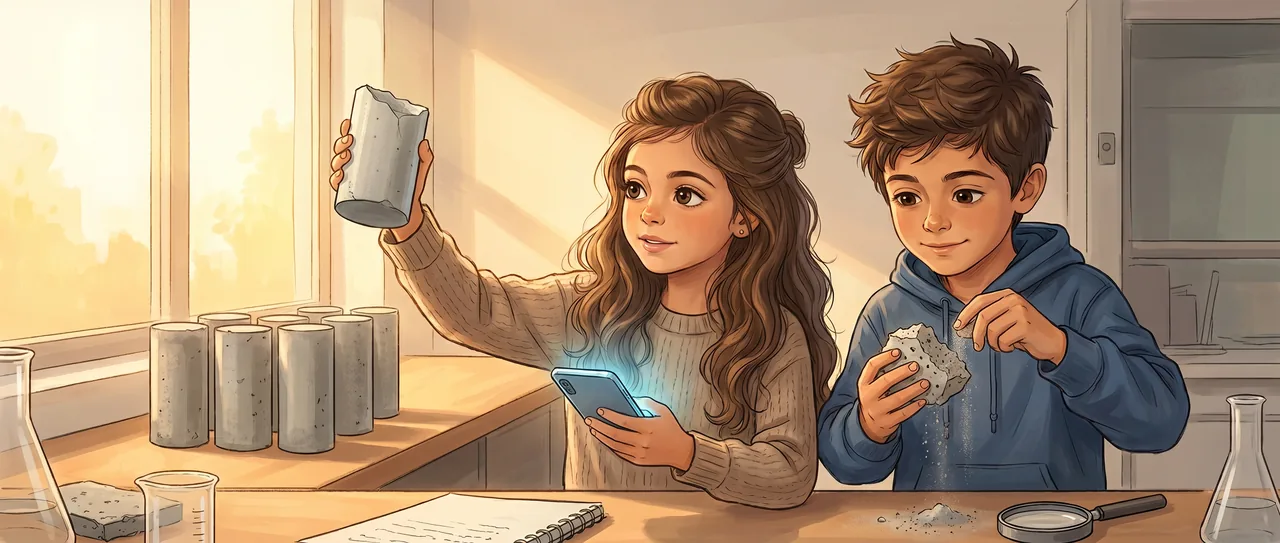
Maya was already looking at the row of six test cylinders they'd made that morning, lined up on the lab bench like gray candles. Dr. Alawi had let them use the university lab for the community bridge project, shown them how to mix the batches, then disappeared into her office to grade papers. She'd given them the recipe. She had not given them much else.
"Batch one, batch two, batch three," Maya said, pointing down the line. "One is rock. Two is okay. Three is chalk. What did we change?"
"Nothing." Soren flipped back through his notebook. "Same cement. Same aggregate. Same water. I measured everything."
"You measured everything the same?"
"I measured everything the same."
Maya picked up the batch one cylinder and knocked it against the bench. It rang. She picked up batch three and knocked it. It thudded, dull and flat, and a piece chipped off.
Soren stared at his notebook. He'd written the ratios. He'd written the amounts. He'd written the time of mixing. And then he saw it.
"Wait." He ran his finger down the page. "Batch one I mixed at nine twelve. Batch three I mixed at eleven forty."
"So?"
"So by eleven forty it was hot in here. I remember because I rolled up my sleeves." He looked at the window, where noon sun was now pouring across the bench. "And batch three was thick. Hard to pour. So I added a little splash of water to make it flow better into the mold."
Maya's eyes narrowed. "How little?"
"Like, a cup?"
"Soren."
"Maybe a cup and a half."
Maya took batch one and batch three and held them side by side. She tilted them both toward the window light. Batch one was dense, smooth on its broken face, almost glassy. Batch three was full of tiny holes, like a sponge pretending to be stone.
"The water left," she said. "It evaporated. And everywhere it used to be, there's nothing."
"Pores," Soren said. He wrote it down. "More water, more pores. More pores, less strength."
"So the recipe isn't just ingredients. It's the ratio. The exact ratio of water to cement."
Soren looked at the crumbled remains of batch three. "The extra water made it easier to pour but the concrete didn't need it for the chemistry. It was just, sitting there. Taking up space. And then it left and took the strength with it."
They were quiet for a moment. Maya set both cylinders down.
"So for the bridge repair, we need to get the ratio right. Not just close. Right."
"Right," Soren said. Then he frowned. "But Dr. Alawi said modern concrete lasts maybe a hundred years. Hundred and fifty if you're lucky. That doesn't seem like enough for a bridge."
"How long does a bridge need to last?"
"Longer than us."
Maya pulled out her phone and started scrolling. Soren watched her face change. First concentrating. Then confused. Then something else.
"Soren. The Romans built a harbor called Portus Cosanus. Concrete, in the ocean. It's been in saltwater for two thousand years and it's stronger now than when they built it."
"That doesn't make sense."
"I know."
"Saltwater destroys modern concrete. The chloride ions corrode the steel reinforcement. Every marine engineer knows that."
"The Romans didn't use steel reinforcement."
Soren put his pen down. "What did they use?"
"Volcanic ash. Mixed with lime. And they used seawater on purpose. Not fresh water. Seawater."
Soren looked at batch three, full of its tiny empty rooms. "We add extra water and it makes our concrete weaker because the water just evaporates and leaves holes. But if the water actually reacted with the mix, chemically, became part of the structure instead of just sitting there..."
"The seawater reacted with the volcanic ash," Maya said, reading. "It created new minerals inside the concrete. Aluminum tobermorite. Phillipsite. They grew in the pores, Soren. They filled them in. The ocean didn't destroy the concrete. It kept feeding it."
Soren opened his mouth and closed it.
"For two thousand years," Maya said. "The seawater keeps seeping in and keeps reacting and the concrete keeps getting stronger. It's not decaying. It's growing."
The lab was very quiet. Sun moved across the bench. Somewhere in her office, Dr. Alawi's keyboard clattered.
"So the Romans made a material," Soren said slowly, "that uses the thing that's supposed to destroy it as food."
"And we still can't do it. We know it works. We've studied the samples. We can see the minerals. But nobody's been able to reproduce it at scale. Not yet."
Soren picked up the batch one cylinder. Dense. Strong. Modern. It would last a hundred years and then it would crumble, just like batch three, just slower. He set it down and looked at the dust of batch three, still on his fingers.
"We're getting the ratio wrong," he said. "Not just the water ratio. The whole idea of the ratio. We think of water as the thing you minimize. The enemy. Use as little as you can get away with. But the Romans made water part of the structure. They made it belong there."
Maya was looking at him with that expression she got when something was connecting.
"The thing that makes you weak," she said. "What if you could make it make you stronger. Not by keeping it out. By changing what happens when it gets in."
She was not talking about concrete anymore. Or maybe she was. Soren wasn't sure it mattered.
Dr. Alawi's door opened. She leaned out, glasses pushed up on her forehead. "How are the test pours? Did batch three come out all right? I saw you added water."
"It crumbled," Soren said.
"Good," Dr. Alawi said. "Now you know why we don't do that. Ready to mix the real batch for the bridge?"
"Almost," Maya said. "Dr. Alawi, has anyone in your department studied Roman marine concrete?"
Dr. Alawi's eyebrows rose. She looked at Maya, then at Soren, then at the six cylinders on the bench and the dust on Soren's hands.
"No," she said. "But I know someone at Woods Hole who has. Why?"
Maya looked at Soren. Soren looked at the pores in batch three, the tiny empty rooms where water used to live, waiting to be filled with something that hadn't been invented yet.
"We have a question," Maya said.
Dr. Alawi pulled over a chair, then reached back for a second one.
Read the interactive version, listen to the narration, and earn a gold star →
A science-verified short story for curious kids · Curiosity Land