The Ones That Hold On
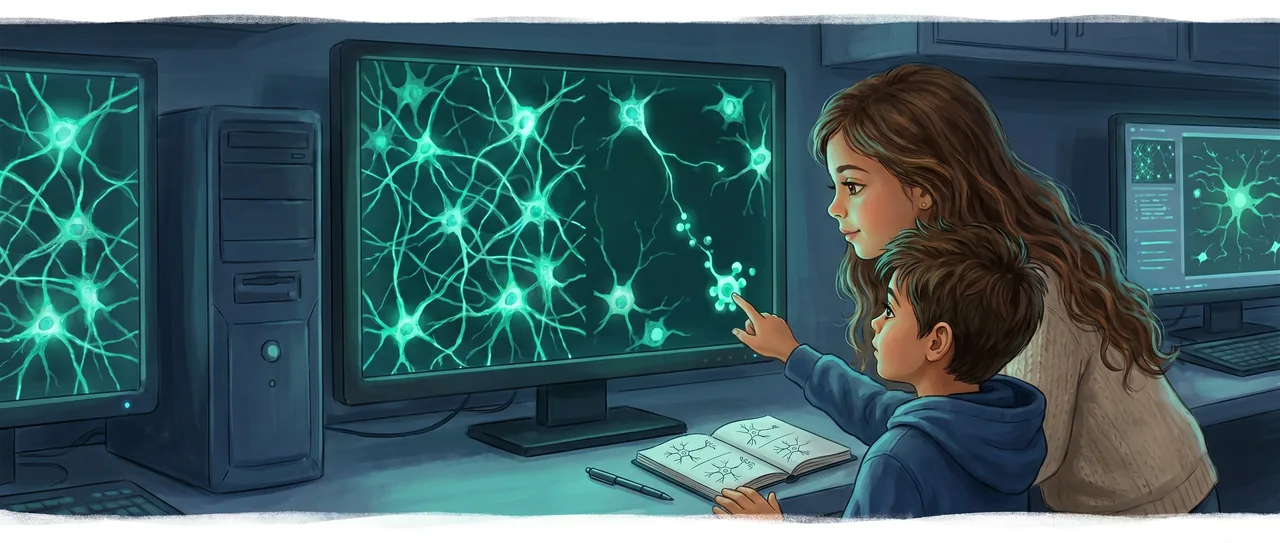
The neuron on the screen was dying.
Maya watched it happen in time-lapse, the cell rounding up like a fist closing, its membrane blistering into small bright bubbles. The whole process took eleven hours in real life. On the screen it took nine seconds.
"That's not damage," she said. "It's doing that on purpose."
Soren leaned closer. "How can you tell?"
"Look at the ones next to it. They're fine. Nothing hit them, nothing infected them. This one just. Stopped."
Dr. Achebe had left them alone twenty minutes ago to take a phone call that she described as "a catastrophe involving a grant deadline and my own poor life choices." She had set up the time-lapse recordings on three monitors, told them not to touch the actual microscope, and disappeared down the hall.
The lab was cold and smelled like plastic and something faintly sweet that Soren couldn't name. He had his notebook open. He'd drawn the neuron four times already, at different stages of its collapse. Each drawing was small and precise.
"Play it again," he said.
Maya dragged the slider back. The neuron reassembled itself, its long axon stretching out like a hand reaching for something. For a few frames, the reaching arm almost touched another cell. Almost. Then it pulled back, curled, and the dying started again.
"It didn't connect," Maya said.
"What?"
"It was reaching for something and it didn't get there. That's why it died."
Soren looked at her, then back at the screen. "That's a guess."
"Yeah." She didn't look away from the monitor. "Play the next file."
The next recording showed a wider field. Dozens of neurons, time-lapsed over what the file label said was seventy-two hours. It looked like a city being built and demolished simultaneously. Cells extended axons in every direction, threading between each other, branching, searching. Some found partners. Their connections thickened and stabilized, turning bright under the fluorescent staining. Others reached and reached and found nothing, and those cells, one by one, collapsed the same way the first one had. Quietly. Precisely. From the inside.
Soren counted. He couldn't help it. In the first frame there were maybe forty cells he could distinguish clearly. By the final frame, he counted nineteen.
"Half," he said. "Roughly half of them are gone."
"The ones that connected survived," Maya said. "The ones that didn't, died. Every time."
"Every time?"
"Find me one that didn't connect and survived."
Soren went through frame by frame. It took him a while. He traced individual cells with his fingertip on the screen, following their reaching arms, checking whether they found a target. Maya watched him do it without interrupting.
"I can't," he said finally. "You're right. If they connected, they lived. If they didn't, they died."
They sat with that for a moment.
"This is from a developing brain?" Soren asked.
"It says embryonic cortical tissue. So yeah. A brain that's still being built."
"Half the neurons die."
"Half the neurons are supposed to die. That's the thing. They're not failing. The ones that die are doing exactly what they're programmed to do. Die, unless they have a reason not to."
Soren put his pen down. "That's backwards."
"What do you mean?"
"I mean, you'd think the default would be to live. And then something kills the ones that aren't needed. But this is the opposite. The default is death. And connecting to another cell is what saves them."
"The signal to live comes from the connection," Maya said. "Not from inside."
Soren stared at the frozen frame. Nineteen survivors out of forty. Each one linked to at least one other cell, axons woven together like fingers interlaced.
Dr. Achebe came back smelling like coffee, her phone still in her hand. "Sorry, sorry. The grant will survive. Probably. Did you break my microscope?"
"No," Maya said. "Why do half the neurons die?"
Dr. Achebe blinked. "Oh. You found the apoptosis recordings. Good ones, right? Very clean."
"But why does the brain make twice as many as it needs and then kill half?"
"That is an excellent question that I am going to answer with a worse question." Dr. Achebe sat down heavily in her chair. "How would the brain know in advance exactly which connections will be needed?"
She let that hang there for a second, then her phone buzzed again and she looked at it and sighed. "I need fifteen more minutes. Don't touch the microscope. Touch anything else you want." She was already walking out.
Soren picked up his pen again. "She's right. You can't pre-plan a network that complicated. So you overproduce and let the network sort itself out."
"The connections decide who lives," Maya said. "Not some blueprint. Not some plan from the top. The cells that find each other, keep each other alive."
"So the brain you end up with isn't the brain you were given. It's the brain that built itself. Connection by connection."
Maya pulled up the first recording again. The single neuron reaching, not quite arriving, folding quietly into death. She watched it three times.
"Does that bother you?" Soren asked.
"No," Maya said. Then, "Yes. Because this is happening right now. In actual babies being born today. Half their neurons are dying so the other half can mean something."
"It's not random, though. That's what makes it okay. The ones that survive aren't lucky. They're the ones that found something worth holding onto. Or something that held onto them."
Maya looked at him. There was something in her face that Soren had seen before, the expression she got when a pattern she'd been tracking suddenly matched a pattern she hadn't expected.
"You know what that means," she said. "About us. About right now. Every thought you're having, you're only having it because those specific neurons held on. Not the ones that were strongest. The ones that connected."
Soren looked down at his notebook. At the four drawings of a dying cell. At his own handwriting, which he'd always thought of as just a weird habit, putting things outside his head because his head felt too small.
"Soren."
"Yeah."
"Your brain kept the neurons that reached for things. That's literally what's happening when you write things down. You're a brain that was built by reaching."
He didn't know what to say to that. On the screen, the time-lapse played on, cells extending axons in silence, half of them destined to disappear, the other half building something that could think about what it was.
Maya reached over and dragged the slider back to the beginning, to the moment before any of them had found each other, when every single cell was still alive and reaching.
Read the interactive version, listen to the narration, and earn a gold star →
A science-verified short story for curious kids · Curiosity Land