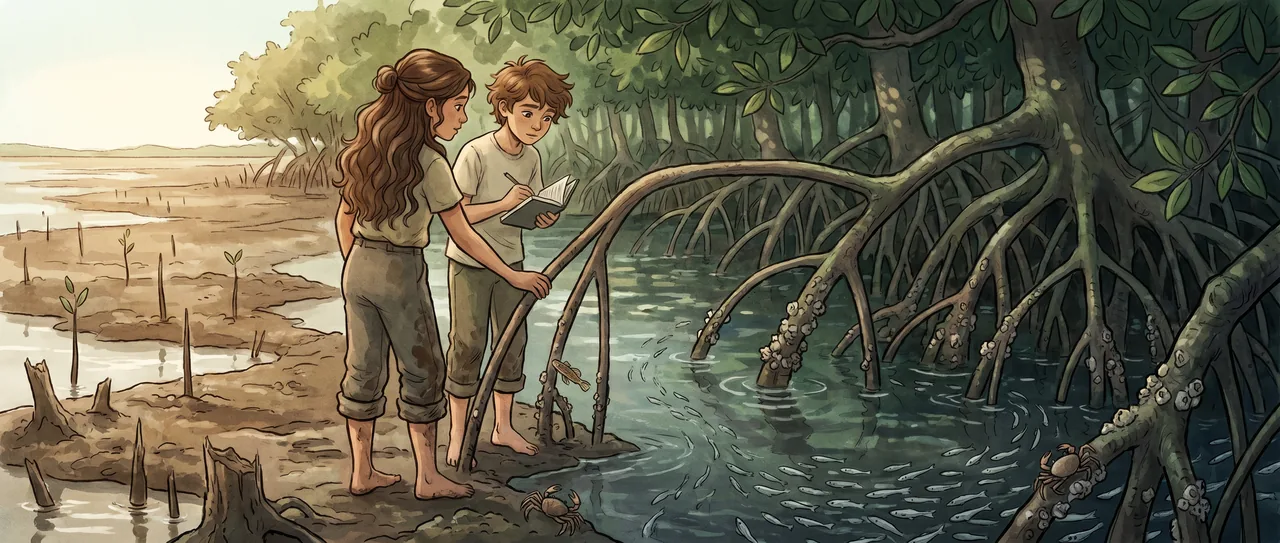
The Nursery
The first thing Soren noticed was that the dead zone had fish.
Not many. But enough. Tiny silver shapes flicking between the stumps of mangroves that had been cut down before he was born. He crouched at the edge of the mud channel, his notebook already open, and counted seven, then lost track when the light shifted.
Maya was twenty meters ahead, shin-deep in tidal mud, jabbing a propagule into the ground with a motion the volunteers had shown them that morning. Stick it in. Push. Move on. She had already planted forty-one. Soren had planted nine. He kept stopping.
"There are fish in here," he called.
Maya looked up. Mud streaked her forearms to the elbows. "There are fish everywhere. It's the ocean."
"No, but these are juveniles. Little ones. And they're in the stumps, not the open water."
She waded back toward him, leaving her bucket of propagules tilted in the mud. She looked where he was pointing.
"They're hiding," she said.
"From what?"
"Everything. That's what baby fish do."
Soren wrote that down, then looked at the stumps again. The roots were still there, tangled under the surface. Cut off at the waterline but reaching into the mud below like fingers gripping earth. Even dead, they made a maze. The tiny fish threaded through it.
"Ms. Choudhury said seventy-five percent of tropical fish species use mangrove roots as nurseries," he said.
"She said that to the whole group, Soren."
"I know. I'm saying it's real. Look at them. The roots are gone and they're still coming."
Maya squatted beside him. She was quiet for a moment, which meant she was actually looking.
"The stumps are doing something," she said. "Even cut down. The roots underneath are still a maze."
"A worse maze."
"Better than nothing."
They watched the fish. A heron landed on a stump thirty meters out, surveyed the channel, and lifted off again. Too shallow for the heron to hunt. Just deep enough for fry to survive.
Ms. Choudhury had been running this volunteer replanting for three years. She was busy. Genuinely busy, the kind of busy where she forgot she was holding a water bottle and gestured with it until it went flying. She had told them that morning, while distributing propagules, that mangrove forests store carbon in their roots and sediment at rates that match tropical rainforests. She said it the way someone says a thing they have said four hundred times. She did not say it with wonder. She said it with the specific exhaustion of someone who cannot believe she has to keep saying it.
Now she was arguing with a supply boat captain about delivery timing. Soren could hear her voice rising across the flats.
"I want to see something," Maya said. She pulled off her shoes, already soaked, and waded into the channel toward the intact mangrove stand that bordered the replanting zone. The transition was sharp. One side: stumps, open mud, glare. Other side: a wall of green.
Soren followed. Of course he followed.
The moment they stepped under the canopy, the world changed. The air dropped five degrees. The water went from silty brown to something darker and clearer. And the roots. Soren stopped moving and just looked. Prop roots arched out of the trunks like legs, plunging into water, splitting, tangling, weaving together until you could not tell which root belonged to which tree. Between them, the water moved slowly, filtered.
It was full of fish. Not seven. Hundreds. Schools of fry so dense they moved like fabric, turning together, splitting around roots, reforming. Crabs climbed the roots at the waterline. Something Soren could not identify made a clicking sound, over and over, from somewhere in the tangle.
"This is what it's supposed to look like," Maya said softly.
"Yeah."
She turned back and looked at the open mudflat they had come from. The stumps. The glare. The forty-one tiny propagules she had planted, each one a pencil-thin stick poking out of the mud.
"Soren. How long do they take to grow?"
"Ms. Choudhury said three to five years before they start developing prop roots like these."
Maya pressed her lips together. "And half the world's mangroves are already gone."
"In fifty years. Yeah."
She reached out and touched one of the prop roots. Her fingers traced it down to the waterline where barnacles clustered at the boundary between air and sea. A tiny goby, no bigger than her thumbnail, darted out of a crevice and vanished into the maze.
"It's doing five things at once," she said. "The roots. They're holding the mud so the shore doesn't wash away. They're slowing storm surge. They're filtering the water. They're storing carbon underground. And they're a nursery. All at the same time. All just by being roots."
"That's more than five things," Soren said.
"I know."
The clicking sound came again. Soren finally spotted it: a snapping shrimp, tucked into the junction of two roots, one oversized claw cocked.
"When Cyclone Amphan hit," he said, "the villages behind intact mangroves lost fewer houses. Ms. Choudhury showed us the satellite data. You could see exactly where the mangroves were, because behind them the coast was still there."
"And where they'd been cut," Maya said.
"Gone."
They stood in the living mangrove stand and looked out at the planting zone. The propagules were barely visible. Tiny sticks. The stumps dwarfed them.
Maya took a breath. "So those seven fish in the stumps."
"Yeah?"
"They came back to roots that aren't even alive anymore. Because it's the only structure they have."
Soren thought about that. He thought about the goby the size of a thumbnail. He thought about the fact that three-quarters of all tropical fish species, at some point in their lives, need exactly this. This maze. This darkness. This shelter that is not one thing but a whole system pretending to be a tree.
He thought about how you could cut it down in a day and it would take five years to come back, and in the meantime everything that needed the maze would have to find the stumps instead, or nothing at all.
"We should go plant more," he said.
"Yeah."
Maya was already moving, back out into the glare, reaching for her bucket. But Soren saw her glance once more into the canopy, at the maze of roots disappearing into dark water, and he saw her count something on her fingers.
He pulled his bucket from the mud and waded to the next open patch of shoreline. Somewhere below the surface, a silver shape no bigger than a comma darted between two dead roots, looking for the forest that was coming.
Read the interactive version, listen to the narration, and earn a gold star →
A science-verified short story for curious kids · Curiosity Land