The Library That Breathed
The argument started because Soren said the word "off."
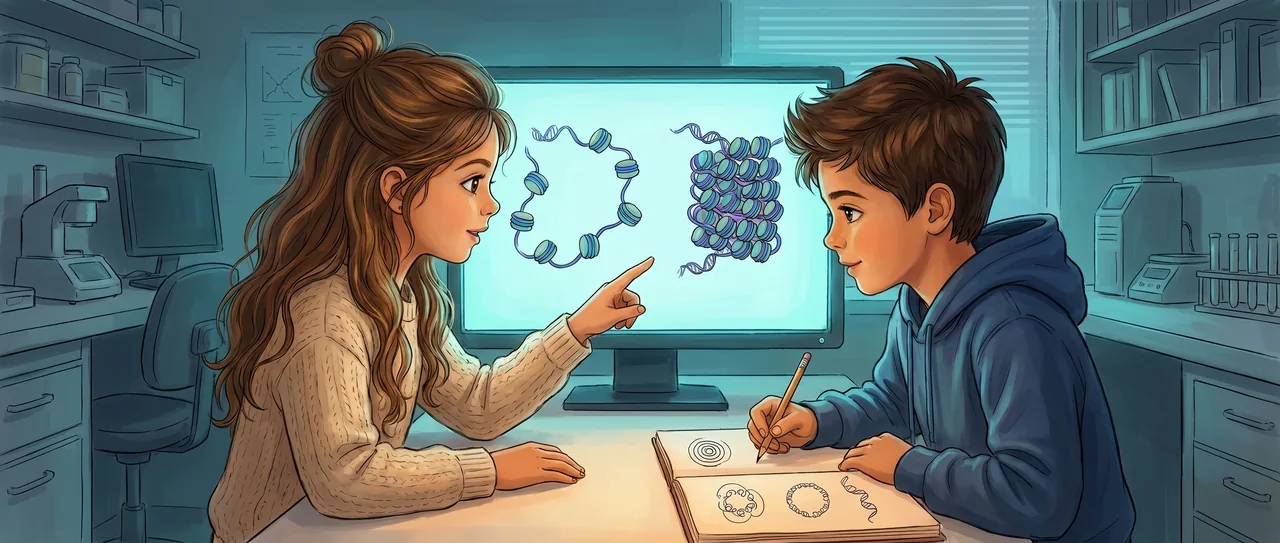
They were standing in Dr. Kapoor's lab, which smelled like the inside of a refrigerator and hummed with machines neither of them could name. The youth program had given them a workstation, a screen, and a chromatin visualization tool that let them zoom into a cell's nucleus and see how DNA was packed. Dr. Kapoor had shown them the basics in about four minutes, then said "Play with it, I have a grant deadline" and disappeared behind a partition where she could be heard typing furiously and muttering about budgets.
Soren had been zooming in on a liver cell when he said, "So some genes are just off."
Maya shook her head. "That's not what she said."
"She said genes can't be read when the DNA is wrapped too tightly. That means they're off."
"No. She said they can't be read. That's different."
Soren looked at her. "How is that different?"
Maya didn't answer right away. She was staring at the screen, where the visualization showed DNA coiled around clusters of small round proteins like thread wound around beads. The beads were histones. Dr. Kapoor had compared them to spools, but Maya thought they looked more like fists, clenching the DNA close.
"Zoom in on that part," Maya said, pointing to a region where the coils were packed so densely the DNA looked almost solid.
"That's heterochromatin," Soren said, reading the label. "Tightly packed. Genes in there can't be expressed."
"Right. Now find a loose part."
He scrolled. The landscape changed. The tight fists of histones relaxed into something more open, the DNA looping out in wide arcs between the protein spools, like thread that had been given slack.
"Euchromatin," Soren read. "Loosely packed. Genes accessible for transcription."
"Okay," Maya said. "So the same DNA. Same exact words. But some of it is readable and some isn't. Not because the words changed. Because of how tightly it's held."
"That's what I said. Some genes are off."
"But they're still there, Soren. The gene didn't disappear. The information didn't change. It's the wrapping."
Soren opened his notebook and drew two small circles with lines coiled around them. One tight, one loose. He stared at them. "So you're saying the difference between off and unreadable matters."
"A locked book isn't a blank book."
That stopped him. He looked back at the screen. The dense region of heterochromatin sat there, impenetrable, and somewhere inside it were genes with complete instructions that no cellular machinery could reach. Not deleted. Not damaged. Just held too close.
"Can the wrapping change?" he asked.
From behind the partition, Dr. Kapoor's voice came, distracted and half-directed at her screen. "Yes. Chemical tags on the histone tails. Acetylation loosens. Methylation can tighten. It's dynamic."
Then more muttering about budgets.
Soren pulled up the search function on the visualization tool and typed in a gene name from the reference sheet they'd been given. The tool found it and zoomed. The gene sat in a loosely packed region, its DNA curving gently between relaxed histones.
"That one's readable," he said.
Maya leaned in. "Now look up the same gene in a different cell type."
He switched the dataset from liver cell to neuron. Same gene. Same sequence. But now the histones gripped it tight, the DNA wound so close that the gene was buried.
"Same book," Maya said quietly. "Different binding."
Soren sat back. He was starting to feel the shape of something. Every cell in a human body carried the same DNA. The same complete library. But a liver cell and a brain cell read completely different books from that library, not because different books were written for them, but because different books were unwound for them. The histones decided what could be opened.
"So what makes a cell a liver cell isn't what genes it has," Soren said slowly.
"It's what genes it can reach."
He wrote that down. Then he crossed it out and wrote it differently. Then he crossed that out too.
"This is hard to say right," he admitted.
"Because it's weird," Maya said, and she was smiling the way she smiled when something was genuinely strange. "Every cell has every recipe. Every single one. But most of the cookbook is wound shut. And the cell becomes what it becomes because of which pages the histones let it open."
Soren looked at the two datasets side by side. The same genome, wrapped in two completely different patterns, making two completely different kinds of cell. Neither pattern was more correct. Neither was the real one. They were both the real one.
"Dr. Kapoor," he said, loud enough to carry past the partition. "Can the wrapping pattern be inherited? Like, passed to new cells when a cell divides?"
"Some of it, yes. Epigenetic inheritance. It's a whole field. Very messy. Very exciting." A pause. "Why?"
Soren didn't answer her. He was looking at Maya.
"So a cell can pass down not just the library," he said, "but which books are open."
"And which books are locked shut," Maya said. "And the daughter cell just trusts that. Never even tries to read the locked ones."
"Unless something changes the tags on the histones."
"Unless something changes the tags."
They sat with that for a moment. The lab hummed. Dr. Kapoor's typing resumed.
Maya reached over and zoomed out. The whole nucleus filled the screen now, a vast territory of coiled and uncoiled regions, tight fists and loose loops, and somewhere in that pattern was the answer to what kind of cell this was and what it could become and what it would never be unless something, some signal, some chemical tag, changed the grip of those small round proteins and let a locked page fall open.
"You know what gets me," Maya said. "It's not a switch. It's a fist. It can always let go."
Soren looked down at his notebook, at his two small circles with their coiled lines, and carefully drew a third one, halfway between tight and loose, the thread just beginning to unspool.
Read the interactive version, listen to the narration, and earn a gold star →
A science-verified short story for curious kids · Curiosity Land