The Hungry Garden
Maya's grandmother had not eaten since yesterday, and she was pulling weeds like she wanted to fight them.
"Abuela, you skipped breakfast again."
"Intermittent fasting," her grandmother said, not looking up. She yanked a thistle out by its roots and tossed it into the wheelbarrow. "My doctor says it is good for the cells. They eat themselves."
"That sounds terrible."
"You would think so." Her grandmother straightened up, pressing both hands into her lower back. "But here I am, sixty-seven years old, outworking you."
That part was true. Maya had cleared one raised bed. Abuela had cleared three. The October air was cold enough to see their breath, and the community garden was mostly empty. Everyone else had already put their plots to sleep for winter. Abuela always waited until the last possible day because she said the plants still had things to teach her.
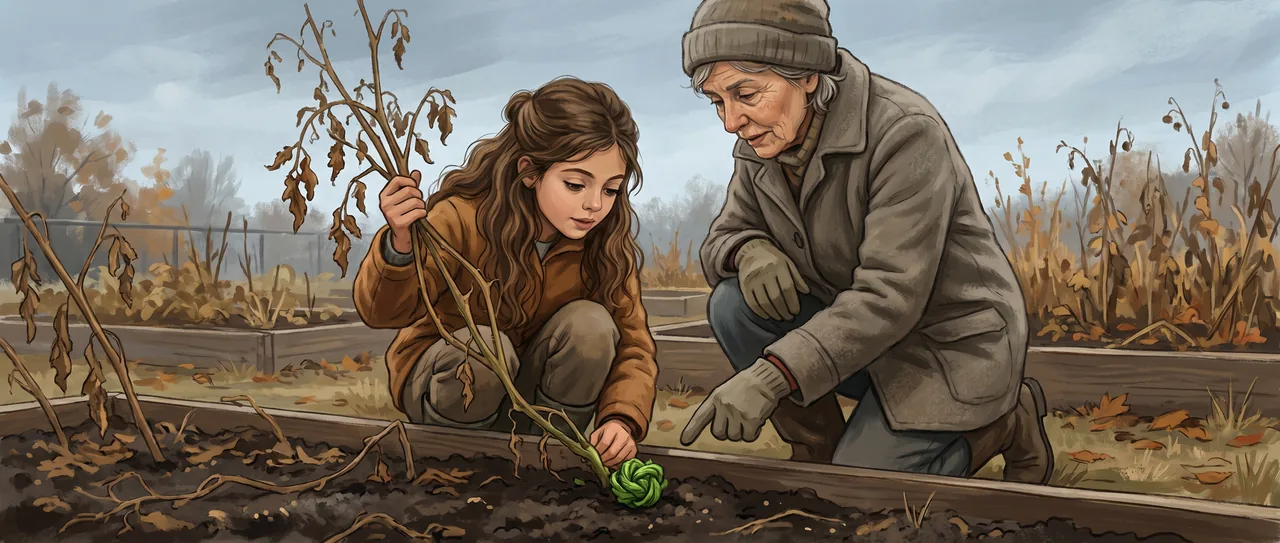
Maya dragged a dead tomato vine out of the soil. Brown, withered, collapsing. She held it up. "What's this one teaching?"
Abuela glanced over. "That one is teaching you to compost."
Maya dropped it in the wheelbarrow and crouched to look at the base of the plant, where the stem met the dirt. Something was bothering her. The vine was dead, clearly dead, brown and dry all the way to the tips. But down here, right at the soil line, there was a section that looked different. Greener. Tighter. Like the plant had pulled all its remaining life down into this one small knot.
"Abuela. Look at this."
Her grandmother came over and knelt beside her, which was a production that involved one knee, then the other, then a sound effect.
"The crown," Abuela said. "The plant is already recycling. Pulling everything useful down into what might survive."
"It's eating itself," Maya said.
Abuela looked at her sideways. "Now who sounds terrible?"
But Maya wasn't joking. She was staring at the green knot at the base of the dead vine and thinking about what her grandmother had said. The cells eat themselves. She'd heard about this in a video once, something about a Japanese scientist who won a Nobel Prize for figuring out how cells break down their own damaged parts and reuse the pieces. The word had been hard to remember. Auto-something. Self-eating.
Autophagy.
She sat back on her heels. "Wait. When you fast, your cells don't just starve. They clean house."
"This is what the doctor tells me."
"No, but, Abuela, listen. The cell has these little, like, stomachs inside it. And when the cell gets stressed, when there's not enough food coming in, those stomachs start grabbing the broken stuff. Old proteins. Damaged pieces. And they digest them and turn them back into building blocks."
Abuela pulled off her gardening gloves. "You learned this from a video?"
"From three videos. And I didn't believe the first two."
Her grandmother laughed, a real laugh that came from somewhere deep.
Maya picked up a brittle leaf from the dead tomato vine and crumbled it between her fingers. "It's like this. The plant doesn't just die everywhere at once. It breaks down the parts that aren't going to make it, and it sends whatever's still useful to the parts that might. The garden does on the outside what your cells do on the inside."
She stopped talking because the thought was getting bigger than her words.
Abuela waited.
"When the cell eats its own broken parts," Maya said slowly, "it's not dying. It's choosing what to keep."
The wind picked up and rattled the dry bean poles two plots over. Maya barely heard it. She was thinking about how this meant that hunger was not just absence. It was a signal. A trigger that told the cell to stop waiting for new material and start rebuilding from what it already had. And that when this process went wrong, when cells forgot how to clean house, that was when the damage piled up. That was when things went bad. Cancer. Degeneration. Aging.
Her grandmother's fasting was not about punishing her body. It was about whispering to every cell: clean up. Rebuild. Use what you have.
"The scientist who figured this out," Maya said. "Ohsumi. He used yeast cells. He starved them on purpose and watched what happened inside. Everyone knew cells broke down, but nobody had figured out the machinery. The how of it. He found the genes that controlled the whole process."
"In yeast," Abuela said.
"In yeast. And then it turned out the same genes exist in us. Because the process is so old, so fundamental, that nearly every living thing that has cells uses the same system. It's been conserved for over a billion years."
Abuela was quiet for a long time. Then she said, "A billion."
"At least."
Her grandmother looked at her own hands. Weathered, spotted, strong. She opened and closed them like she was feeling the cells inside doing their work.
"So when I am hungry," Abuela said, "and I feel that my body is awake in a way it is not when I am full. That sharpness. That is real."
"It might be. The research says autophagy is connected to all of it. Inflammation. Brain health. How fast things age. When the system works, the cell gets younger. Not younger exactly. Cleaner. More efficient."
Maya looked at the green knot at the base of the tomato plant again. Such a small thing. You'd miss it if you weren't on your knees in the dirt, looking at the place where death met the soil.
Abuela put her glove back on. "You know what I think?"
"What?"
"I think most people are afraid of the breaking down. They think it means something is going wrong. But the breaking down is the point. You cannot rebuild if you do not first take apart what is no longer working." She paused. "In gardens. In cells. In most things."
Maya didn't answer. She was crouched over the base of the plant, turning that green knot over and over in her mind. A billion years, the same machinery, in yeast and in her grandmother. A process that only starts when something is taken away.
She thought about all the things she'd ever been told to be afraid of. Hunger. Failure. The parts of life that felt like loss. And she thought about a tiny compartment inside a cell, waiting in the dark for exactly the right kind of stress, and then opening like a mouth.
The wind came again. Abuela was already at the next bed, pulling dead roots with both hands, sixty-seven years old and not slowing down.
Maya pressed her thumb into the soil beside the green knot, feeling how warm the earth still was beneath the surface.
Read the interactive version, listen to the narration, and earn a gold star →
A science-verified short story for curious kids · Curiosity Land