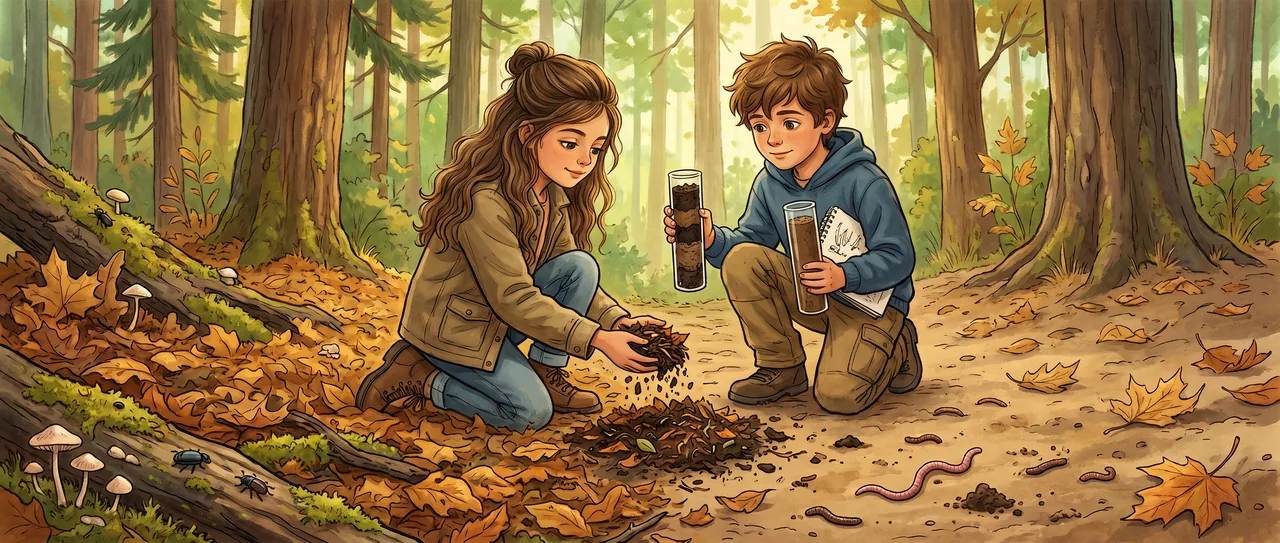
The Forest That Forgot Its Floor
The argument started because of the smell.
Maya said the east side of the trail smelled like a forest. Soren said it smelled like a basement. They were both standing in the same place, facing the same trees, breathing the same air, and they could not agree.
"It smells alive," Maya said. "Mushroomy. Thick."
"It smells like my grandmother's cellar after it rains," Soren said. He wrote both descriptions in his notebook, side by side, because the disagreement interested him more than being right.
They were supposed to be collecting soil cores for Dr. Hashimoto's weekend survey. Sixteen volunteers had shown up. Most of them were already deep into the woods with their little plastic tubes, pressing them into the dirt and labeling bags. Dr. Hashimoto herself was somewhere near the lake, talking loudly into her phone about a grant deadline. She had shown them how to push the corer in, twist, pull, bag, label. "Depth matters," she had said. "Note the layers." Then she had gotten the phone call and waved them all off.
So Maya and Soren went east. And then the smell happened. And then, about forty meters later, the smell stopped.
Maya noticed first. "The ground changed."
Soren looked down. On one side of an invisible line, the forest floor was thick. Leaves piled on leaves, brown and amber and black, a spongy carpet that gave under his boots. He could see pale threads of fungus when he crouched. The soil core, when he pushed it in, showed distinct layers. Dark crumbly leaf mold on top, then something lighter, then something dense and mineral below.
"Now do one here," Maya said. She was standing three steps away.
Soren pushed the corer in. It slid easily, almost too easily, into bare dirt. The soil was uniform, a grainy brown all the way down. No layers. No leaf mold. No fungal threads. The ground was hard and smooth, and the leaves that had fallen this autumn just sat on top like paper on a desk. Nothing was pulling them in.
"Where did the floor go?" Maya asked.
Soren pulled his core out and held it next to the first one. They looked like they came from different continents.
"Something is eating it," Maya said.
"Eating dirt?"
"Not the dirt. The stuff on top. The leaves. The layer." She was already on her knees, peeling back the thin scattering of leaves on the bare side. Underneath, the soil surface was pocked with tiny granular pellets. She picked some up and rolled them between her fingers.
"These look like castings," she said.
"Like worm castings?"
"Exactly like worm castings."
Soren went back to the thick side and dug gently. No castings. No worms. He dug on the bare side. Within seconds his fingers found one, pink and muscular and longer than his hand, pulling itself frantically through the soil.
"Since when are earthworms a problem?" he said. "My dad puts them in his garden on purpose."
"Your dad's garden isn't ten thousand years old."
That stopped him. He looked at her.
"The glaciers," Maya said. She was talking in short pieces the way she did when something was assembling itself behind her eyes. "This whole region. The ice scraped everything. Killed everything in the soil. When the glaciers left, the forests grew back. But the worms didn't."
"So these forests grew up without earthworms."
"For thousands of years. The leaf litter just piled up. That was the floor. That was where everything lived."
Soren looked at the thick side again. He could see now what he had been walking on without seeing. It was not just dead leaves. It was a world. A whole architecture of decomposition, built up over centuries, layer on layer, fungus breaking things down slowly, tiny organisms living in the gaps. The springtails and mites and beetle larvae Dr. Hashimoto had mentioned in her distracted briefing. Wildflowers rooted in it. Seedlings taking hold.
He looked at the bare side. Clean. Empty. Efficient.
"The worms are doing what worms do," he said slowly. "They're eating dead leaves and mixing soil. That's just what worms do."
"But the forest didn't evolve with them here," Maya said. "The forest built its whole life on top of that layer. And now it's gone."
Soren sat down between the two worlds, one boot on each side of the invisible line. He pulled out his notebook and began sketching the two soil cores side by side. The layered one, with its visible history. The uniform one, with its clean efficiency. Both real. Both the result of something natural doing what it naturally does.
"It's not like a disease," he said. "It's not like the worms are broken. They're just in the wrong story."
Maya sat down next to him. "Someone brought them. Fishing bait, maybe. Or in the soil of plants from somewhere else. And now they're just doing their thing, and the forest doesn't have a chapter for them."
A hermit thrush called from somewhere on the thick side. Soren had read that hermit thrushes nest on the ground, in the leaf litter, in the duff. He looked at the bare side and tried to imagine a bird building a nest on that smooth, exposed dirt. He could not.
Maya picked up a handful of the deep litter from the thick side and held it close to her face. It was teeming. Things moved between her fingers, tiny legs and translucent bodies, an entire civilization in a handful of rot.
"This is what a forest floor is supposed to hold," she said. "And nobody even notices it's disappearing because worms seem so normal."
"That's the problem," Soren said. "It looks helpful. It looks like what soil is supposed to do."
They sat there for a long time. The line between the two sides of the forest was invisible to anyone walking through. You could cross it and never know. The trees still stood on both sides. The sky was the same. But the ground had lost its memory on one side, and on the other it was still telling a story ten thousand years long.
Dr. Hashimoto's voice carried faintly through the trees, still on her phone call.
Maya set the handful of litter down gently, right at the border, exactly where the thick world ended and the bare world began.
Something with too many legs crawled off her palm and disappeared into the last edge of the duff.
Read the interactive version, listen to the narration, and earn a gold star →
A science-verified short story for curious kids · Curiosity Land