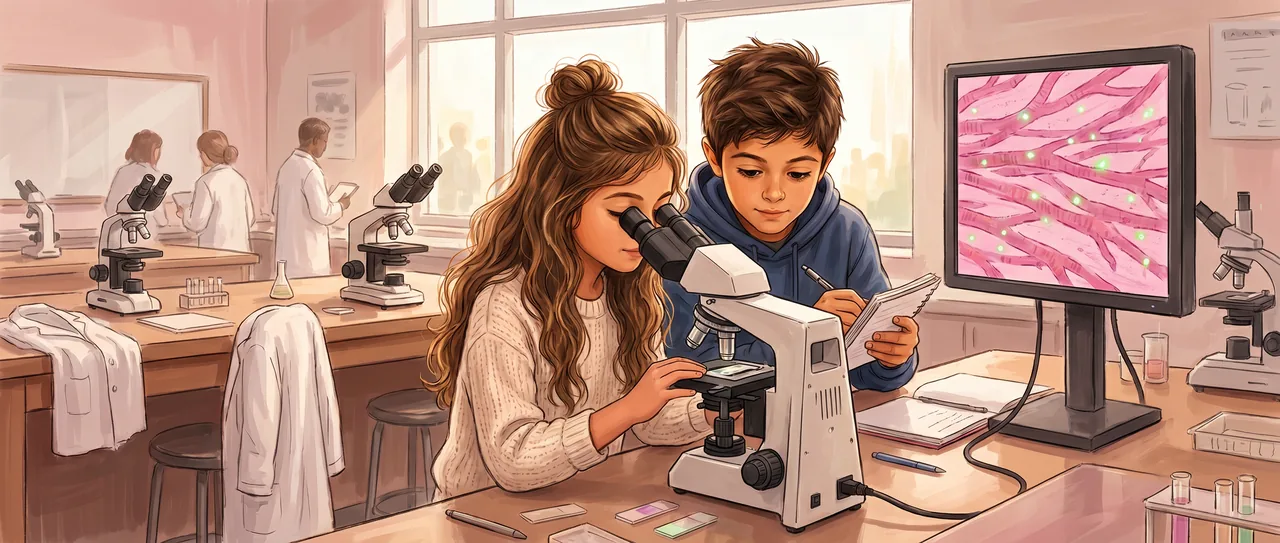
Every Room in the House
The slide was labeled HEART-F-47 and it was not supposed to be interesting.
Maya had already looked at six slides that afternoon. Brain tissue. Liver. Lung. The university's open house let visitors use the teaching microscopes, and the grad student running the station had lined up a dozen samples with little index cards explaining what you were seeing. Maya had read every card. Soren had read every card twice.
But HEART-F-47 did not have a card.
It was sitting in a plastic tray behind the others, and Maya noticed it only because it was turned label-down, as if someone had set it aside and forgotten it. She picked it up and held it to the light. Thin pink section, like all the others.
"This one doesn't have a description," she said.
Soren looked up from the microscope where he'd been sketching the branching pattern of cardiac muscle fibers. "Ask Priya."
Priya was the grad student. She was across the room helping a family figure out the focus knobs, her voice bright and patient and slightly hoarse from three hours of talking.
"She's busy." Maya slid the orphan slide onto the stage and adjusted the objective.
At first it looked like the other heart samples. Long fibers. Branching. Intercalated discs, if she remembered the card from the last one correctly. But something in the staining was different. Some cells were marked with a fluorescent tag that made them glow pale green against the pink.
"Soren. Come look at this."
He came. He looked. He was quiet for four full seconds, which Maya had learned to respect.
"Some of the cells are tagged," he said. "Fluorescent marker. But only some of them. Like, one in a thousand maybe."
"Why would you tag only certain cells in a heart?"
Soren sat back. "Because they're different from the others somehow."
"Different how? It's all heart tissue."
"Okay, but the tag has to be binding to something specific. Something those cells have that the rest don't."
Maya looked again. The green cells were scattered. Not clustered, not forming a pattern she could see. Just there, among the pink, like stars in a city sky. Few enough to miss. Present enough to be real.
Priya appeared at their shoulder, leaning in with a water bottle in one hand. "Oh, you found the microchimerism slide. That's from Dr. Kendall's research upstairs. It's not part of the display, sorry."
"What's microchimerism?" Soren asked.
"So." Priya took a breath like she was deciding how much to say. "You know what a chimera is? In mythology?"
"A creature made from parts of different animals," Maya said.
"Right. Microchimerism is like that, but real, and tiny. Those green cells are from a genetically different person. They're living in the heart tissue, but they don't belong to the person whose heart this is."
Soren's pen stopped moving.
"Whose are they?" Maya asked.
"Her child's."
The lab was loud with families and microscopes and Priya's colleague explaining something about mitosis to a group of eight-year-olds. But for a moment Maya heard none of it.
"When a woman is pregnant," Priya continued, "fetal cells cross the placenta into her bloodstream. That's been known for a while. What surprised people is that they don't go away. They persist. For decades. They've been found in maternal brain tissue, liver, heart. The green tag on that slide binds to a Y chromosome marker. That heart belonged to a woman. Those green cells are from her son."
"How long ago was she pregnant?" Soren asked.
"Dr. Kendall could tell you exactly, but in the published literature, fetal cells have been detected in women twenty-seven years after their last pregnancy. Maybe longer."
Priya got pulled away by another family. Maya and Soren stayed at the microscope.
"Twenty-seven years," Soren said. He was writing in his notebook but slowly, like the words needed time.
"Those cells are alive," Maya said. "They're not just, like, debris. They're incorporated. They became part of the heart."
"Do they do anything?"
"I don't know." She pressed her eye back to the lens. The green stars held still in their pink sky.
Soren flipped to a blank page and started listing questions, which was what he did when the inside of his head felt too small. Maya watched him write and did not interrupt.
Finally he said, "My mom has three kids."
"Yeah."
"So she's got cells from all three of us. In her brain. In her heart. Just, walking around."
"Living there. Like tenants."
Soren almost smiled but didn't quite get there. Something bigger was happening on his face. "My brother's eight. My sister's five. And there are cells from all of us, mixed together, in the same person. She's literally made of us."
Maya said nothing because something was assembling itself in her head. Not a fact. More like a shape.
"My mom had me," she said slowly, "and before that she had my brother. And before that, her mom had her. So my grandmother carried my mom's cells for years. And then my mom carried mine."
"Three generations of cells."
"At least. Maybe more. What if some of my grandmother's mother's cells were still in my grandmother when my mom was developing? Could they cross again?"
Soren looked at her. "I have no idea. That's a really good question."
"It means," Maya said, and then stopped. Because what it meant was so large she needed to find the edges of it.
Every mother a chimera. Every child leaving behind a small embassy of cells in the body that built them, those cells surviving, dividing, becoming part of the architecture. Not metaphor. Actual cells with actual DNA making actual proteins, living in the walls of a heart that was not originally theirs.
She thought about her own mother's heart beating right now in a hospital on the other side of the city where she worked the weekend shift. Some of those heartbeats traveling through cells that carried Maya's own DNA.
"Nobody's ever just themselves," Soren said.
Maya looked through the microscope one more time. She turned the fine adjustment knob, and the green cells sharpened until each one was a single bright point, steady and unmistakable, at home in a heart they had chosen for themselves.
Soren turned to a fresh page.
Read the interactive version, listen to the narration, and earn a gold star →
A science-verified short story for curious kids · Curiosity Land