What Water Knows
The membrane was supposed to keep everything out.
Maya held it up to the fluorescent light. It looked like nothing. A dark, papery square, thinner than a page torn from Soren's notebook. Dr. Chandra had given each pair of kids in the Saturday program a sample of graphene oxide paper and a challenge: try to get something through it.
"Helium," said the boy at the next bench, already dragging over a balloon.
"Alcohol vapor," said his partner, reaching for the ethanol bottle.
Soren turned the membrane over in his fingers. "She said it stops everything."
"She said almost everything." Maya was reading the data sheet Dr. Chandra had left on each bench. Tensile strength values. Conductivity measurements. A chart showing permeability results for different gases and liquids. Everything tested came back the same. Nothing got through. "Helium won't work. It's on the chart."
"Helium atoms are tiny."
"I know. Look." She pointed. Helium, blocked. Nitrogen, blocked. Oxygen, blocked. Hydrogen gas, blocked. Every liquid tested, blocked. The chart was a long column of nos.
Soren pulled the data sheet closer and read it the way he read everything, from top to bottom, not skipping ahead. Halfway down, he stopped.
"There's a gap in the chart," he said.
"What do you mean?"
"They didn't test water vapor. Every other thing is listed, but water vapor isn't here. That's weird. You'd test that. It's the most common thing in a lab besides air."
Maya looked at the omission. Then she looked at the membrane. Then she looked at the small humidifier Dr. Chandra had placed on each bench, which none of the other kids had touched because it seemed like it was just there to keep the room comfortable.
"It's not an accident," Maya said.
"The humidifier?"
"The gap in the chart. She left it out on purpose. That's the answer."
Soren didn't argue, but he didn't move toward the humidifier either. "We should test it, not just guess it."
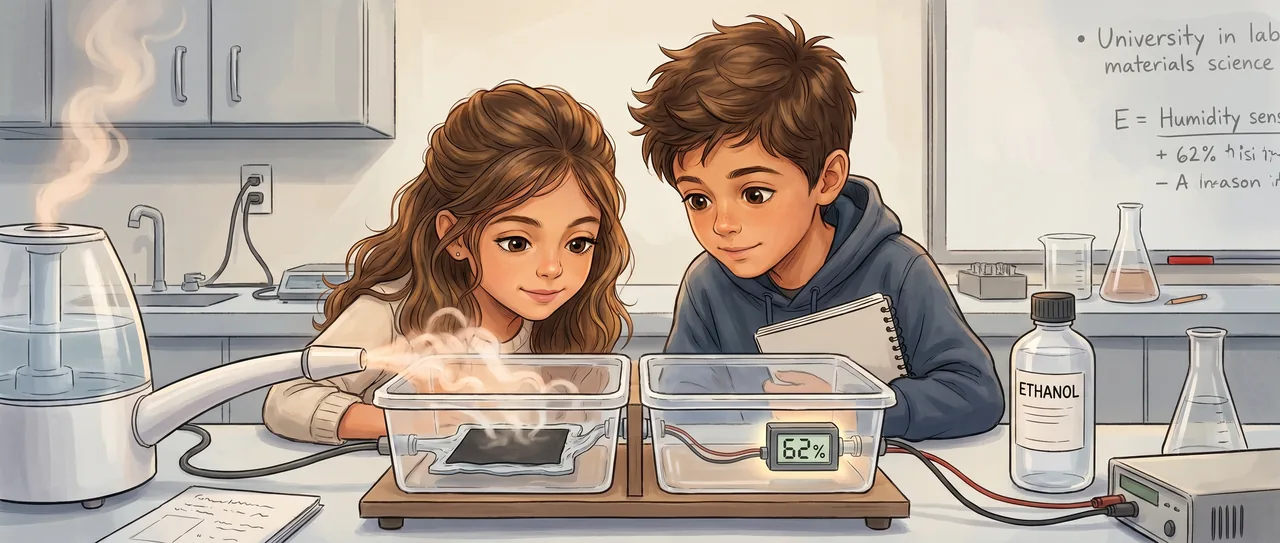
So they built a test. It took eleven minutes and most of the supplies on their bench. Soren cut two small chambers from plastic containers, sealed the graphene oxide membrane between them with silicone caulk from the supply drawer, and left an opening in one chamber where they could introduce a substance. Maya found a humidity sensor in the electronics bin and placed it in the sealed output chamber.
The sensor read fourteen percent. Dry.
Maya turned on the humidifier and held its nozzle against the input opening. Warm mist curled into the first chamber and pressed against the dark membrane.
They watched the sensor.
Fifteen percent. Seventeen. Twenty-two.
"It's coming through," Soren said.
Thirty-one percent. Forty. Forty-six.
"Pour some ethanol in the input side," Maya said.
Soren did. They watched. Nothing. No ethanol scent, no change in the readings from the chemical detector they'd placed next to the humidity sensor. The membrane passed water vapor and stopped alcohol vapor cold.
"Okay," Soren said slowly. "So the thing that stops helium, which is the smallest atom there is, the thing that's stronger than steel and conducts electricity and blocks literally every molecule they've thrown at it, just lets water through. Like a door."
"Like a door that only opens for one guest."
At the next bench, the helium balloon test had failed. The ethanol test had failed. Kids around the room were getting that frustrated look. Dr. Chandra was circulating, not giving hints, just asking what they'd tried so far. She was the kind of adult who enjoyed being patient a little too much, Maya thought. But when she reached their bench and saw the two-chamber setup, she stopped circulating.
"You found the humidity sensor," she said. Not a question.
"You put it there for us to find," Maya said.
"I put it there for someone to find. How did you know to test water?"
"Soren noticed you didn't include it in the chart."
Dr. Chandra looked at Soren with an expression that was hard to read. Surprise, maybe, but also something sharper. Like she was recalculating.
"Do you know why it works?" she asked him.
"No," Soren said. "That's the part I'm stuck on. Water molecules are bigger than helium atoms. They shouldn't fit through if helium can't."
"They shouldn't," Dr. Chandra agreed.
"So why do they?"
"The honest answer is that we're still arguing about it. The graphene oxide layers have tiny channels between them. Most molecules can't navigate those channels. But water molecules form hydrogen-bonded networks, little chains, and those chains seem to slide through the channels in a way we didn't predict and still can't fully model. The material practically pulls water through. It's as if the membrane wants it."
"Wants," Maya repeated.
"That's not the scientific word. The scientific word is that the interaction between water and the oxidized regions of the graphene creates a frictionless capillary effect. But I'll be honest with you both. When we first measured it, wants is the word every researcher in the room used."
She left to help another group. Maya and Soren sat with their two-chamber apparatus, watching the humidity sensor climb past sixty percent.
"It's just carbon," Soren said. "The whole membrane. Just carbon atoms arranged in a sheet. And somehow the arrangement does all this. Stops everything. Conducts electricity. Stronger than steel. And then it lets water through like water has a password."
"One layer of atoms," Maya said. "One. And it can tell the difference between water and everything else in the universe."
Soren opened his notebook, then closed it. The thing he was feeling didn't fit in lines of writing yet. It was the specific dizziness of realizing that carbon was also what pencils were made of. And what diamonds were made of. The same element, the same atom, but the arrangement changed everything. Not a little. Completely. As if the universe had a rule that said: it's not what you're made of, it's the pattern you make.
And nobody predicted this. Somebody stacked carbon atoms into a sheet and the sheet did something no one had written down in any theory first. The material was smarter than the predictions.
Maya reached over and disconnected the humidifier. In the silence, they could hear the humidity sensor still ticking upward, the membrane still passing water from what little moisture remained in the input chamber. Still working. Still choosing.
"We should try salt water next," Maya said. "If it only lets the water part through and stops the salt, that's a desalination filter. That's clean drinking water for everyone."
Soren looked at her. She was already pulling the chambers apart to rebuild them.
He grabbed the salt shaker from the snack table and a clean beaker from the rack.
Read the interactive version, listen to the narration, and earn a gold star →
A science-verified short story for curious kids · Curiosity Land