The Thousand Wrong Cranes
Maya had folded nine hundred and sixty paper cranes, and every single one of them was wrong.
Not wrong the way most people meant wrong. They looked like cranes. Wings, beak, tail. Her grandmother would have smiled at them. But Maya had been trying for something specific since August, a crane that balanced on the tip of its beak without falling, and none of them did. She had tried thicker paper, thinner paper, foil, napkins. She had adjusted every fold by fractions of degrees. Nine hundred and sixty attempts, and the best she'd managed was a crane that wobbled for four seconds before tipping.
She thought about this while standing in Dr. Adaora's lab, watching a postdoc named Jem argue with a screen full of slowly rotating shapes.
"No, no, no," Jem muttered. She was not talking to Maya. She had mostly forgotten Maya was there. "You're giving me the same garbage fold every time. That's not a binding pocket. That's a blob."
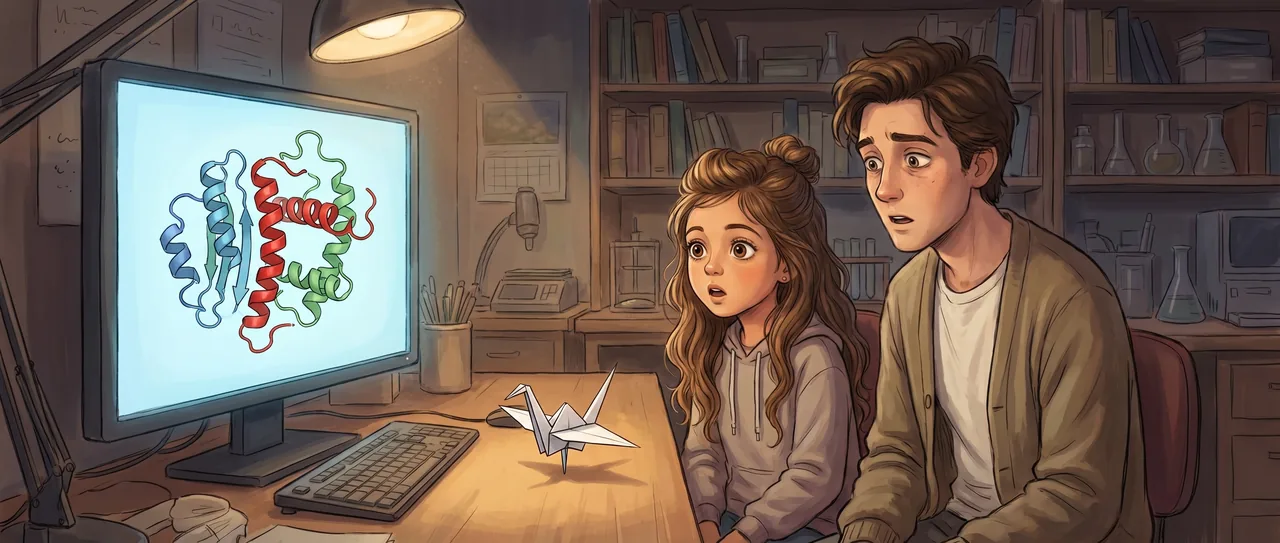
The screen showed something that looked like a tangle of ribbons and coils, color-coded in blues and greens and one angry stripe of red. Maya had been told this was a protein. It did not look like anything alive.
"What's it supposed to do?" Maya asked.
Jem glanced at her like she'd forgotten humans could speak. "Bind to a specific receptor on liver cells. Like a key in a lock. But the shape keeps coming out wrong. I've redesigned the sequence four times."
"The sequence of what?"
"Amino acids. The chain of building blocks." Jem waved at the screen. "You type in the order of amino acids, and the protein folds itself into a shape. Nobody forces it. The shape just happens, based on which amino acids are next to each other, which ones are attracted to water, which ones hide from it. The shape is everything. If the shape is wrong, the protein is useless. Doesn't matter what it's made of."
Maya looked at the angry red stripe. "So you pick the ingredients, and they fold themselves."
"Every time. Same sequence, same fold. It's not random. It's physics. Every amino acid is pulling and pushing on every other one, and they settle into the lowest energy state they can find. One specific shape." Jem rubbed her eyes. "The problem is I keep getting the wrong specific shape."
"How many amino acids?"
"In this one? Two hundred and twelve."
Maya tried to imagine two hundred and twelve things all pulling on each other simultaneously, every single interaction mattering, the whole chain twisting and coiling and folding in on itself until it snapped into one exact form. She couldn't. Nobody could hold that in their head.
"And it happens fast?" Maya asked.
"Milliseconds, some of them. The chain comes off the ribosome and just, pfft. Folds."
Milliseconds. Two hundred and twelve pieces finding one shape out of, Maya didn't even know. Billions? More?
"Jem, how many possible shapes are there?"
Jem laughed, but it wasn't a happy laugh. "For a chain this long? More shapes than there are atoms in the observable universe. And the protein finds the right one in less time than it takes you to blink. Every single time."
Maya stood very still.
More shapes than atoms in the universe. And the chain didn't try them one at a time. It didn't search. It just fell into the answer, the way a river falls downhill. Not because something told it where to go. Because every piece of it was simultaneously pulling on every other piece, and the answer was the only place all those forces balanced.
She thought about her cranes.
"Can I see the sequence?" Maya asked.
Jem pulled up a wall of letters. Just letters. A, V, L, I, P, F, W, M and more, hundreds of them in a row, each one standing for a different amino acid. It looked like someone had fallen asleep on a keyboard.
"And that's all the information it needs," Maya said. "Just the order."
"That's it. The order is the shape. Or it should be." Jem pointed at the red stripe on the model. "See that helix? It's supposed to curve left and form the binding pocket. Instead it's flaring out. I changed the sequence in that region three times. Every change fixes the helix but breaks something else. It's like the whole thing is connected."
"It is all connected," Maya said. "That's the point."
Jem looked at her.
"You keep changing the part that's wrong," Maya said. "But the fold isn't coming from that part. It's coming from everything at once. What if the problem is somewhere far away in the sequence? Something that's pulling on something that's pulling on the helix?"
Jem opened her mouth, closed it, and turned back to the screen. She scrolled to the far end of the sequence, a region she'd marked in gray. Unchanged through all four redesigns.
"I haven't touched this section," Jem said slowly. "It's far from the binding site. I assumed it was fine."
"But it still folds," Maya said. "It still pulls."
Jem stared at the gray letters for a long time. Then she started typing, fast, substituting amino acids in the distant region, the part she'd never questioned because it wasn't near the part that was broken. She ran the folding simulation.
The ribbon model on screen twisted. The coils shifted. And the red helix curled gently, precisely to the left, and a pocket opened up like a cupped hand.
Jem said a word Maya was pretty sure she wasn't supposed to hear.
"It's the right shape," Jem whispered. "That's a binding pocket."
Maya watched the protein rotate on screen, this impossible object that had assembled itself from a string of letters. Two hundred and twelve amino acids, each one connected to all the others by forces too tangled for any human mind to hold, and yet the chain knew. Not knew. There was no knowing. There was just physics, every piece pulling on every other piece, and the shape was where all the pulling agreed.
She thought about her cranes. Nine hundred and sixty of them, and she'd been adjusting the wings every time. The beak. The tail.
She'd never once changed the first fold.
Maya pulled a square of paper from her pocket. She always carried paper. She creased it down the center, but not in the middle. A few millimeters off. Then she began folding, every subsequent fold the same as always, and she could already feel the difference traveling through, each crease pulling on the next.
She set the finished crane on Jem's desk, on the tip of its beak, and let go.
Read the interactive version, listen to the narration, and earn a gold star →
A science-verified short story for curious kids · Curiosity Land