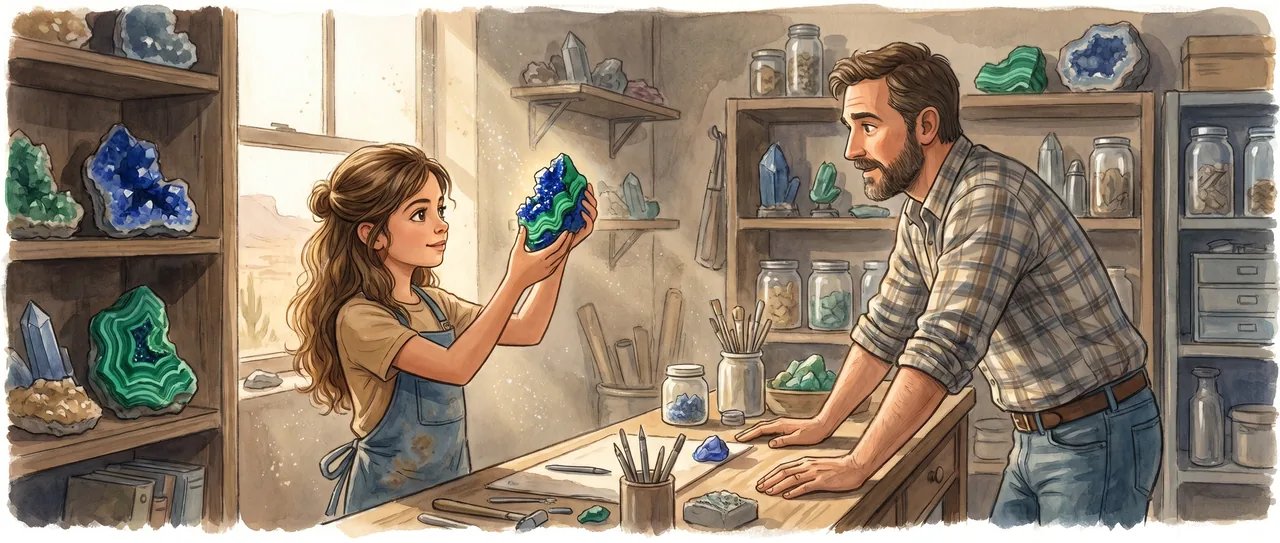
The Same Blue Twice
Maya's grandmother had two rules in the workshop. First, always wear your goggles when the saw is running. Second, never tell a customer that two stones are the same thing unless you are absolutely sure.
Maya had broken the second rule. Not on purpose. A woman had come in with a pendant, a deep blue stone in a silver setting, and asked what it was. Maya had said azurite, because it was. The blue was unmistakable, that particular blue that looked like it had weight to it, like the color itself was heavy.
Then the woman had held up a ring. Bright green, banded, like layers of a forest seen from above.
"And this?"
"Malachite," Maya said.
"My husband says they're the same thing." The woman looked amused, like she was waiting for Maya to settle an argument.
"They're not," Maya said. "One's blue. One's green."
The woman bought a strand of malachite beads and left satisfied, and that should have been the end of it. But Maya's grandmother had been listening from the back room, and she came out with her hands dusty and her expression complicated.
"She didn't ask the right question," Abuela said. "But her husband wasn't wrong."
Then she went back to her grinding wheel, and that was all she said about it.
This was the thing about Abuela. She never explained more than one sentence past where Maya was already thinking. She left the rest like a stone left rough on one side.
Maya stood behind the counter for a while. She looked at the azurite in the display case. She looked at the malachite beside it. Blue. Green. She had sorted those two stones into different bins since she was seven years old. They didn't look related. They didn't feel related. The blue was deep, almost purple at its edges. The green was bright and banded and completely different.
But her husband wasn't wrong.
Maya pulled the old mineral reference from under the counter. It was heavy, dog-eared, with Abuela's handwriting in the margins. She found azurite first. Cu3(CO3)2(OH)2. She found malachite. Cu2(CO3)(OH)2.
Copper. Both of them were copper.
She read the formulas again. Copper, carbon, oxygen, hydrogen. The same elements. Rearranged. Different amounts, different arrangements, but copper was in both of them, and copper was the reason both of them had color at all.
She closed the book and opened it again. She had known, in the way you know something you've read and never thought about, that copper was in both minerals. But she had never stood behind a counter and told a woman they were different things while holding that knowledge somewhere in the back of her mind, unused.
The thing that bothered her was the color. Not that they were different colors. That they were so completely, wildly, absurdly different colors. The same metal. The same copper. Blue in one, green in the other.
She went to the back room. Abuela was shaping a piece of turquoise on the grinding wheel, water misting up around her fingers.
"Turquoise has copper in it too," Maya said.
Abuela nodded without looking up. The turquoise was blue-green, like it couldn't decide which version of copper it wanted to be.
"Why is it different colors?"
"The copper is the same copper," Abuela said. She turned off the wheel and held up the turquoise, still dripping. "The question is what's sitting around it."
Maya went back to the book. She read about crystal structures and coordination chemistry and a phrase she had to read three times: crystal field splitting. The book said that when a copper atom sits inside a mineral, surrounded by other atoms, those surrounding atoms affect the copper's electrons. The electrons can only absorb certain wavelengths of light depending on exactly how the atoms around them are arranged. Change the arrangement, and the electrons absorb different light, and the leftover light, the light that bounces back to your eye, is a different color.
The same copper. The same electrons. But the neighborhood changes, and the electrons respond differently, and blue becomes green.
Maya put the book down. She picked up a piece of raw azurite from the back shelf, then a piece of malachite. She held them side by side. In some specimens, she knew, the two minerals grew together. You could find a single rock that was blue on one side and green on the other, the copper atoms doing two completely different things inches apart, because the chemistry around them had shifted.
She thought about that for a long time. The same element, expressing itself in opposite ways, depending on what surrounded it.
The bell on the front door rang. Maya went out. A man was standing at the counter, looking at a tray of polished stones.
"My wife was here earlier," he said. "She said you told her azurite and malachite are different things."
"They are different things," Maya said. "And they're the same thing. Both of those are true."
The man laughed. "That's what I tried to tell her."
"But it's stranger than that," Maya said, and she could feel the idea still unfolding in her, not finished yet. "It's not like mixing paint. It's not like the copper just happens to be in both of them. The copper is the reason they have color at all. And the reason the colors are different is because of what's around the copper. The exact same atom, doing completely different things, because of its neighbors."
The man picked up a piece of azurite and turned it in the light. "So the copper doesn't have a color."
Maya opened her mouth to correct him and then stopped. She thought about copper wire, which was reddish-orange. Copper patina on old roofs, which was green. Copper sulfate in the chemistry set Abuela had given her, which dissolved into water so blue it looked like a mistake.
"No," she said slowly. "It doesn't. Not one color. It has whatever color the world around it pulls out of it."
The man nodded and bought a piece of azurite-malachite, the kind where both minerals grew together in the same stone, blue pressing against green in a border so sharp it looked painted.
After he left, Maya carried the reference book to the display case and started reading the entries for every green stone, every blue stone, every red one. Chromium was in both rubies and emeralds. Red and green, from the same element.
She was still reading when Abuela came out, wiping her hands, and pulled over a second chair.
Read the interactive version, listen to the narration, and earn a gold star →
A science-verified short story for curious kids · Curiosity Land