The Fairest Way
The problem started with the strawberries.
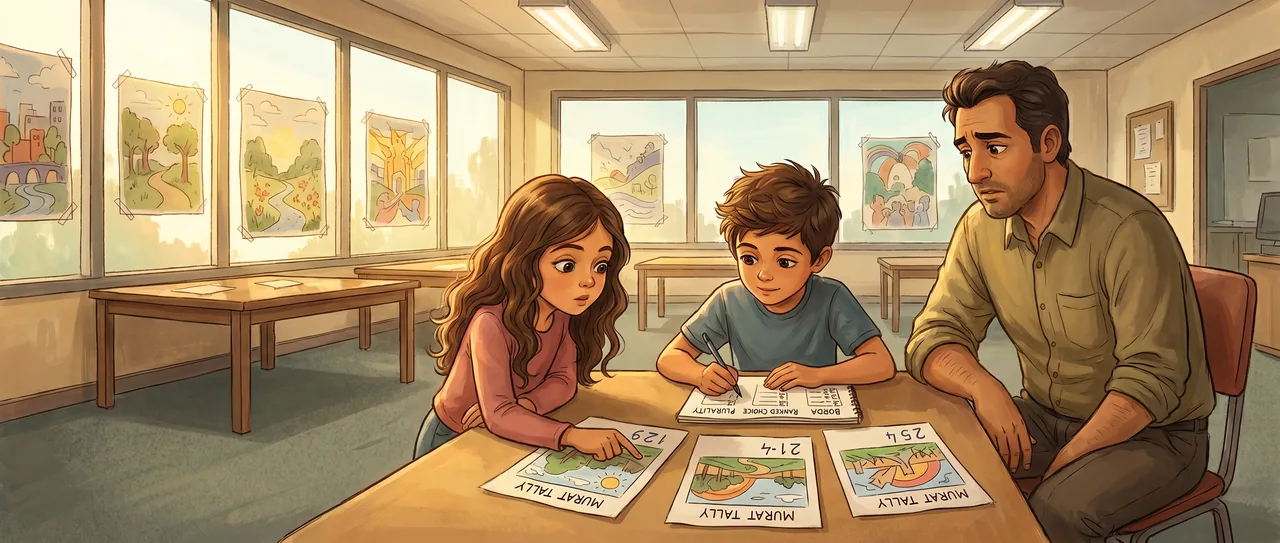
Not actual strawberries. The mural design called Strawberry Sun, submitted by Mrs. Kowalski, which showed a field of enormous red fruit rising like balloons into a golden sky. It was one of five finalists for the neighborhood mural, and Maya had been staring at the vote tallies for eleven minutes without blinking.
"It doesn't work," she said.
Soren looked up from the table where he was sorting the last of the forty-seven ballots. Each voter had ranked all five designs from first to fifth. The community center smelled like old coffee and carpet cleaner, and Mr. Hadid, who had organized the competition, was in the back room making copies of something nobody needed.
"What doesn't work?" Soren asked.
"The votes. I've counted them three ways and I get three different winners."
Soren set down his stack. "Show me."
Maya spread her tallies across the table. "Okay. If we just count first-place votes, Bicycle City wins with fourteen. But most people ranked Bicycle City third or fourth. More people disliked it than liked it."
"So count it differently."
"I did. If we compare every design head-to-head, like, would voters prefer Strawberry Sun over Bicycle City, and do that for every pair, then Strawberry Sun beats everything. It wins every matchup."
"So Strawberry Sun wins."
"Except." Maya pulled out a third sheet. "If we use a point system, five points for first place, four for second, all the way down, then The River Remembers wins by nine points."
Soren sat down slowly. "Three methods. Three winners."
"Three completely reasonable methods."
He pulled the ballots toward him and started checking her math. Not because he doubted her. Because he needed to see it himself. He went through every head-to-head comparison for Strawberry Sun, marking tallies in his notebook. Maya waited. She was used to this.
After seven minutes he said, "You're right. Strawberry Sun beats every other design one-on-one. But it comes in third on total points and second on first-place votes."
"So which method is fair?"
They looked at each other.
"All of them?" Soren said. "None of them?"
Maya pulled her chair closer. "Let's think about what fair means. Like, the actual requirements. What should a fair voting system do?"
Soren opened to a blank page. "Okay. First: if every single person prefers one design over another, the result should too. Like, if all forty-seven people rank Strawberry Sun above Bicycle City, then Strawberry Sun should finish higher."
"Obviously. What else?"
"No dictator. One person's ballot shouldn't determine the whole outcome."
"Obviously."
Soren chewed his pen. "Here's one that's less obvious. The ranking between two designs should only depend on how people feel about those two designs. Not on some third design that has nothing to do with them."
Maya's eyes narrowed. "Say that again."
"Like, whether Strawberry Sun beats Bicycle City should depend on how people ranked Strawberry Sun versus Bicycle City. It shouldn't change just because someone moves The River Remembers up or down on their ballot."
"That seems. Yes. That seems like the minimum."
"Right? If I ask you whether you prefer apples to oranges, your answer shouldn't depend on how you feel about bananas."
Maya was quiet for a moment. Then she said, "Find me a system that does all three."
Soren started writing. He tried the point system first, testing whether moving a losing design around on ballots could change the winner between two other designs. Within four minutes he found a case where it could. He tried the head-to-head method. It satisfied the banana rule, but it could produce cycles where A beats B, B beats C, and C beats A, and then you needed a tiebreaker, and the tiebreaker broke something else.
Maya was working the same problem from the other direction, trying to construct a system from scratch that met all three rules. Every time she built one, she tested it, and every time, one of the rules cracked.
"It's not that we're bad at this," she said slowly.
"No," Soren agreed, though he wasn't sure what she meant yet.
"It's that it might actually be impossible."
The word sat between them like a stone dropped in water.
"Impossible is a big word," Soren said.
"I know. I'm not using it lightly. I mean mathematically impossible. Like, provably. Not we haven't found one yet. There isn't one to find."
Soren stared at his notebook. At the six systems he'd tried. At the wreckage of each one. "Three completely basic fairness rules. And you can't have all three at once."
"Not with ranked preferences. Not with three or more options. Not ever."
The community center hummed. The fluorescent light above them buzzed at a frequency that suddenly seemed important, like the room itself was vibrating at the edge of something.
Mr. Hadid came back from the copy room. "So? Do we have a winner?"
Maya and Soren looked at him.
"We have a question," Maya said.
"That's not what I asked for."
"Mr. Hadid, did you pick the voting method before or after you saw the designs?"
He blinked. "Before, I suppose. We always just count first-place votes. Why?"
"Because the method you choose changes who wins. And there's no method that's perfectly fair. Not this one. Not any one."
Mr. Hadid looked at her the way adults look at children who have said something either very stupid or very important and they cannot tell which. "So what do we do?"
"We pick a method anyway," Soren said. "But we pick it honestly. Knowing what it's good at and what it gives up. Instead of pretending it's the only way."
"The head-to-head method finds the design the most people can live with," Maya said. "The point system finds the one people feel the strongest about overall. The first-place count finds the one with the most passionate supporters. They're all answering different questions."
Mr. Hadid rubbed his forehead. "This was supposed to be simple."
"It was never simple," Maya said. Not unkindly. "It just looked that way because nobody checked."
He stared at the three different tallies spread across the table. Then he pulled up a chair and sat down with them, heavily, like a man who has just learned that a floor he trusted has a different shape than he thought.
"Show me," he said.
Soren turned his notebook to a fresh page and began drawing the three methods side by side, and Maya reached for the ballots to walk Mr. Hadid through the impossibility, and outside, someone had taped all five mural designs to the community center windows where they caught the late afternoon light, each one beautiful, each one somebody's favorite, each one the winner of a system that hadn't been invented yet.
Read the interactive version, listen to the narration, and earn a gold star →
A science-verified short story for curious kids · Curiosity Land