The Biggest Thing There Is
The argument started because of a smudge.
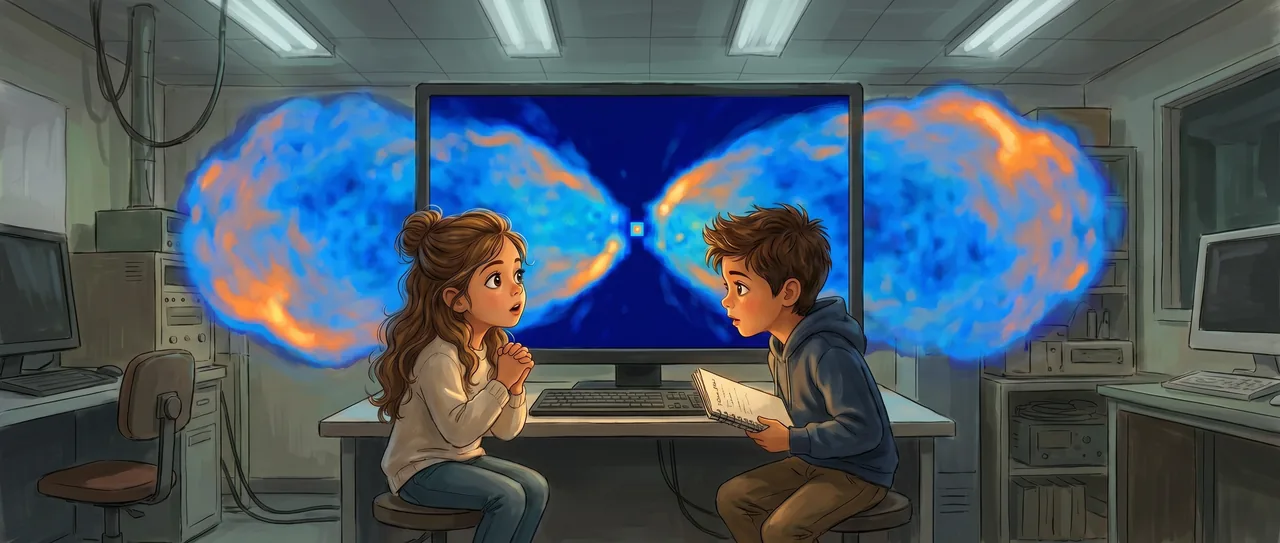
Maya said it was an error. Soren said it was real. They were both looking at the same image on the terminal the graduate student had left open when she went to get her third coffee. The screen showed a radio survey map, false-colored in blues and oranges, and the smudge sat in the middle of it like a thumbprint somebody had dragged across wet paint.
"It's too big," Maya said. "Look at the scale bar."
Soren looked at the scale bar. He looked at the smudge. He looked at the scale bar again.
"That can't be right," he said.
The smudge, if the scale bar was correct, was about four million light-years across.
"See?" Maya said. "Error."
"No, hold on." Soren leaned closer. The smudge wasn't really a smudge. It had structure. Two huge lobes, like wings, billowing out from something tiny and bright at the center. The central point was barely a pixel. The wings filled most of the frame. "It has a shape. Errors don't have shapes like that."
"Errors have whatever shapes they want."
"Not butterfly shapes. Not symmetrical ones."
Maya stopped. She looked again. He was right about the symmetry. Two lobes, roughly matched, streaming out in opposite directions from that single bright point. She pulled up the coordinate overlay. The central point sat on top of a galaxy. A small elliptical galaxy, unremarkable, just sitting there in the middle of something enormous.
"Okay," she said slowly. "So what makes a galaxy have wings?"
Soren had already opened the catalog entry. Source designation: 3C 236. One of the largest known radio galaxies. He read fragments aloud as he scrolled. Supermassive black hole at the center. Relativistic jets. Plasma moving at nearly the speed of light.
"Nearly the speed of light," Maya repeated. She said it flat, like she was testing whether the words would break.
"From the black hole," Soren said. "It shoots out jets of plasma in two directions, and they just keep going. Into intergalactic space. For millions of light-years. And the plasma inflates these lobes."
He gestured at the wings on the screen.
Maya sat down on the stool next to him. "The galaxy itself. How big is it?"
Soren checked. "Maybe a hundred thousand light-years across. Pretty normal."
"And the lobes?"
"Fifteen million light-years. End to end."
Neither of them said anything for a moment.
"That's like," Maya started, and then stopped, because the comparison she was reaching for didn't exist. A marble launching something that fills a football stadium wasn't big enough. A grain of sand filling an ocean wasn't big enough. The galaxy was a hundred thousand light-years across and the thing it had made was a hundred and fifty times larger.
"It's bigger than galaxy clusters," Soren said quietly. "The lobes. They're bigger than entire groups of galaxies."
"From one black hole."
"From one black hole."
The graduate student came back with her coffee. She had red hair pulled into a knot and a pen behind each ear and she almost walked past them before she noticed they were at her terminal.
"Oh, you found 3C 236," she said, glancing at the screen without slowing down. "Classic source. We use it for calibration sometimes. You guys here for the open house?"
"How does a black hole do this?" Maya asked.
"Accretion disk, magnetic fields, it's a whole thing." The graduate student was already pulling up a different dataset on her laptop. "The short version is material spiraling into the black hole gets redirected along the magnetic poles and launched outward. The jets slam into the intergalactic medium and inflate the lobes over millions of years. Tens of millions. Hundreds of millions, actually. It's like a hose spraying into fog, except the hose is a few light-days wide and the fog is the entire space between galaxy clusters."
She said all of this while opening files and didn't look at them once.
"What are the lobes made of?" Soren asked.
"Electrons and magnetic fields, mostly. Relativistic plasma. They glow in radio wavelengths. You can't see them with your eyes, obviously. But a radio telescope sees them just fine. They're some of the largest structures in the universe. Some of them, anyway." She took a sip of coffee. "There's a volunteer doing a planetarium show in room twelve if you want something more, you know, visual."
She put her headphones on.
Maya and Soren looked at each other. Then they looked back at the screen.
"She said some of them," Maya said. "Some of the largest structures in the universe."
"Yeah."
"What's larger?"
Soren opened a new search. Galaxy filaments. Cosmic web. Structures hundreds of millions of light-years long, made of thousands of galaxies strung together by gravity and dark matter. But those weren't made by anything. They just formed as the universe expanded and matter clumped together.
The radio lobes were different. They were made by something. By a process. By a black hole smaller than our solar system, pulling matter in so violently that it shot plasma out at nearly the speed of light, and that plasma kept going until it had painted a structure across the sky larger than any single thing gravity had built.
"Soren," Maya said.
"Yeah."
"The black hole is tiny. Compared to the lobes, it's nothing. It's a dot. It's less than a dot."
"I know."
"And it made the biggest thing."
Soren was writing in his notebook. Not because anyone asked him to. Because the inside of his head was too small to hold the idea that something could be so much larger than the thing that created it. That a process could matter more than a size. That a point could be small and still be the most important thing in a volume of space that dwarfed everything around it for millions of light-years in every direction.
He wrote: the dot matters more than the wings.
Maya was reading the catalog again. There were hundreds of them. Radio galaxies with jets and lobes, scattered across the observable universe. Some active right now, jets still firing. Some ghosts, lobes fading, the black hole gone quiet, the jets switched off millions of years ago, the plasma still glowing but slowly dimming.
"Some of them are dead," she said. "The jets stopped, but the lobes are still there."
"Still there."
"Still enormous."
The graduate student's headphones leaked a faint tinny beat. The fluorescent light above them buzzed. On the screen, the lobes of 3C 236 stretched across fifteen million light-years of false-color blue, still glowing, painted there by something they could not see at the center.
Maya scrolled the view outward, and the galaxy at the heart of it disappeared into the dot of a single pixel, and the wings kept going, and going, past the edges of the frame.
Read the interactive version, listen to the narration, and earn a gold star →
A science-verified short story for curious kids · Curiosity Land