The Wrong Pipe
Soren was the one who hit Marcus Weld on the back.
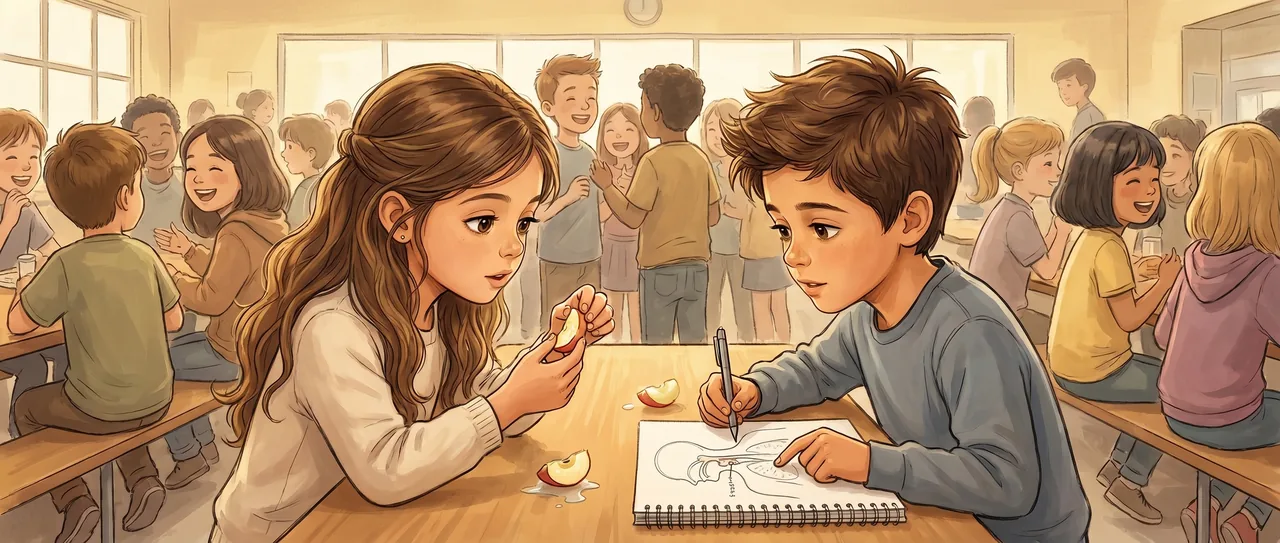
Not hard. Not panicked. Three firm strikes between the shoulder blades, the way the poster in the cafeteria showed, while Marcus coughed and coughed and a piece of apple came flying out and landed on the table next to Maya's lunch tray.
Marcus caught his breath. His eyes were watering. Mrs. Huang came running over, and then there were adults everywhere, and Marcus was fine, and Soren sat back down across from Maya like nothing had happened.
His hands were shaking.
"You okay?" Maya asked.
"Yeah." He picked up his sandwich. Put it down. "That was really fast. The choking. He was talking and then he just wasn't."
Maya looked at the piece of apple on the table. Wet and small and ordinary. "He was talking and eating at the same time."
"Everyone does that."
"Yeah," Maya said. "But why does that go wrong?"
Soren frowned. "Because food goes down the wrong pipe. Everyone knows that."
"I know. But think about it. We have two pipes right next to each other. One for air, one for food. And they share the same entrance. That's a terrible design."
Soren pulled out his notebook, not to write yet, just to have it near his hands. "Dogs eat and breathe at the same time. You can watch a dog eat. They never stop to breathe. They just keep going."
"Dogs don't choke?"
"They can, but it's really rare. Not like us." He paused. "My uncle's a vet. He says the air passage and the food passage in dogs are more separated. The tubes connect differently in their throat."
Maya was doing the thing she did, the one where she stopped looking at Soren and started looking at something behind her own eyes. "So why are ours so close together? Why would our throat be designed worse than a dog's?"
"It's not designed. It evolved."
"Fine. Why would it evolve to be worse?"
That was the question. Soren opened his notebook.
Mrs. Huang came by again. "Marcus is fine, you two. Soren, that was good thinking with the back blows."
"Mrs. Huang," Maya said. "Can humans breathe and swallow at the exact same time?"
Mrs. Huang blinked. "I don't think so, actually. You have to stop breathing for a moment every time you swallow. Why?"
"Can babies?"
"Oh." Mrs. Huang tilted her head. "You know, I think newborns can. They nurse and breathe simultaneously. But they lose that ability."
She moved on to check on Marcus again. Maya turned to Soren. "Babies can do it. We can't. We lose the ability."
Soren was already writing. "So something changes. In the throat. As we grow up."
"The larynx," Maya said. "Voice box. I remember from music class, Ms. Porter said our voice box sits lower than in any other primate. She said that's why we can make so many sounds."
Soren stopped writing. He looked at Maya. She looked at him.
"Say that again," he said.
"Our larynx is lower. In our throat. Lower than any other primate."
"And in babies it's higher. That's why they can breathe and nurse at the same time, because the passages are still separated." He drew a rough diagram. A tube splitting into two paths. Then he drew it again with the split point lower down. "When it drops, the air tube and the food tube start sharing more space. More crossover. More chance for food to go where air should go."
"So we evolved a throat that's more dangerous," Maya said.
Soren tapped his pen against the page. "There's that flap. The epiglottis. It's like a little trapdoor that closes over your windpipe every time you swallow so food goes to your stomach instead of your lungs."
"A patch," Maya said. "A workaround. We evolved a throat that was dangerous and then we evolved a patch for it."
"But why would the dangerous version survive at all? Why wouldn't the animals with that throat just die out?"
They sat with that for a moment. The cafeteria noise was huge around them. Two hundred kids talking, shouting, laughing, whispering, singing, making the particular sounds that no chimpanzee, no gorilla, no dog or dolphin or parrot truly makes.
Two hundred human throats, each one a narrow passage where air and food and sound all share the same few inches of space.
"Because of that," Maya said quietly, and she didn't point at anything, but Soren knew she meant all of it. The noise. The words. The specific, impossible, ridiculous range of sounds coming from every direction.
Soren set his pen down. "The larynx dropped, and we could choke. But the larynx dropped, and we could talk."
"Not just talk. Make every sound we make. Every vowel, every consonant. Every language on Earth. All of it comes from the exact same change that lets an apple go down the wrong pipe."
Soren looked at his diagram. The lower passage. The shared space. The little flap of tissue, the epiglottis, working thousands of times a day to keep every human alive because evolution had made a bet. A bet that the thing this throat could do was worth the risk of what it could do wrong.
Maya picked up the piece of apple from the table. She held it between two fingers.
"Every word anyone has ever said," she said. "Every song. Every argument. Everything your mom said to you this morning. All of it exists because somewhere, a long time ago, an animal's throat got more dangerous, and that was worth it."
Soren thought about that. About the first hominid whose larynx sat lower than its mother's. Who could make sounds its mother couldn't. Who could choke on fruit its mother swallowed safely.
Who opened its mouth and made a noise that nothing on Earth had ever heard before.
"Was it worth it?" he asked.
The cafeteria answered. Two hundred voices, telling two hundred different stories, the sound bouncing off the walls and filling up the room until the air itself was thick with language.
Maya set the piece of apple down on the table between them, and they both just listened.
Read the interactive version, listen to the narration, and earn a gold star →
A science-verified short story for curious kids · Curiosity Land