The Wall of True Things
The problem on the whiteboard had been wrong for three weeks.
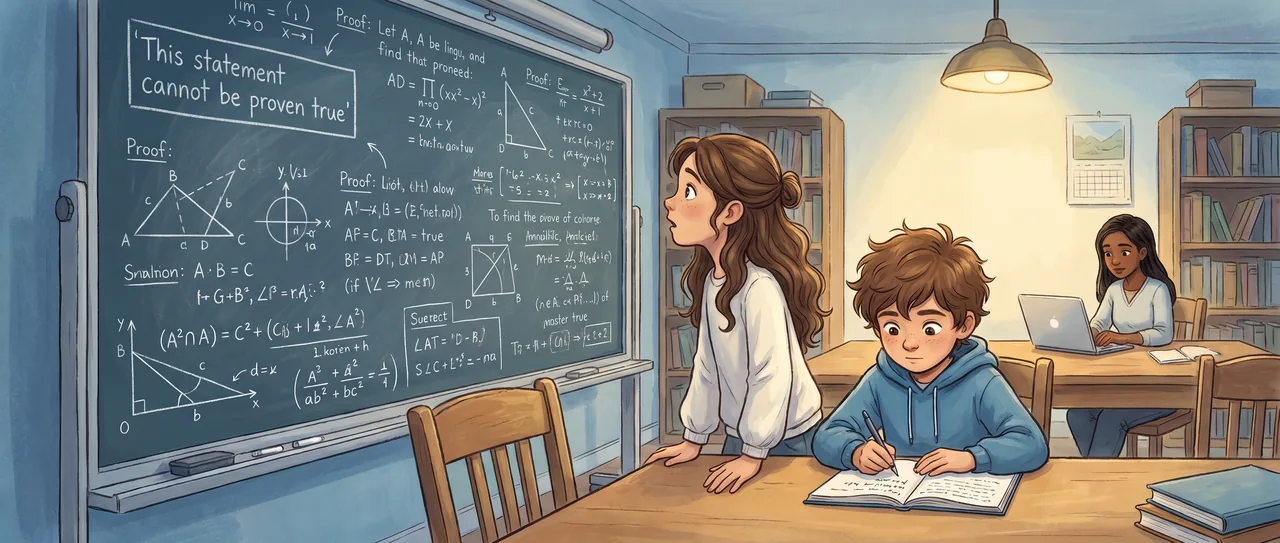
Not wrong like someone made a mistake. Wrong like a splinter under the skin. Maya could feel it every Saturday when she walked into the basement of the Ellsworth Public Library for math circle, and there it was, still written in Ms. Achebe's sharp handwriting in the upper left corner where nobody erased:
This statement cannot be proven true.
It wasn't a problem, exactly. It wasn't assigned. Ms. Achebe had written it there the first week and said, "Don't worry about that yet," and then never mentioned it again. She was like that. Half her whiteboard was covered in things she was working on for her dissertation, and she sometimes forgot which side was for them and which side was for her.
Soren had written it down. Of course he had. Maya had seen him copy it into his notebook that first week, then draw a small box around it, which was what he did with things that bothered him.
"It's a liar," Maya said. They were supposed to be working on modular arithmetic, but Maya had turned her chair to face the whiteboard corner. "Like the liar's paradox. This sentence is false."
"Almost," Soren said. He had his pencil flat between his teeth, which meant he was close to something but not there. "The liar's paradox says it's false. This one says it can't be proven. Those are different."
"How?"
"I don't know yet."
Ms. Achebe was at the other end of the table, buried in her laptop, typing with the ferocious speed of someone whose deadline had already passed. Two other kids from the math circle had stopped coming. It was just Maya and Soren now, which meant Ms. Achebe sometimes forgot to actually teach and instead just left problems on the board and muttered at her screen.
"Okay," Maya said. "Suppose it's false. Suppose the statement can be proven true."
"Then what it says is wrong," Soren said, taking the pencil out of his mouth. "It says it can't be proven, but it can. So the statement is false."
"But if someone proved it true, and it's actually false, then the proof proved something false."
"Which means the system is broken," Soren said. "You proved a lie."
Maya turned back to the board. "So the system can't prove it. Not without breaking itself."
"Right."
"But, Soren. Read it again."
He read it. This statement cannot be proven true.
"If it really can't be proven," Maya said, "then what it says is correct. It's telling the truth."
The room got quiet except for Ms. Achebe's typing.
"It's true," Soren said slowly, "and it can't be proven."
"It's true because it can't be proven."
Soren put his pencil down. He picked it up. He put it down again.
"That's not a paradox," he said. "The liar's paradox loops forever, true then false then true. This one doesn't loop. It just sits there. It's true. And you can never prove it."
"Ms. Achebe," Maya said.
Ms. Achebe didn't look up. "Mmhm."
"Is this Godel?"
"Godel," Ms. Achebe confirmed, still typing. Then she stopped. She looked up over the edge of her laptop like a prairie dog surfacing. "Wait. You got there?"
"There's a true thing that can't be proven," Maya said.
"Is it just this one statement, though?" Soren asked. He had the box in his notebook open, and he was writing fast. "Can you just, I don't know, add it as a rule? Say okay, this one's true, we'll just include it."
"You can," Ms. Achebe said. She closed her laptop, and for the first time in weeks, she actually looked like a teacher instead of a graduate student who had forgotten they were there. "You can absolutely add it as an axiom. You get a bigger, more powerful system."
"And then," Maya said.
She didn't finish the sentence. She didn't need to. Soren's pencil stopped moving.
"And then there's a new one," he said.
"There's a new one," Ms. Achebe said. "In the bigger system, you can construct a new statement that's true and unprovable. Every time you expand the system, a new true thing appears that the system can't reach. Godel proved this. It's not a guess. It's not a maybe. It is a proof that there will always be true things beyond the edge of what you can prove."
Maya stood up. She didn't mean to. She was just suddenly standing.
"It never ends," she said.
"It never ends," Ms. Achebe said. "And this isn't a flaw. This isn't because we haven't been clever enough. Any system powerful enough to do basic arithmetic will have this property. Godel proved it in nineteen thirty-one. He was twenty-five."
Soren was staring at his notebook, but Maya didn't think he was reading it. She knew that look. It was the look he got when the inside of his head felt too small.
"It's like," he started, and stopped. "It's like you're standing in a room, and you can see everything in the room, and then you realize there's a window. And through the window there's a thing that's definitely real, but you can't get to it from inside the room. So you build a bigger room that includes that thing. And then the bigger room has a window too."
"Yes," Ms. Achebe said. She was smiling. "That's exactly what it's like."
"Every room has a window," Maya said.
"Every room has a window."
Ms. Achebe opened her laptop again. The moment was over for her. She had a deadline. But Maya could see it on her face, a kind of brightness underneath the stress, the look of someone who remembered why they chose this in the first place.
Soren was writing again, and Maya didn't interrupt him. She sat back down and looked at the statement on the whiteboard. Three weeks it had been sitting there, and she had known something was off about it, and the thing that was off about it was that it was the most important sentence in the room.
Mathematics was not a finished building. It was not a closed box. It was a thing that would always have a window, and the window would always show something true and unreachable, and you could always build outward toward it and find another window beyond.
She thought about every math test she'd ever taken, every answer key, every problem with a clean solution at the back of the book. All of that was real. But past the edges of it, there were true things, proven to exist, that no system would ever catch.
Soren closed his notebook and looked at Maya, and she could see it in him too. Not excitement exactly. Something bigger. Something like standing at the edge of a cliff that went up instead of down.
"Ms. Achebe," Soren said.
"Mmhm."
"Can you leave that on the board?"
Ms. Achebe glanced at the corner of the whiteboard. "I wasn't planning to erase it."
Maya pulled her chair closer to the table and picked up a fresh worksheet, but before she started, she looked at the whiteboard one more time, that sentence in the corner, surrounded by all the things that could be proven, a small window that would never close.
Read the interactive version, listen to the narration, and earn a gold star →
A science-verified short story for curious kids · Curiosity Land