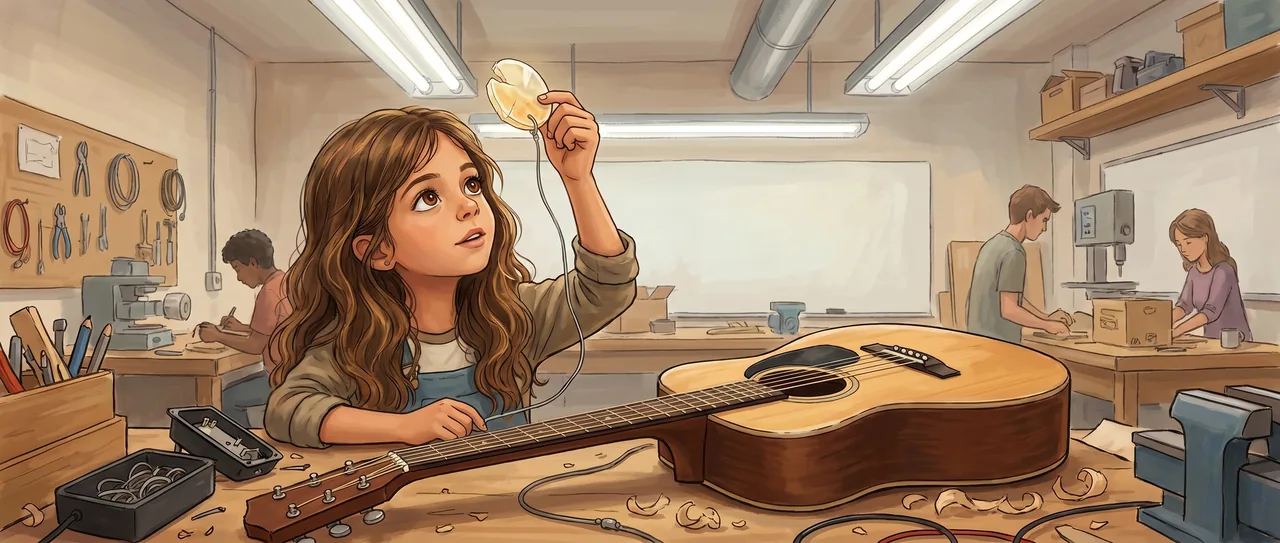
The Squeeze
The pickup was dead.
Maya had pulled it from the old acoustic guitar herself, the one her uncle left in the garage when he moved to Tucson. She wanted to make it electric. She had watched four videos. She had soldered the wires exactly right. She had plugged the guitar into the little practice amp at the makerspace bench, strummed the open strings, and heard nothing.
Not silence, exactly. The amp hummed. It was alive. But the guitar was invisible to it.
She unsoldered. Resoldered. Checked every connection twice. Strummed again. Nothing.
Raj, who ran the Saturday build sessions, walked past with a box of capacitors. He glanced at her bench.
"Dead pickup?" he said.
"I think so."
"Toss it. I've got a spare in the parts bin." He kept walking.
Maya did not toss it. She picked up the pickup instead, which was a flat black rectangle no bigger than a domino. She turned it over. Something rattled faintly inside.
That was wrong.
She knew, vaguely, that pickups on electric guitars used magnets and coils of wire. Magnets don't rattle. But this wasn't from an electric guitar. It was from an acoustic. She pried the casing open with a flat screwdriver, carefully, and found something she did not expect.
A thin disc of crystal, yellowish-white, about the size of a shirt button. Cracked clean in half.
She held both pieces up to the fluorescent light. They were translucent. Almost pretty. One half had a thin wire still bonded to its face. The other half had nothing.
She set them down and pulled out her phone.
Twenty minutes later she had not moved from the bench and the word piezoelectric was becoming a real thing in her head instead of just a collection of syllables.
Squeeze the crystal. It makes voltage.
That was the part that got her. Not voltage makes the crystal do something, which also turned out to be true, but the first direction. You press it, and electricity comes out. The crystal turns physical force into an electrical signal. That was how the acoustic pickup worked. The vibration of the guitar string pushed on the crystal thousands of times per second, and the crystal turned each tiny push into a tiny voltage, and those voltages became the signal that went through the wire to the amp and came out as sound.
The crystal was listening to the guitar by being squeezed by it.
Maya pressed her thumb against one of the broken halves, hard. Nothing she could feel, obviously. The voltage would be tiny. But it was there. She knew it was there.
She looked around the makerspace. Things she had seen a hundred times and never thought about.
The gas lighter hanging by the stove in the kitchenette corner. She walked over and clicked it without lighting anything. That click was a spring-loaded hammer hitting a piezoelectric crystal. The spark that lit the gas was the voltage from the squeeze.
She clicked it again. Again.
Squeeze. Spark. Squeeze. Spark.
Raj looked up from across the room. "Please don't set anything on fire."
"The lighter has a crystal in it," Maya said.
"Sure," said Raj, already looking back at his capacitors.
She walked past the inkjet printer on the supply shelf and stopped. She had read that too. Inkjet nozzles used piezoelectric elements. The printer sent voltage to a tiny crystal, and the crystal compressed, and the compression squeezed a droplet of ink out of the nozzle. Thousands of droplets per second. Every letter on every page she had ever printed was pushed into existence by a crystal being told to flinch.
She went back to her bench and sat down.
The two halves of the broken crystal sat there, looking like nothing.
Here was the part that was starting to make her skin feel too small.
It went both ways. Not just squeeze makes voltage. Also, voltage makes squeeze. The same property. The same crystal. The same phenomenon, perfectly reversible. In the guitar pickup, sound became electricity. But in a medical ultrasound machine, it was exactly the opposite. Electricity became sound. The crystal vibrated when voltage was applied to it, pushing sound waves into the body, and when those waves bounced back, the same crystal caught them by being squeezed and turning the pressure back into voltage.
The same crystal could be the mouth and the ear.
She thought about her mother's phone. The thin, flat speaker. She thought about the quartz watch Raj was wearing, which kept time because a tiny quartz crystal vibrated at exactly thirty-two thousand seven hundred sixty-eight times per second when voltage was applied, and that number was so reliable, so perfectly consistent, that every second on every quartz clock in the world was counted by a crystal trembling at that exact frequency.
The trembling was the clock.
Maya looked at the two broken halves on her bench. She picked up one half and set it on the guitar's soundboard, under the strings but not glued down. She soldered a new wire to its face, carefully, her hands steady. She connected the wire to the output jack.
She plugged in the amp.
She strummed.
The sound came through thin and sharp and not quite right. Half a crystal doing the work of a whole one. But it was there. The vibration of the string pressed the air, and the air pressed the wood, and the wood pressed the crystal, and the crystal became electric, and the amp turned the electricity back into vibration, and the vibration pressed the air again, and the air pressed her eardrums, and somewhere in that chain the word "sound" happened, but Maya was not sure exactly where.
She strummed again. The amp rang.
She thought about all the places in the world where something was being squeezed into signal, or signal was being squeezed into something. Printers and lighters and clocks and guitars and machines that looked inside the human body without cutting it open. All of them relying on the same strange reversible fact about certain crystals, a fact that was just sitting there in the structure of the atoms, waiting to be found.
Not invented. Found.
She pressed her thumb against the second half of the crystal, the unused one, and held it there.
Then she set it down on the bench next to the first, reached for the soldering iron, and pulled a second wire from the spool.
Read the interactive version, listen to the narration, and earn a gold star →
A science-verified short story for curious kids · Curiosity Land