The Map That Moved
The creek was wrong.
Maya had been staring at the survey team's map for twenty minutes, and the blue line on the paper did not match the brown ditch in front of her. The map showed a creek that spread wide in three places, with dotted green areas labeled "seasonal wetland" fanning out on either side. What she was looking at was a narrow cut in dry ground, barely deep enough to hold her shoe.
"Soren. Come look at this."
Soren was already looking, but at the ground. He was crouched where the bank should have been, pressing his thumb into cracked mud. "This dirt is wrong too," he said. "Feel it. It's like powder. But the map says this was a wetland four years ago."
"Four years," Maya repeated. She looked upstream, downstream. Bare dirt. A few dead willows, gray and stripped. No cattails, no rushes, nothing green touching the water. "How does a whole wetland just leave?"
Dr. Tavares, the survey leader, was fifty meters upstream with two college students, driving stakes into the ground and not really listening. She had told Maya and Soren to walk the lower reach and flag anything that didn't match the map. She had said it like she expected everything to match.
Everything was wrong.
Soren opened his notebook and started a list. "No standing water in the wide sections. No green bank vegetation. Channel is deeper and narrower than mapped. Soil is powder-dry within two meters of water." He paused. "The water's moving faster too. See how it cuts?"
Maya did see. The little water left in the channel was hurrying, like it wanted to get somewhere else. On the map, the creek wandered. In real life, it ran straight.
"What happened to the bends?" she asked.
Soren flipped to the satellite photo Dr. Tavares had printed for them. It was from six years ago. In it, the valley was a different color entirely. Dark green where they were standing. Ponds visible, little bright spots scattered along the creek like beads on a string. And in three places, crossing the channel, small dark lines.
"Those are dams," Maya said.
"Beaver dams," Soren confirmed. He looked up from the photo to the empty ditch. "There's nothing left of them."
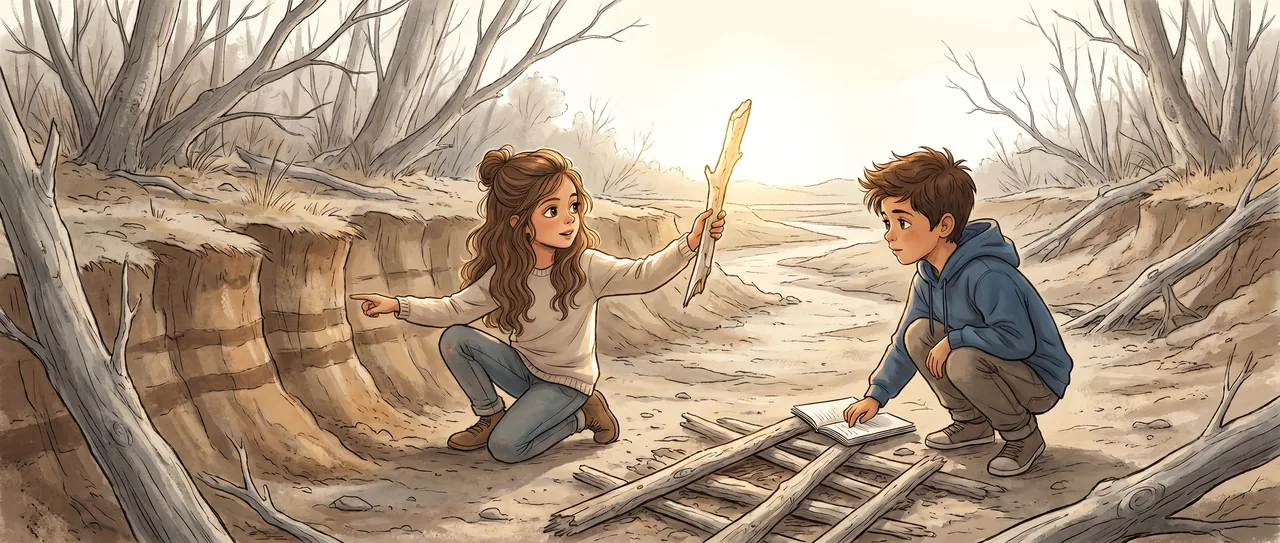
Maya walked to the nearest wide spot, the place the map insisted was a wetland. She kicked at the ground and her foot hit something hard under the dust. She scraped with her heel until she uncovered a pale, gnawed stick, flat on one end, pointed on the other. Then another. A whole lattice of them, buried under dried silt.
"Here," she called. "The dam was here."
Soren came over and they cleared more of it together, pulling sticks and packed mud out of the dust. It was like finding a skeleton. The structure was there, but everything it had held was gone. No water pooled behind it. No pond. The creek had cut straight through the middle and kept going.
"So the beavers left," Soren said. "Or were removed. And then the dams broke down. And then the ponds drained. And then the wetlands dried. And then the willows died. And then the soil dried out." He was counting on his fingers. "All of that in four years?"
"Less," Maya said. She was thinking about something else now. She was thinking about Dr. Tavares saying the survey was to check if the map needed updating. But this was not a map that needed updating. This was a different place.
She walked downstream to where the channel cut through what used to be the lowest pond. The banks here were the tallest, over her head. She could see layers in the exposed dirt, like a slice of cake. Dark bands and light bands, roots and no roots.
"Soren. Bring the notebook."
He was already beside her. They looked at the layers together.
"The dark parts are when the wetland was alive," Maya said. "Organic material. Things growing and decaying."
"And the light bands are just sediment. Mineral. Nothing living in it." Soren touched one of the dark bands. It crumbled, rich and black. "There are at least four dark layers. So beavers built here, and left, and built here again, and left again."
"Over and over," Maya said.
She felt the valley tilt around her. Not this valley, this ditch, this cracked mud. The real valley. The one that existed in time. Beavers had been building here for maybe hundreds of years, and every time they built, the whole landscape changed. Ponds formed. Water slowed and spread and sank into the ground. Willows grew. Birds came. Frogs came. Insects she could not name arrived because the water was there, and the water was there because a beaver had dragged sticks across a creek. And every time they left, all of it reversed. The ponds drained. The creek cut deep. The valley dried to powder.
One animal. Building a home. And the whole world rearranging itself around that work.
Soren was writing furiously. Then he stopped. "Maya. If this happened over and over, then everything that lives in this valley. Every fish, frog, bird, plant. They all depend on whether or not a beaver decides to live here."
"Not just decides," Maya said. "Whether we let them."
She picked up one of the old dam sticks. It was light as paper, all the life weathered out of it. She thought about the hundreds of species Dr. Tavares had listed on the survey sheet. The ones they were supposed to be checking for. The ones that were not here.
They were not here because the water was not here. The water was not here because the ponds were not here. The ponds were not here because the dams were not here. The dams were not here because the beavers were not here.
The whole list, the whole survey, the whole green valley on the old satellite photo, hung from one thread. And the thread had teeth and a flat tail and could be driven away by a single annoyed rancher.
"Dr. Tavares," Soren called up the bank. "The map doesn't need updating."
She looked over, distracted, a stake in each hand. "What do you mean?"
"It needs rebuilding," Maya said. "From scratch. The creek isn't a creek anymore. It's a drain."
Dr. Tavares opened her mouth, closed it, and came walking toward them. She did not look like someone about to give a lecture. She looked like someone about to see something she had missed.
Maya held out the gnawed stick, pale and light in the afternoon sun, and pointed to the layers in the bank where the whole history of the valley was written in dark and light, over and over, waiting for someone to read it.
Read the interactive version, listen to the narration, and earn a gold star →
A science-verified short story for curious kids · Curiosity Land