The Loudest Thing That Ever Happened
The alert came at eleven fourteen p.m., and Dr. Vasquez almost missed it because she was arguing with the coffee machine.
Maya heard the chime first. Three ascending tones from the terminal in the corner of the control room, the one nobody had touched all week because it was, quote, not relevant to the junior program. She was supposed to be finishing her observation log at the long table by the window. She was not finishing her observation log.
"Something just went off," she said.
Soren looked up from his notebook, where he had been sketching the layout of the antenna array from memory because looking at it once had not been enough. "The GCN terminal?"
"The what?"
"Gamma-ray Coordinates Network. It gets alerts from satellites when they detect a burst." He said this the way he said most things, like he was reading from the inside of his own skull and checking each fact before releasing it. "I read about it on the website before we came. I didn't think it was live."
Maya was already at the terminal.
The screen showed a sparse block of text. Coordinates, a timestamp, a satellite designation. And one line that stopped her: BURST DURATION 0.3 SECONDS. PRELIMINARY CLASSIFICATION: SHORT GRB.
Dr. Vasquez came back with her coffee, saw Maya at the terminal, and did a strange thing. She set the coffee down very carefully and walked over without saying anything for about five seconds.
"Huh," she said. "That's real."
"What does it mean that it's short?" Soren asked, joining them.
"Means it lasted less than two seconds. Probably two neutron stars merging. Somewhere very far away." Dr. Vasquez was already pulling up another screen, her fingers moving fast. "I need to call the duty scientist. You two should go back to your logs."
She picked up a phone and turned her back to them. Maya did not go back to her log.
"Point three seconds," Maya said quietly.
"Yeah."
"How much energy are we talking about?"
Soren was already flipping back through his notebook. He had written it down three days ago during the lecture on transient events, the one most of the other juniors had found boring. "More than the Sun will produce in its entire lifetime. Like, its whole ten billion years. In a fraction of a second."
Maya stared at the coordinates on the screen. She did the thing she always did when something enormous landed in front of her. She got very quiet and very still, and her eyes moved like she was watching something nobody else could see.
"That doesn't make sense," she said.
"It's real though. The energy output is something like ten to the forty-seven joules."
"No, I know it's real. I mean it doesn't make sense that we can detect it at all. If it's that far away. If it's that fast."
Soren sat down next to the terminal. This was what he liked about Maya. She never skipped the parts that were strange. "The alerts come from satellites in orbit. Swift, Fermi. They have detectors that catch gamma rays. Then they broadcast the coordinates so telescopes on the ground can swing around and look for the afterglow."
"The afterglow."
"It fades. It's already fading right now. If we could point a telescope at those coordinates in the next few minutes, we might catch what's left of it."
They both looked at each other. Then they both looked at the antenna array through the window, twelve dishes gleaming white under the desert stars.
Dr. Vasquez was still on the phone, speaking rapidly in half sentences. The duty scientist was apparently not answering.
"We can't move the dishes," Soren said.
"I know."
"We don't have authorization."
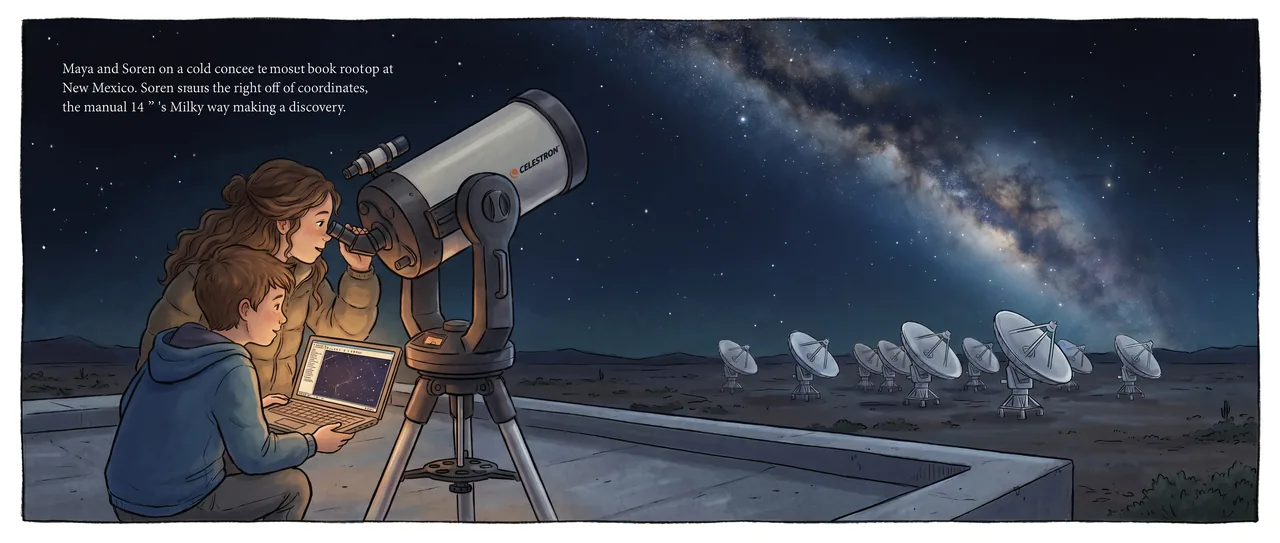
"I know. But the optical telescope on the roof. The fourteen-inch. That's manual."
Soren opened his mouth, closed it, and then said, "We'd need to convert the coordinates to something we can point with."
Maya was already writing the right ascension and declination on the back of her observation log. "You have the star chart software on your laptop."
"I have the star chart software on my laptop."
They moved. Not running, because running would have attracted attention from Dr. Vasquez and the conversation she was having. Walking with great purpose. Up the metal stairs, through the fire door, onto the flat roof where the fourteen-inch Celestron sat under its housing.
The desert air hit them. Cold, thin, enormous. The Milky Way arched overhead like a bridge made of light. For one second they both stopped, because you had to stop for that. Then they kept moving.
Soren entered the coordinates. Maya uncapped the telescope and swung it roughly toward the right patch of sky, southeast, about thirty degrees above the horizon. Soren read her fine adjustments while she turned the slow-motion knobs.
"Up one degree. Left. Little more. There."
Maya pressed her eye to the eyepiece.
She saw stars. Hundreds of them, steady and cold. And among them, one tiny smudge of light that was not a star. Not quite a point. Not quite nothing.
"I see something," she whispered.
"Let me look."
She stepped back. Soren looked. He looked for a long time. Then he pulled away and looked at her, and his face was doing something she had not seen before.
"That light," he said. "How far did the alert say?"
"It didn't give a distance yet."
"Gamma ray bursts are visible across billions of light years. If this one is even a billion years old, then what we're seeing happened before complex life existed on Earth."
Maya sat down on the roof. Not because she was tired. Because the scale of what he had just said needed a different posture.
"Point three seconds," she said again. "Something that lasted point three seconds is visible across a billion light years."
"More energy than our Sun will ever make. In the time it takes to blink."
They sat together on the cold concrete roof of a building in New Mexico and looked at the patch of sky where something had once screamed louder than almost anything since the beginning of the universe. The afterglow was fading. It was fading right now, right while they watched, the last light of a collision so powerful that it had crossed a significant fraction of the observable universe and still had enough energy left to land on a satellite, trigger three ascending tones, and pull two eleven-year-olds onto a roof.
The fire door banged open. Dr. Vasquez stood there, phone in hand, slightly out of breath.
"Are you two on the Celestron? Did you actually find it?"
Maya looked at Soren. Soren looked at Maya.
"It's fading," Maya said. "You should look before it's gone."
Dr. Vasquez crossed the roof in four steps, leaned down to the eyepiece, and went completely silent.
Above them, the Milky Way continued its slow rotation, two hundred billion stars turning like they had somewhere to be, while below the eyepiece, one woman held her breath at the last light of something so brief and so vast that the universe was still delivering the news.
Read the interactive version, listen to the narration, and earn a gold star →
A science-verified short story for curious kids · Curiosity Land